43 Recommendations for Kids Space Books

The Mars Generation_43 Book Recommendations from Our Space Community_2021

Looking for a good book to read? Well, in a recent tweet, a father asked for book recommendations for his fifth-grade stepdaughter, who is starting a Space Club at her school.

The Twitter community came together and delivered! So we’ve compiled a list of everyone’s favorite space books so that you can find your next great read. Here are the best book recommendations from our space community!


The Mars Generation_43 Book Recommendations from Our Space Community_20211. Interstellar Cinderella by Deborah Underwood

Recommended Age: 3-5 years

In this book, the author swaps Cinderella’s glass slippers for space boots! Cinderella’s got a knack for building spaceships and uses it to help others. When the prince’s rocket breaks down, she’s there to help him get to the Royal Ball. Soon after, though, she runs off, and the prince is left to search the cosmos for the girl that saved him. With colorful illustrations, this is the classic story of Cinderella with an interstellar twist.

The Mars Generation_43 Book Recommendations from Our Space Community_20212. Red Rover by Richard Ho

Recommended Age: 3-6 years

Join the mission of NASA’s Curiosity rover and see what it does on Mars day to day. Told from the perspective of the Red Planet, readers will learn about Mars’ significance and why scientists send rovers and other spacecraft there. Coupled with stunning illustrations, this book brings young readers on a ground-breaking mission while also teaching them about the science and history of space exploration.


3. Moonshot by Brian Floca

Recommended Age: 4 years and up

Learn about NASA’s Apollo 11 mission in a new light and what it was like to travel somewhere no human had gone before. Hear the stories of the scientists behind the Moon landing’s success, and follow along with astronauts right from their spacecraft. Moonshot brings readers on a roller coaster of emotions and inspires them to reach new heights.


The Mars Generation_43 Book Recommendations from Our Space Community_20214. A Computer Called Katherine by Suzanne Slade

Recommended Age: 4-8

This illustrated biography tells the story of NASA mathematician, Katherine Johnson, who was a leader in sending the first crewed missions to space. However, her journey wasn’t an easy one. She needed to prove that her race and gender didn’t define her intellect, and she could do anything her male counterparts could. Learn how Johnson broke stereotypes in the space industry and paved the way for new generations to find their place in the world of STEM.

The Mars Generation_43 Book Recommendations from Our Space Community_20215. Margaret and the Moon by Dean Robbins and Lucy Knisley

Recommended Age: 4-8 years

Margaret Hamilton was a pioneer in her field. Without her, many of NASA’s Apollo missions may have had a different outcome. She even hand wrote the code that helped spacecraft solve issues right from orbit. In Margaret and the Moon, readers will follow along on her journey and learn how essential this code was during history-making missions.


The Mars Generation_43 Book Recommendations from Our Space Community_20216. What Miss Mitchell Saw by Hayley Barrett and Diana Sudyka

Recommended Age: 4-8 years

Learn about the incredible true story of Maria Mitchell, the first professional female astronomer in the United States, and how her late-night discovery earned her worldwide recognition. Discover how Mitchell went from humble beginnings to making incredible scientific achievements, and how her legacy continues to inspire generations of young female scientists.


The Mars Generation_43 Book Recommendations from Our Space Community_20217. Your Place in the Universe by Jason Chin

Recommended Age: 4-8 years

How small are we…really? Your Place in the Universe helps readers understand the extraordinary size and composition of our universe. The sizes and scales of objects in outer space can seem unimaginable, but with detailed illustrations, audiences can better picture the world beyond our planet and what is out there to explore.


The Mars Generation_43 Book Recommendations from Our Space Community_20218. A is for Astronaut by Clayton Anderson and Scott Brundage

Recommended Age: 6-9 years

Learn about the mission of an astronaut from A-Z, told by retired NASA astronaut Clayton Anderson. Discover how astronauts prepare, what they go through during the flight, and the history of NASA over the years. With fun poems and illustrations, budding astronauts will learn about spaceflight right from someone who has experienced it.


The Mars Generation_43 Book Recommendations from Our Space Community_20219. Ambassador by William Alexander

Recommended Age: 8-12 years

When Gabe Fuentes is selected to be Earth’s ambassador to the galaxy, he quickly runs into trouble. A dangerous alien force is on its way towards Earth, and they’re targeting Gabe. As Gabe struggles to figure out what to do, he learns that his undocumented immigrant parents are at risk of being deported. Can Gabe solve both his problems at home and problems in the Galaxy?


The Mars Generation_43 Book Recommendations from Our Space Community_202110. Chasing Space by Leland Melvin

Recommended Age: 8-12 years

Leland Melvin has had a remarkable career. He’s played football with the Detroit Lions, made music with will.i.am, completed missions to the International Space Station, and served as the NASA Associate Administrator for Education. It’s no surprise that Melvin has been regarded as one of the most inspirational astronauts! Now, he’s sharing his story to show anything is possible and motivate young people to chase their dreams.


The Mars Generation_43 Book Recommendations from Our Space Community_202111. Clues to the Universe by Christina Li

Recommended Age: 8-12 years

Rosalind Ling Geraghty has always loved building rockets with her father, but when he passes away suddenly, Ro has no one to finish the project with. Meanwhile, her friend Benjamin Burns doesn’t like rockets all that much –  he’s a comic book fan! When Benji finds out his favorite comic was written by his father, who walked out years ago, he decides he wants to meet him. Ro helps the two reunite, knowing just how powerful a child’s relationship with their father is, and in return, Benji helps Ro finish her rocket. Together, the two take on an adventure of self-discovery and explore just how the universe works.


The Mars Generation_43 Book Recommendations from Our Space Community_202112. Countdown Conspiracy by Katie Slivensky

Recommended Age: 8-12 years

When Miranda Regent is chosen to be one of six kids on the first mission to Mars, she couldn’t be more excited. But just as the news was announced, Miranda starts receiving threatening messages, all while  attacks are made on the astronauts’ training base. She’s going to need the help of her friends around the world to save the mission and show that science is more important than personal greed.


The Mars Generation_43 Book Recommendations from Our Space Community_202113. Curiosity: The Story of a Mars Robot by Markus Motum

Recommended Age: 8-12 years

Read about the mission of the Curiosity rover, right from the rover herself. Curiosity traveled somewhere no human has gone before and has spent years collecting data for scientists back on Earth. Learn how she got her name, how she completes her tasks, and how exactly she spends her time on Mars.


The Mars Generation_43 Book Recommendations from Our Space Community_202114. I Love You, Michael Collins by Lauren Baratz-Logsted

Recommended Age: 8-12 years

It’s 1969 and Mamie’s class is preparing for the launch of Apollo 11. The boys are writing letters to Buzz Aldrin and the girls are writing to Neil Armstrong. No one is writing to Michael Collins…well, except for Mamie. Michael Collins’ job is important: taking care of the ship the others can return home safely. This resonates with Mamie, who in her letters, tells him about her family struggles and how no one is ever home to take care of her. The Apollo 11 mission brought the world together, but can it bring Mamie’s family back home?


The Mars Generation_43 Book Recommendations from Our Space Community_202115. In the Red by Christopher Swiedler

Recommended Age: 8-12 years

Michael and Lilith know they shouldn’t venture out on the Mars surface alone, but when adventure awaits, how can they refuse? They leave the safety of the colony and ride miles away when suddenly, a solar flare strikes and knocks out power, communication, and even Mars’ magnetic field! Will Michael and Lilith be able to make it back to the colony alive?


The Mars Generation_43 Book Recommendations from Our Space Community_202116. Lost In Outer Space: Incredible Journey of Apollo 13 by Tod Olson

Recommended Age: 8-12 years

The astronauts on NASA’s Apollo 13 mission were aiming for the Moon, but after a damaging explosion, they’re just lucky to make it back to Earth alive. Step inside the Apollo 13 spacecraft and experience firsthand this exhilarating mission for survival. Learn how astronauts overcame obstacles and how scientists back on Earth dealt with problems as they rose thousands of miles away.


The Mars Generation_43 Book Recommendations from Our Space Community_202117. Planet Earth is Blue by Nicole Panteleakos

Recommended Age: 8-12 years

Nova can’t wait for the upcoming space launch. She has big dreams, but because she has severe autism, her teacher and foster parents don’t take her seriously. The only person that does is her sister, Bridget. But when Bridget mysteriously disappears one day, Nova is left to find her place in her community – and celebrate the launch – alone.


The Mars Generation_43 Book Recommendations from Our Space Community_202118. Quintessence by Jess Redman

Recommended Age: 8-12 years

When Alma spies a falling star in her telescope, she’s excited to see it land in her backyard. However, upon closer inspection, she notices it looks like a child. The star is lost, far from home, and lonely – Alma knows how it feels. She embarks on a mission to return the star back to its place in the sky, but can’t do it alone. She needs some magical help, and the assistance of her school’s Astronomy Club.


The Mars Generation_43 Book Recommendations from Our Space Community_202119. Space Case by Stuart Gibbs

Recommended Age: 8-12 years

Space Case is a whodunit mystery with an astronomical twist. Twelve-year-old Dashiell Gibson is one of the first humans to live on the Moon. But when the base’s top scientist, Dr. Holtz, is found dead, Dash suspects foul play. Only, no one believes him. Dr. Holtz was on the verge of an important discovery that would change everything for the families living on the base. Is that discovery worth killing someone to keep it a secret?


The Mars Generation_43 Book Recommendations from Our Space Community_202120. The Lion of Mars by Jennifer Holm

Recommended Age: 8-12 years

Bell grew up on Mars, only ever hearing stories about the US colonies. He knows that they keep secrets and remain largely isolated from the colonies on Mars. But when all the adults fall ill with a mysterious illness, Bell needs to figure out why. In order to unite the planet, he and the other kids need to uncover the truth, because in order to survive, everyone needs to work together.


The Mars Generation_43 Book Recommendations from Our Space Community_202121. To Fly Among the Stars by Rebecca Siegel

Recommended Age: 8-12 years

For years, NASA’s astronaut groups have been dominated by men. But during their training, women have always worked alongside them. Women went through the same astronaut tests and worked hard to prove themselves worthy of being a part of the astronaut crews. Learn about their inspirational stories and how they broke down barriers so that young women, too, can now fly among the stars.


The Mars Generation_43 Book Recommendations from Our Space Community_202122. Voyage of the Dogs by Greg van Eekhout

Recommended Age: 8-12 years

Lopside is a specially trained dog who journeys to space alongside human astronauts. Their mission is to set up a base on another far-off planet, but along the way, they run into some trouble. The human crew disappears, leaving Lopside and the other Barkonauts alone. Will they be able to complete their mission safely? Lopside is going to show that he’s not only man’s, but Earth’s, best friend.


The Mars Generation_43 Book Recommendations from Our Space Community_202123. We Dream of Space by Erin Entrada Kelly

Recommended Age: 8-12 years

Middle school is a difficult time for everyone, and that includes Cash, Fitch, and Bird Nelson Thomas. These three seventh-grade siblings each have their own struggles, from poor grades to low self-esteem. They don’t connect with each other much, except when dealing with their tense home environment. What ultimately brings them together is a school project and the 1986 space shuttle Challenger launch. Follow along the resilient story of the Nelson Thomas kids as they navigate middle school and learn just how powerful family can be.


The Mars Generation_43 Book Recommendations from Our Space Community_202124. Above and Beyond: NASA’s Journey To Tomorrow by Olugbemisola Rhuday-Perkovich

Recommended Age: 9-11 years

NASA’s has been pushing the limits of science and technology since it was established in 1958. Learn about the organization’s history and how feats like landing on the Moon and Mars were made possible. Hear the stories of lesser-known scientists and discover their important contributions to these missions. Also, discover what the driving force behind space exploration is and how it will propel us toward exciting future discoveries!


The Mars Generation_43 Book Recommendations from Our Space Community_202125. Spaceman by Mike Massimino

Recommended Age: 9-12 years

Discover the true story of Mike Massimino and how he went from a boy with a dream to one of NASA’s most well-known astronauts. While his story begins as a young boy growing up in Long Island, where people rarely moved far from home, he eventually ends up flying thousands of miles above the Earth. Along his journey, Massimino faced challenges and setbacks, but they never stopped him from pursuing his dream, and now he’s sharing his story to inspire others to do the same.


The Mars Generation_43 Book Recommendations from Our Space Community_202126. Seventh Grade vs. the Galaxy by Joshua S. Levy

Recommended Age: 9-13 years

Can you imagine going to school on a spaceship orbiting Jupiter? For thirteen-year-old Jack, that’s his reality. But when that school is mysteriously attacked, Jack’s father leaves it up to him to save the ship. He gives Jack an important invention, allowing them to be catapulted away from danger… only its  into a group of aliens no one has seen before (uh-oh). Now, it’s up to Jack to get his school back to safety and get his friends home.


The Mars Generation_43 Book Recommendations from Our Space Community_202127. The Martian by Andy Weir

Recommended Age: 10 years and up

Astronaut Mark Watney was one of the first humans to have stepped foot on Mars. But when a dust storm forces the crew to evacuate, Watney finds himself as the only human on the Martian surface; the rest of the crew left him behind. When the dust clears, he’s left with limited resources, food, and damaged technology. When the odds are all stacked against him, can he survive long enough for a rescue mission to bring him home?


The Mars Generation_43 Book Recommendations from Our Space Community_202128. Fighting For Space by Teitel Amy Shira

Recommended Age: 10 to 12 years

This dual biography tells the stories of female pilots Jackie Cochran and Jerrie Cobb and the dream of being the first American woman in space. From breaking the sound barrier to taking the same tests as the Mercury astronauts, readers will follow the adventures of Cochran and Cobb as they fight to turn their dreams into reality. Their journey takes on both social and political issues as they strive to defy odds and create a “women astronaut” program.


The Mars Generation_43 Book Recommendations from Our Space Community_202129. My Life as an Ice Cream Sandwich by Ibi Zoboi

Recommended Age: 10-12 years

Ebony-Grace Norfleet grew up nurtured by her grandfather, one of the first black engineers at NASA. She loves Star Wars and Star Trek, and all things science fiction. But when family trouble arises and she has to move to the other side of the country, Ebony-Grace has to find new ways to share her passion. She doesn’t let herself be limited by other people’s imaginations and instead journeys to find her own place in her new home.


The Mars Generation_43 Book Recommendations from Our Space Community_202130. Path to the Stars by Sylvia Acevedo

Recommended Age: 10-12 years

Discover the inspiring true story of Sylvia Acevedo, one of the first Latinx to earn a master’s in engineering from Stanford University. Throughout her childhood, she struggled with loss following the meningitis outbreak. How did she cope? She joined Girl Scouts! Girl Scouts taught her to take control of her life and helped her reach her dream of becoming a rocket scientist at NASA’s Jet Propulsion Laboratory. Today, Acevedo serves as CEO of the Girl Scouts of the USA and continues to help girls reach their full potential.


The Mars Generation_43 Book Recommendations from Our Space Community_202131. See You in the Cosmos by Jack Cheng

Recommended Age: 10-13 years

In 1977, astronomer Carl Sagan helped send the Golden Record into space on board the Voyager spacecraft. Now, 11-year-old Alex Petroski wants to do the same….t only with his golden iPod instead. Before he can send it, he needs to record what life is like on Earth and document his journey in case any aliens ever happen to stumble upon it.


The Mars Generation_43 Book Recommendations from Our Space Community_202132. Rocket Science by Andrew Radar

Recommended Age: 10-14 years

In Rocket Science, Andrew Radar makes rocket science accessible to anyone. Learn how rockets work – down to the different stages and power generation – and how scientists use them to travel far beyond our planet. This guide opens up discussions about the future of exploration too, and the possibility of discovering extraterrestrial life. Hard? Pssh…it’s only rocket science!


The Mars Generation_43 Book Recommendations from Our Space Community_202133. The Wondrous Workings of Planet Earth by Rachel Ignotofsky

Recommended Age: 10-14 years

Earth works in fascinating ways. The Wondrous Workings of Planet Earth breaks down biodiversity, ecosystems and their inhabitants, the cycles of nature, and a whole lot more. Readers will learn what we need to do to protect our planet and how we can better contribute to nature’s wellbeing.


The Mars Generation_43 Book Recommendations from Our Space Community_202134. What We See in the Stars by Kelsey Oseid

Recommended Age: 10-14 years

Take a tour of the night sky guided by beautiful artwork combining mythology and science. Learn about everything from constellations to  bright stars to nebulae to deep space, and fall in love with the magic and history of outer space. This book takes young stargazers deeper into the night sky and helps them find their place among the stars.


The Mars Generation_43 Book Recommendations from Our Space Community_202135. Hidden Figures by Margot Lee Shetterly

Recommended Age: 11 years and up

Behind the historic missions of Alan Shepard and Neil Armstrong were a group of “human computers.” These female mathematicians made complex calculations by hand that were essential to  sending the first humans to space and bring them home safely. Among these women were Dorothy Vaughan, Mary Jackson, Katherine Johnson, and Christine Darden who worked specifically in the all-Black “West Computing” unit. Learn about their stories and how they overcame barriers and stereotypes to ultimately change the space industry forever.


The Mars Generation_43 Book Recommendations from Our Space Community_202136. The Hitchhiker’s Guide to the Galaxy by Douglas Adams

Recommended Age: 11 years and up

Earth is about to be demolished, and Arthur Dent needs a way out. Luckily, his friend Ford Prefect is there to pick him up and together they fly off on a journey into the galaxy. Along the way, they meet other travelers looking for the answers to the universe. Join their hilarious adventure as they frolic through the galaxy and figure out outer space’s inner workings.


The Mars Generation_43 Book Recommendations from Our Space Community_202137. Endurance: My Year in Space, A Lifetime of Discovery by Scott Kelly

Recommended Age: 12 years and up

Scott Kelly holds the record for most consecutive days spent in space by an American and has flown on four spaceflights. However, his time in space has not been without challenges. He’s dealt with isolation from his loved ones, unique struggles with his physical health, and the fear of colliding with space junk – challenges far from the mundane. Discover his incredible journey as he recalls his career and the obstacles he’s had to surmount in the pursuit of science.


The Mars Generation_43 Book Recommendations from Our Space Community_202138. Nightwatch by Terence Dickinson

Recommended Age: 12 years and up

For decades, Nightwatch has been one of the top stargazing guides around the world. It includes charts and tables, stunning photography, how-to instructions, and planet locations perfect for any backyard astronomer. With only your naked eye, you’ll learn how to see some of the most incredible stellar spectacles, and if you have a telescope, you can discover how to peer even farther into space.


The Mars Generation_43 Book Recommendations from Our Space Community_202139. Sally Ride: America’s First Woman in Space by Lynn Sherr

Recommended Age: 12 years and up

Sally Ride was the first American woman and known LGBTQ+ person to travel to space. In this biography, discover her story and learn how she broke down barriers to allow young women to chase after their dreams and become astronauts. She’s dedicated her entire life to promoting science education, co-founding a company and writing several books on the matter. Her determination and achievements have inspired millions around the world, and now, readers can take a glimpse into how Ride balanced her public image as a scientist with her heavily guarded personal life.


The Mars Generation_43 Book Recommendations from Our Space Community_202140. The Space Race by Deborah Cadbury

Recommended Age: 12 years and up

Travel back in time to the space race and experience the remarkable triumphs, political fears, and ground-breaking technological feats between the United States and the Soviet Union. Hear the stories of the people at the center of the race that were unrelenting in their mission to make history and send humans to the Moon. Learn what life was like during this era and how two countries’ competition for dominance led to revolutionary innovations.


The Mars Generation_43 Book Recommendations from Our Space Community_202141. Packing for Mars by Mary Roach

Recommended Age: 13 years and up

Ever wonder what it’s like to travel to space and live on the International Space Station? Mary Roach has the answers. In Packing for Mars, she takes on the particularly gross challenges astronauts face on their journey – vomit, feces, body odor, and more – in a humorous way. These are topics not often discussed in the media, but for young aspiring astronauts, they paint a more realistic picture of space travel to consider.


The Mars Generation_43 Book Recommendations from Our Space Community_202142. Martian Chronicles by Ray Bradbury

Recommended Age: 14-16 years

In this science fiction, dystopian tale, Ray Bradbury explores what life looks like on Mars and what happens when humans try to interfere with it. Set immediately after World War II, Bradbury brings to life an alien species and describes their conflicts with the people from Earth. The post-apocalyptic technologies will bring readers to the Red Planet and leave them wondering what’s really there.


The Mars Generation_43 Book Recommendations from Our Space Community_202143. Rocket Boys by Homer Hickam

Recommended Age: 14-16 years

This memoir by Homer Hickam shares the story of how he chased after his dreams to become a NASA engineer. It’s a coming-of-age story set in the 1950s, where Hickam’s biggest fear was never growing up and getting out of his dying town. Against all odds, he made his dream of launching rockets into space come true during an important time in the space industry. Hickam recalls the obstacles he faced and how he found the hope and determination to overcome them.


What Will Your Next Space Read Be?

A huge thanks to our space community for these fantastic recommendations! We have one more to add: our very own Abigail Harrison’s new book, Dream Big!: How to Reach for Your Stars, for anyone looking to chase after their dreams. However, each and every one of these books is perfect for both school clubs and to pass the time in quarantine!

If you are looking for more space content to share with the astronomy-lover in your life, be sure to follow The Mars Generation on Facebook, Twitter, Instagram, and LinkedIn, and sign up for our email list.

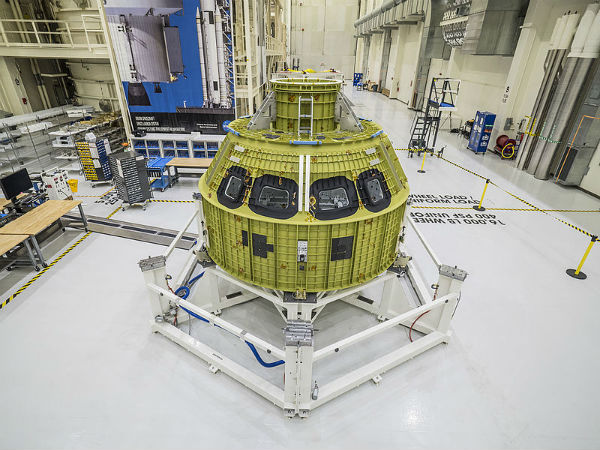
Going to Mars, Part 3B: More Orion Essentials

We are so lucky to have Ross Wakefield join us as a guest writer.

Please visit our “Get Involved” page to learn more about how you can volunteer and/or join The Mars Generation. Let’s go to Mars!

*** Please note guest submissions are opinions of the author and do not necessarily reflect the mission or beliefs or The Mars Generation.

Orion Spacecraft in Orbit

Photo: NASA

Introduction

As 2018 begins, development is approaching completion of what is fated to be the next generation of human-operated space modules – the NASA Orion capsule. Packed with a combination of old but reliable and cutting-edge technology, the project to bring it to fruition has passed through many years of research, development and policy changes.

And, finally, after over a decade, the day is finally approaching when a craft capable of carrying humans beyond Earth’s orbit is available to use once again.

In the previous article, some of the various aspects that make the Orion ready for a trip to the Moon – or even to Mars – such as the life support and structural systems, amongst others, were covered. In this article, the last few of the essential systems of the Orion will be discussed, along with another part of the program that would be essential to the success of a Mars mission run by NASA – the Deep Space Habitat.

Orion to Mars – Part 2

At the Cutting Edge – Computers and Docking

Some of the key structural elements of the Orion crew module may be pretty similar in type to the Apollo-era modules of old, but in the fifty years hence technology has made a great many jumps. NASA, of course, has often been at the forefront of this new wave of development, and the Orion crew module looks to be no exception.

Back in the heady days of the old Space Race, computers used to take up entire rooms – indeed, one of the big features of the Apollo program was developing a computer capable of fitting inside the craft itself; in the end, the one-of-a-kind computer design that controlled the majority of the essential systems sending the Apollo astronauts to the Moon weighed seventy pounds and was around the size of a medium-sized suitcase, a big jump forward in miniaturization at the time. Now, far more computing power can be held and applied in a device the size of a wristwatch, supplying vastly more ease of use and maintenance for almost every area of management of the module.

Orion Image 5

Photo: Mark Garcia

A corollary of this advancement in computer technology is vastly increased automation – after all, the stresses of spaceflight are manifold, so being able to have at least some of the routine tasks capable of being accomplished by a computer allows more time for the crew to engage in less monotonous and more worthwhile tasks while on mission. Of course, any crew would still be trained to carry out any task manually if needed, but the additional legwork being accomplished by automated systems would be a great help, especially under the long and likely often stressful scenario of a Mars mission.

One of those key tasks is that of docking; until the development caught up with it, it was a task that had to be accomplished manually, requiring a massive amount of training of manual dexterity and spatial awareness coupled with the stress of there being very little room for error and most of the time, having to get the maneuver correct the first time, every time – having two spacecraft moving at high speed close to each other can result in problems when not handled correctly, after all. Automated systems simply could not maneuver the craft with the same accuracy that a human could. Up to and including the Space Shuttle, all NASA vehicles have involved purely manual docking procedures as their only option.

However, in recent times, with the continued development of both real-time monitoring, communication and navigation systems that enable location and control of a spacecraft in real-time at the touch of a button with no delay, the success of the auto-docking systems on the Russian Progress spacecraft and the ESA Automated Transfer Vehicle (both of which have an outstanding track record ferrying supplies to the International Space Station fully automated) has given confidence that the Orion module can enjoy similar automated docking success. While, again, in the case of an emergency the crew would be able to assume manual control and dock the craft themselves, having the mentally arduous and often lengthy yet essential task of docking in orbit at least partly taken care of by a computer would be a great help.

The advancement of computing technology is the last half-century won’t do the full work of taking a human crew to Mars…but it will certainly make it a lot easier.

The Beating Heart – Orion Service Module

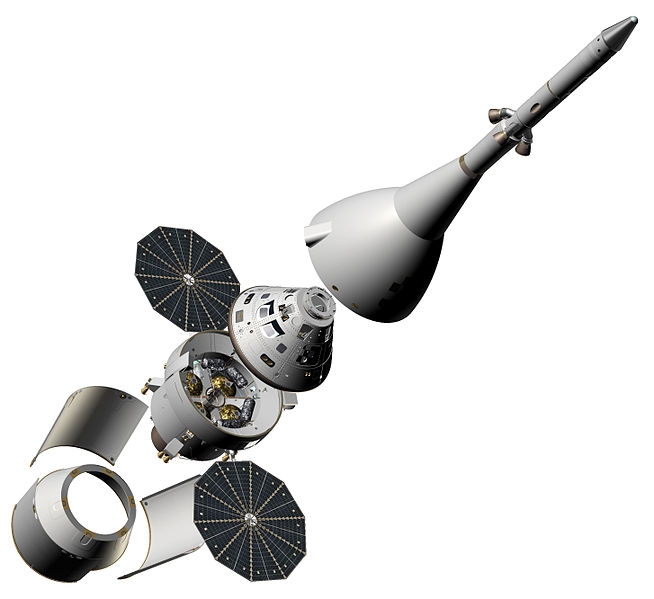
Having a command module – a place where the crew can direct, control and above all live safely during any space mission is merely one part of the Orion picture. More understated, but equally important, is the part of the spacecraft that contains no crew at all – but provides the warmth they need to stay functional, the propulsion that will get them to where they need to go, and the atmosphere they need to stay alive. All of that, and more is contained in a four meter length by four meter diameter chamber directly beneath the command module…the Orion Service Module.

The Orion Service Module differs from most of the other Orion modules in one rather important regard: its construction is not only of American origin but also of considerable European input as well. In 2010, when the Constellation Program was mothballed, rather than abandon the service module out of hand and leave only the command module under construction, NASA and the ESA (European Space Agency) agreed to collaborate on developing a service module based on the existing Automated Transfer Vehicle – the workhorse responsible for many ISS resupply missions mentioned above. This gave the developers a head-start in terms of knowledge and therefore reduced costs – with the existing knowledge given by the ATV, much less development would be needed in order to bring about a service module capable of servicing all the needs of the Orion command module for the duration of a mission. Agreements were quickly reached with a variety of European and American contractors to design and build all the various components that would be required, from the solar panels providing power to the adapters that would connect the service module to the command module above and the Space Launch System below.

As is the case with most of the Orion makeup, the latest design for the Orion Service Module combines well-tested venerable technology with the latest where it would work better. For instance, the main engine for the first OSM will be an engine previously used for the space shuttle, one that has performed 89 burns over 19 different missions…but one that is reliable, proven and guaranteed to give the required performance again and again. Contrast that with the improved power generation, cutting-edge solar panels providing almost twice as much electrical power as the Apollo service module, and aluminum-lithium alloy structure meaning that the module will deliver this extra punch despite being both smaller and lighter when fully fueled than its Apollo-era equivalent. It also contains more fuel for maneuvers overall than the Apollo, and can support a crew of four for three weeks.

Only one service module is being worked on as of 2018, however, in 2017 an agreement was made to procure a second, which will become the backbone of the crucial first human flight of the Orion and will hopefully also function as the nerve center for many future missions.

Though the development of the Orion service module has, like many other areas of the project, been rocky at times, has its fair share of cutbacks, setbacks and delays…it seems, as we approach the third decade of this century, that the beating heart so long designed, cultivated, and wished for, may finally soon be ready to support mankind in its next big venture into space.

Lasting the Distance – The Deep Space Habitat

However, as is noted above, the Orion command module, backed by careful management of life support resources given by the service module, can only support a crew of four for four weeks maximum. While this would be enough for a human Moon mission, a human mission to Mars could be reliably expected to last for at least two years, and likely much longer. This, rather obviously, represents something of a shortfall. Clearly, more than just the service module is required for the purposes of keeping a human mission alive for a trip to and from Mars.

Orion 8

Photo: NASA

To this end, since 2012 NASA has been hard at work designing and developing a system capable of supporting a crew of several astronauts for the length of time necessary. The current solution, as touched on in a previous entry, has been proposed as the Deep Space Habitat (DSH).

The DSH would be made up of three primary parts: the Multipurpose Logistics Module (MPLM), the lab module (very similar to the Destiny-style module currently used on the International Space Station) and a stand-alone propulsion stage…just to make sure the whole thing can actually get somewhere. The Orion command module would then attach to the MPLM to complete the entire design.

The whole design of the DSH is meant to be versatile, depending on the length of the mission involved and the destination. For instance, a reasonably simple 60-day mission (used, for example, to demonstrate the capability of the design in a first run) would be made up of just those four basic modules with the Orion command module supplying command and control, the lab providing scientific capability as well as crew quarters, the MPLM providing all the supplies needed for such a mission, and the cryogenic propulsion stage getting the whole craft from A to B. For a more complex 500-day mission, however, additional extras can be attached to the MPLM – such as a second MPLM for additional supply space and (perhaps even more importantly) a design of NASA’s latest Space Exploration Vehicle (SEV). These vehicles are designed to support two crew for two weeks with their own inbuilt propulsion and life support systems, be able to maneuver either through the vacuum of space or with wheels on the ground, and are specifically designed with one purpose in mind – to land a crew on another world, whether that be the Moon, an asteroid…or Mars itself.

Timeline

The scope of NASA’s ambition to use the Orion and the DSH to take humans back to the Moon and further onward is clearly not in question – the current designs, already being field-tested, are a testament to that. With that being said, however, the question then switches to when? When will NASA finally be able to send astronauts out beyond Earth orbit once again?

It has been roughly a year since this blog touched on the projected timeline for the Orion Program, and though in some regards that timeline remains as unpredictable as ever (continued funding governed by political will and inevitable schedule slips for such a big project being what they are), but some of the more immediate missions on the program have become a little clearer in the last twelve months.

The first service module will be used for the very next test of the Orion capability: the Exploration Mission 1; a full uncrewed test of the capability of the Orion craft scheduled for 2019, sending it into a four-to-six week jaunt in space, including six days orbiting the Moon – a mission very similar in design to the first Apollo mission to leave Earth orbit, Apollo 8. During this time, a wealth of information will be gathered from the multitude of instruments on the craft, verifying that it has the survivability to qualify it for the next step in the Orion program. This mission will also include a secondary payload; many different small satellites designed by a variety of different education centers and companies, with a variety of different purposes in mind once deployed – from looking for additional evidence for water ice on the Moon to demonstrating the communication ability of a satellite in an orbit around the Sun – a distance much further than all but the communication modules designed for use on the deep-space probes sent to the various Solar System.

Once that has been completed and provided it is successful to the degree demanded to progress onwards, the very next step will be to accomplish a similar mission in or around 2023…but with a full crew on board, sending humans beyond Earth orbit for the first time in what will be, at that point, over five decades. The mission will not have quite as much time in orbit the Moon as the previous mission did, but instead remain in space for anywhere between eight days and three weeks. A key part of this mission, quite apart from the achievement of venturing beyond Earth orbit again, will be the deployment of the first part of what is called the Lunar Orbital Platform-Gateway – designed to be a staging post for almost all future Orion missions. The following human missions, to take place yearly thereafter until 2027, would involve the completion and full testing of this station, culminating with two long-term stays on the newly constructed platform. Recent announcements from NASA even hint at an acceleration of this timetable, with the first human flight taking off earlier than 2023 – though that is very much open to question right now.

Orion 7

Photo: NASA

With all of that accounted for, the first mission to Mars orbit is currently planned tentatively for 2036 – a flight that would bring a crew into Mars orbit and back again. With that date rather far in the future, however, it is, of course, open to speculation.

So, to answer the question at the beginning of this passage…with any luck at all, we may well see humans under the remit of NASA head, at the very least, out beyond Earth orbit again within the next five years.

Conclusion

Since the great days of the Apollo program there have been a number of great projects for human spaceflight conceived by NASA, designed to carry on their legacy as the trailblazer, to go from the Moon to Mars and beyond – indeed, not long after Neil Armstrong first set foot upon the Moon, the belief was widespread that humanity would set foot upon Mars before the end of the 20th Century.

Unfortunately, for a variety of reasons, these projects have been matched by a fair number of false dawns that have kept humanity limited to our little corner of the Solar System, unable or unwilling to venture beyond for the time being. In the intervening time investigating near-Earth projects, humanity has learned much about the rigors of spaceflight, as well as developing more and more advanced technology in order to mitigate these effects on man and machine…but plans to utilize that improvement to go further have never made it beyond a purely conceptual stage.

Until now.

Orion is by far the most advanced beyond-Earth program that NASA has developed since the days of Apollo. The drive to succeed is there, matched by the technology to make it happen – and that technology is being crafted, even now approaching completion, into a vehicle capable of going to the Moon, to Mars…and perhaps even beyond.

More from Ross:

The Road To Mars: Our Past and Our Future

Going To Mars, Part 1: The Human Element

Going To Mars, Part 2: The Curiosity Rover, A Martian Marvel

Ross WakefieldRoss Wakefield is a freelance science writer, communicator and consultant, with specialized expertise in the field of current and historical space developments. Ross has a Bachelors degree in Physics with Astrophysics from the University of Leicester and a CMCU in Astronautics and Space Engineering from Cranfield University and is a member of the Institute of Physics and British Mensa. Ross is currently beginning a series of articles with The Mars Generation on various space-related topics. When he’s not glued to a computer screen, he enjoys playing and watching sport, reading various books and trying to find where the nearest good pool table is in the United States. Find Ross on his Twitter.


Join TMG At The Humans To Mars Summit May 8 – 10 2018| Discount Code

humans to mars summit 2018We are happy to announce we are continuing our partnership with Explore Mars for a third year in a row and will be participating in their Humans To Mars Summit in Washington, D.C. May 8-10th. We are excited to announce several TMG leaders are participating as part of the event:

  • May 8, 2018: Listening To The Mars Generation Panel with TMG Student Space Ambassador Board Members: Brittany Wedd, Morgan Irons and Aaron Shepard.
  • May 10, 2018: Viral Mars: Social Media and Space Exploration with TMG Vice President, Nicole Harrison serving as moderator.
  • May 10, 2018: Why Mars: A Boisterous Discussion With Space Luminaries panel with TMG founder and president, Astronaut Abby.
  • May 10, 2018: Capital Hill Briefing Panel moderated by TMG founder and president, Astronaut Abby.

We have a special 15% discount code for everyone in our community. Discount code: TMGmars

TMG members get 25% off the conference. Please email groudsupport@themarsgeneration.org to get your special discount code. If you would like to become a member to get this and other discount codes go to our membership page: http://themarsgeneration.org/membership/

Want to learn a little more? Watch the video of Astronaut Abby with Ellen Stefan (former NASA Chief Scientist) in a discussion about women paving the path to Mars at the Humans to Mars conference last year here:

This is an exciting event you do not want to miss! Visit http://h2m.exploremars.org/ and sign-up today.

The Martian Garden Project

Canadian-Martian-Garden-Project- The Mars Generation

We are excited to have Amanda Green and Julie Arsenault join us as guest writers. Please scroll to the bottom of this post to learn more about Amanda and Julie. 

I love science, and the only thing I love more than teaching science is teaching and learning about space.  My name is Amanda Green, and I am a middle school science teacher in Beaumont, Alberta, Canada.  I work alongside my colleague and friend, Julie Arsenault, from Edmonton.  We enthusiastically share our love of science and space and often collaborate and share ideas for lessons, activities, and just getting nerdy.  

Over the past few years we have both participated in the Canadian Space Agency/ Let’s Talk Science Tomatosphere project several times.  It is a fantastic experiment where kids from across Canada and the United States compare germination rates of two groups of tomato seeds: one control and one that has been either onboard the International Space Station or exposed to a simulated space environment.  We have used this project to kick off the school year with the scientific method and to have plants thriving in our classrooms all year long.  

THE PILOT

In 2016/2017 I  started with my class by using notable Twitter accounts – SpaceX, NASA, The Mars Generation, and Astronaut Abby, for example – these accounts helped us to keep up with all of the exciting innovations in science and technology.  Throughout this process, the name Wieger Wamelink kept coming up as someone who had been growing plants in impressive simulated Martian conditions in the Netherlands.  These experiments made me think about the connection between our Tomatosphere experiment, my favorite movie/book The Martian, and the educational value of doing a similar project with our students.  I was curious to figure out how we could marry science and science-fiction in an authentic and meaningful way.

The Martian Garden produces Mars simulant soil from ground up, sterilized lava rock that closely resembles Martian soil based on its texture and chemical composition.  One major problem is that the soil is quite expensive, especially to ship all the way up to Edmonton. However, I was able to convince my school administration to fund a small pilot project.  This sparked some discussion with my students and, after researching various possibilities, we planted some of our Tomatosphere space seedlings in Earth soil, Mars simulant soil, and Mars simulant soil with a variety of fertilizers. 

The Mars Generation Canadian Martian Garden By watching our plants grow throughout the school year, we were able to observe many changes that fueled many ‘teachable moments’ and discussions in our classroom.  As our hypothesis predicted, the plants grown in plain Martian soil control was not as visibly healthy as the plants grown in other soil variants. They were thin, pale, and less lush than the other plants, and they died before they could produce any flowers.  While this was a great initial experiment, we knew that what we needed to gather more significant data as replication for each variable tested.  In order to have more replicates, we needed more soil.  

COLLABORATION AND FUNDING

One of the fantastic things about this age of social media is that it makes reaching out and finding like-minded people much easier than in the past.  Julie and I met at a Science Teaching Conference and kept track of each other’s classes via Twitter.  We have forged a very productive working relationship, in addition to our friendship, and we often brainstorm and troubleshoot projects we are doing in our classes.  Julie was intrigued by our initial experiments and was eager to get on board with future work.  We researched possibilities and collaborated to find a solution to our financial concerns for expanding the initial project.  Together we applied for and received a Devon Science Giants Grant, allowing us to purchase more soil and any additional supplies needed to take our project to the next level and to ensure we could produce valid and reliable results.  

THE MARTIAN GARDEN PROJECT

As the 2017/2018 school year began, Julie and I prepared to make our Martian Garden the centerpiece for instruction throughout our year.  Although we teach different grade levels, we have both found ways to weave a Martian survival theme into most topics covered in our respective science curricula, valuing the real-world application it brings.  We have brought in experts, and have had students brainstorm questions and continue to research all that is required to prepare a human mission to Mars.  Our students have been excited to discover more about what it would take to survive this journey!  

The Martian Garden project Alberta Canada

Our classes have now completed the transplanting phase of our experiments.  Our Tomatosphere seedlings have been transplanted into either Earth or Mars simulant soil, and, in addition to control groups for each type, we’ve included some test groups with various fertilizers added to the soils.  Inspired by The Martian, one student brought in manure for us to mix in with our soil (I think our room smelled for a few days after that), and Julie’s class wanted to try mixing some Earth soil with Mars simulant soil to “infect” it with plant-friendly soil bacteria.  Our students feel like they’re a part of something bigger than just our classroom; they feel like they’re a junior high version of Mark Watney, trying to find ways to grow plants on a planet where nothing grows.

In addition to the variations in soil, we are testing another variable across our two classrooms – the source of light.  My classroom has only one window so we will be using shelving with grow lights as our primary source of light, whereas Julie’s classroom has a large bay window so her class’s plants will have natural light as their primary source.

The Mars Generation Martian Garden Project Canada

 At this point our observations are largely qualitative, but we have noticed that tomatoes grown in Mars simulant soil have a red/purple hue to their stems.  Julie’s class has also noticed that the plants in Earth soil are growing taller and are healthier overall (her class has not added fertilizers yet, as they are trying to see if there is a marked difference in plain soil first).  As we continue to gather quantitative data, we are looking forward to seeing what explanations our students come up with to explain their observations.

In addition to our Science curriculum, we will be using this project to fuel discussions and examples in other subject disciplines as well.  We will be graphing and analyzing results, designing 3-D models of Mars habitats, developing charters and laws needed for settling a new planet, and more.  We will be meeting with experts and innovators in various relevant fields throughout the school year so students can get feedback and input from those “in the know.”

THE MARS GENERATION

Julie and I have both been following Astronaut Abby and her work with The Mars Generation for some time now, and we are proud to support such a positive and important initiative.  Students learn better and work harder when they can see how their work can impact their world, and with all of the exciting research and technology pointing humanity towards space travel and colonizing Mars, we are hoping to inspire our own “Mars Generation.”  Whether it be as an astronaut, engineer, computer scientist, or botanist, the possibilities for our students to one day contribute to humankind’s journey further into space are endless and we are so excited to be a small part of this journey.

About #2MartianTeachers

2MartianTeachers

Amanda Green

Inspired by her nature-loving family and enthusiastic science teachers, Amanda graduated from the University of Alberta in 2001 with a BEd. in Biological Sciences and Social Studies.  She is a passionate educator who has been teaching middle school Science, Mathematics and Robotics/Technology in both English and French for the majority of her career.  She is currently the Science Department Head at Ecole Coloniale Estates School in

Beaumont, Alberta, Canada and is dedicated to bringing science to life with authentic lessons that weave STEM concepts and her interests in space and biology into almost everything.  https://sites.google.com/gshare.blackgold.ca/green/home

Julie Arsenault

After earning her BSc. and MSc. in Microbiology and Biotechnology from the University of Alberta, Julie developed a passion for teaching and entered the Secondary Education After Degree program. Julie has been teaching science with Edmonton Public Schools since 2002 and enjoys bringing vast and varied experiences into the classroom (and beyond) to help students make authentic connections to their world. Project Based Learning, STEM, and Place-Based Learning are large components of her junior high (grades 7-9) science classes.  A strong believer in the power of collaboration, Julie has presented her work at conferences for ATA Science Council, Edmonton Regional Learning Consortium and Greater Edmonton Teachers Convention, and has consulted with Nelson Publishing. https://sites.google.com/a/epsb.ca/mrs-arsenault-s-nerdy-world-of-science/


The Mars Generation’s Post-Mission Interview with HI-SEAS Crew Members 2017 [VIDEO]

HI-SEAS Mars Analogue Mission

The crew of the HI-SEAS Mars Analogue Mission

The Mars Generation had the opportunity to conduct an exclusive interview with crew members from the HI-SEAS Mars Analog Mission during their mission that ran from January 19th to September 17th, 2017. Our blog editor and writer, Becca Browder, conducted an interview with the crew that included questions submitted by The Mars Generation members, a perk offered to members only.

The Hawai’i Space Exploration and Analog Simulation (HI-SEAS) project is a NASA-funded research program operated by the University of Hawai’i. During the simulation, crew members lived in isolation for a long-duration mission with conditions simulating those of an actual mission to Mars. The crew experienced a simulated 20-minute communications delay, lived in the 1,200-square-foot habitat, and went outside only while wearing mock spacesuits. Led by UH Mānoa professor Kim Binsted, the mission’s purpose was to study crew selection and the effects of long-term isolation on teams.

Four crews have previously completed missions at the site on Mauna Loa in Hawai’i, and now the six crew members of Mission V have finished their eight-month mission. During their mission we solicited questions from our members and selected the best questions to include in the interview. The crew gathered together to answer the questions as a group during their mission.

Watch all 4 segments of the interview below to see what it’s like to live on “Mars”!

HI-SEAS Mars Simulation 2017 | Interview Part 1 | The Space & Science Show by The Mars Generation

HI-SEAS Mars Simulation 2017 | Interview Part 2 | The Space & Science Show by The Mars Generation

HI-SEAS Mars Simulation 2017 | Interview Part 3 | The Space & Science Show by The Mars Generation

HI-SEAS Mars Simulation 2017 | Interview Part 4 | The Space & Science Show by The Mars Generation

Don’t forget to follow The Mars Generation on Twitter, Facebook, and Instagram, and sign up for our email updates today!

Going to Mars, Part 3A: Orion, The Next Generation of Travel

We are so lucky to have Ross Wakefield join us as a guest writer.

Please visit our “Get Involved” page to learn more about how you can volunteer and/or join The Mars Generation. Let’s go to Mars!

*** Please note guest submissions are options of the author and do not necessarily reflect the mission or beliefs or The Mars Generation.

Orion Spacecraft in Orbit

Photo: NASA

Introduction

It has been almost 50 years since the last time mankind truly escaped the bounds of Earth orbit and ventured out to the last destination reached beyond that point – the Moon. This was accomplished during successful landing and return of Apollo 17 to and from the Moon in 1972. That journey, made by three U.S. astronauts, represents the final time both man and machine were tested by the rigors of spaceflight beyond where Earth’s own gravity was the dominant force.

In the near five decades since, massive advancements have been made in the fields of space exploration – in terms of both the technology used to explore it, and the ways the human body and mind are being trained to prepare for it. These advancements have been so profound, so radical, that when the time came for plans to be made for mankind to make that journey beyond Earth once again, the planning called for something rather different from the amalgamation of aluminium and plastic that made up the command and lunar modules of Apollo 17.

This was to be a 21st century craft for 21st century flight – a craft capable of sending up to six travelers to the Moon…and possibly, one day, to Mars. And based on that singular vision, what has arisen is what NASA believes to be the next stage in human space exploration.

The Orion Multi-Purpose Crew Vehicle, better known simply as the Orion. A craft capable of sending mankind to Mars and returning, again and again.

But…how exactly is such a craft prepared to deal with the rigors of a spaceflight so much longer and further than any before in human history?

An earlier article spoke of the training the human body and mind has to receive for such an undertaking. This one, the first of two covering the Orion craft, shall continue that discussion. We will establish the history of how such a craft came about, outline the preparation the machine, like its human controllers, must undergo before the mission can go ahead, and describe how every part of the craft is conditioned for survival and optimal performance in the most exacting of environments over a long period of time.

Before looking at how the Orion module is set up to get to Mars, we will take a look at its history, which will cover the first key areas. The other areas will be covered in later articles.

History: How Orion Came To Be

History is littered with plans for spacecraft designed to go to Earth orbit and beyond. However, many never made it past the planning stage, due either to lack of feasibility, money, or often both. One example is the ambitious Mars Design Reference Mission conceived by NASA in the 1980s, or the Soviet Heavy Interplanetary Spacecraft design of the 1970s. However, it was reasonably clear from the start that Orion was not to be one of these – it was thought of at a time where the desire for a new kind of spacecraft was paired with the political will to make it happen.

For the longest time, NASA had been looking for a capable vehicle to replace the aging Space Shuttle fleet, especially in the aftermath of the dreadful loss of the astronauts and the shuttle Columbia in 2003. It was decided that the new craft was to be one that would fit as many requirements as possible – to be as capable of going into orbit and resupplying the International Space Station in the fashion of the Shuttle as it would be capable of returning to the Moon…or further afield.

To this end, the Orion was conceived as part of the Constellation Program put into motion by President G.W. Bush, and was shortly announced thereafter in 2004. It would be designed to fulfill both crew and cargo lift requirements to the ISS, as well as be capable of taking a crew of up to six beyond Earth orbit and return them safely. This would be coupled with a new generation of heavy lift rockets capable of sending it into orbit and beyond.

However, in 2010 a government inspection found the Constellation Program to be underfunded, behind schedule, and lacking in several key areas of development. As a result of this, almost all of the project was scrapped, including the heavy lifters…but the Orion survived the cuts, instead being re-conceived as the Orion Multi-Purpose Crew Vehicle. It would no longer use a specifically designed rocket, but instead would rely on the existing Delta IV Heavy rockets used by NASA, but the purpose remains the same as it ever had been – to follow in the steps of the Apollo missions and go even further.

Orion to Mars

Overview

Though modern technology may have changed a great deal from the heady days of the Apollo Program, some key design aspects of Orion would remain much the same – the basic composition, a crew module being attached to a command module, and the shape of the crew module itself. Re-entry dynamics being very much unchanging, the pioneers of the Apollo Program had the ablative flat surface for re-entry into Earth’s atmosphere pretty much down-pat half a century ago. In light of that, a general shape rather similar to the Apollo module was called for.

However, that is where the similarities end.

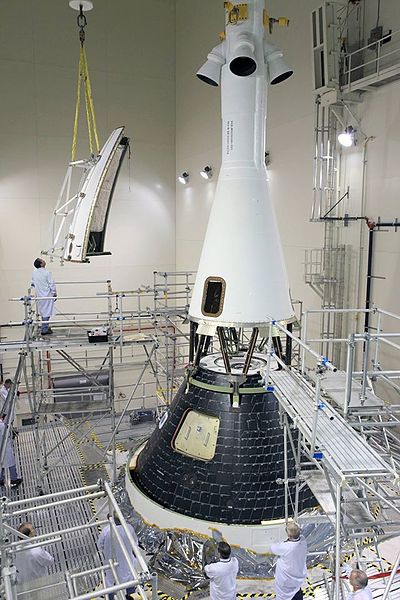
Orion Spacecraft construction

Photo: NASA

The Orion crew module is designed to be bigger in terms of volume and mass than the Apollo equivalent – two and a half times the volume and around one and a half times the mass. This increase is offset some by the attached service module which contains essential equipment and more that is much lighter than its Apollo equivalent. This increase in volume means much more room for the apparatus needed to support the crew, which boosts the capacity from the Apollo-era three to a possible six member crew in the module.

Other improvements in the name of modern technology include a digital control system similar to the “glass cockpit” systems on the most modern airliners, a system designed to achieve docking with another spacecraft automatically rather than manually (a first for a U.S. spacecraft), vastly improved computer systems, and, possibly the most significant development, heat shield ablation technology designed to not only achieve a safe re-entry, but to make the module entirely reusable after more than one journey back to Earth. Such an advancement will save vast amounts of time and money in the future. To allow for further developments in technology over the next couple of decades, the components of the Orion are also designed to be as generic and as adaptable as possible for new parts to be integrated into the module once they are developed.

All in all, the Orion is designed to combine the vehicle style and shape of the Apollo-era command module with the very latest in technology to carry it to the Moon and Mars – and safely back again.

However, it might now be asked…what about the specific systems? What exactly makes them capable of taking the long trip to Mars and back – possibly multiple times – safely and successfully?

Keeping Them Alive – Life Support

The core of the Orion is the crew module. And the core element of the crew module is, of course, the system designed to keep crew members alive and healthy through a journey that could last a matter of years before completion. Of course, the basic requirements for such a system – maintaining food, oxygen and potable water, eliminating waste, and preventing possible hazards to the life of the crew – have been the same ever since the very first human missions into space, but the advancements of technology in that time have made it easier to meet such requirements and lower the risks associated with spaceflight.

The basic life support requirements for the Orion are eightfold, but can be summed up as being able to support a full crew (either four or six) in a “shirtsleeve” – that is to say no spacesuits – environment for a full Lunar or ISS mission. Furthermore, it must be able to operate for six months in an inactive mode either attached to the ISS or in Lunar orbit, tolerate failure of more than one essential system, and satisfy the various dimension and mass limits that were part of the Orion design.

With all of that in mind, the Orion crew module life support system meets these needs and uses new, modern technologies to do so, some of which include:

Orion Spacecraft Construction

Photo: NASA

  • advanced carbon filters that recycle the air that astronauts would need (and, yes, no square scrubbers in round holes this time)
  • a Halon gas fire extinguisher system as well as hand-held fire extinguishers for the crew
  • a comprehensive temperature control that is both active (can be controlled by the crew) and passive (happens all the time regardless of crew involvement)
  • waste and water management systems that eliminate potentially harmful waste while recycling where they can

All of this accounted for, the Orion is perfectly capable of taking a crew of six to the ISS or a crew of four to the Moon.

But what about Mars?

Though the Orion crew module is capable of supporting astronauts for a reasonable amount of time, the lack of space for food and other supplies mean that more room is needed should it be required to take on the many-years venture of a Mars mission. To that end, a Deep Space Habitat (DSH) covering exercise, training, recreation, and supply space is envisioned, which will be covered in greater detail in the future.

Gotta Be Tough – Structure

As has been covered in previous articles, the rigors of spaceflight place as much stress on machine as they do to man. From the initial g-forces of liftoff to the various heat and gravitational stresses that happen upon re-entry, every aspect is designed to test the limitations of the technology placed up there…with the penalty for failure being severe. And with spacecraft, the first point of possible failure is the outside structure of the vehicle itself.

So, having considered this, the outer hull of the Orion has to be designed to resist everything that launch, a long period of spaceflight, and the rigors of not one but multiple re-entries can throw at it – and more. And as was mentioned earlier, though the general shape of the crew module hasn’t changed since the days of the very first human spaceflight – re-entry dynamics haven’t either, after all – the materials used to build and coat it have.

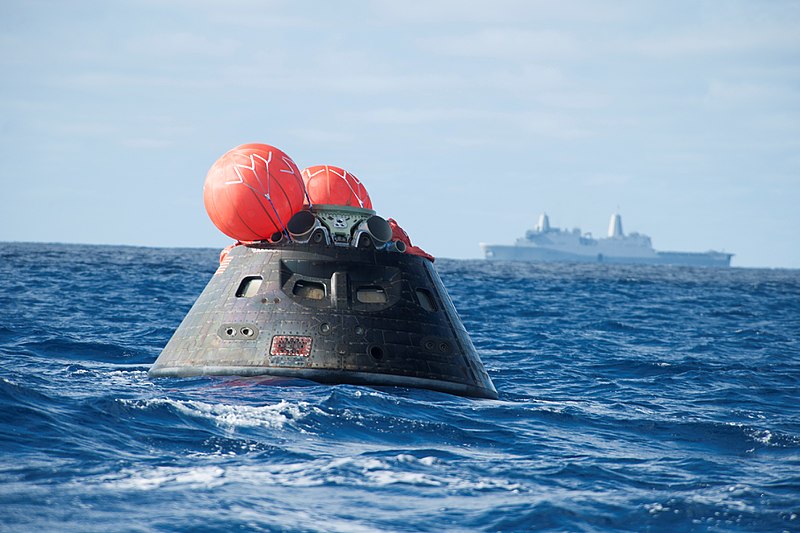
Firstly, the Orion crew module is fitted with possibly the most comprehensive abort system ever designed for a human spacecraft. Should a failure happen on the launchpad or ascent that might endanger the lives of the astronauts involved (and tragically both of these things have happened in U.S. missions in the past), then the abort system would fire, throwing the capsule and its occupants away from the failure and to a safe landing with immediate effect.

Orion Landing in Water

Photo: US Navy

Once in space, the capsule defends against the various rigors of spaceflight in a variety of ways. The structure is designed to defend against micro-meteor strikes, which on any long mission would become a significant hazard. The capsule also utilizes a form of welding named friction-stir welding (FSW) in its construction, which vastly reduces the possibility of leaks in the structure, and strengthens the hull while reducing its overall weight – always a plus in space operations.

Finally, for re-entry, the module has been fitted with the Avcoat ablator system – a system that shows the advantages of revisiting the old days, seeing as a similar system was used to outfit the Apollo crew modules. Facing the extreme conditions of temperatures of over 5,000 degrees Fahrenheit, the Avcoat material heat shield, made from a combination of silica fibres, epoxy resin and fibreglass, is fitted directly to the bottom of the crew module. When returning from the ISS or the Moon or even from Mars, the ablator will absorb all of the friction heat buildup caused by the spacecraft coming into the atmosphere at several thousand meters per second, directing it away from any weaker parts of the structure. Additionally, the ablator is designed so that upon recovery of the module, it can be detached from the crew module and a new one put in place – thus making the module reusable as many times as is deemed safe. This will be a great help both in terms of time between launches to prepare, and the overall costs of the missions themselves.

A long time in space provides an exacting test for both man and machine. With the measures put in place described here, the structure of the Orion demonstrates – as it did during its first test flight in 2014 – that it is as up to the task as its occupants will be.

Conclusion

Since its inception, the Orion has been, through a combination of some old reliable technology and most cutting edge new technology, NASA’s vision of a spacecraft that can go forth far into the 21st century. It will be all things for all occasions, as comfortable on a cargo run to the ISS as touching down on the Martian surface. In this article, the history and a few of the systems of this remarkable vehicle were covered, and in the next, the remainder will be detailed, giving a better idea of what makes this spacecraft truly special. And it will reveal that why, in come a couple of decades time, this craft could indeed be taking people to one of our nearest planetary neighbors for the very first time.

More from Ross:

The Road To Mars: Our Past and Our Future

Going To Mars, Part 1: The Human Element

Going To Mars, Part 2: The Curiosity Rover, A Martian Marvel

Ross WakefieldRoss Wakefield is a freelance science writer, communicator and consultant, with specialized expertise in the field of current and historical space developments. Ross has a Bachelors degree in Physics with Astrophysics from the University of Leicester and a CMCU in Astronautics and Space Engineering from Cranfield University and is a member of the Institute of Physics and British Mensa. Ross is currently beginning a series of articles with The Mars Generation on various space-related topics. When he’s not glued to a computer screen, he enjoys playing and watching sport, reading various books and trying to find where the nearest good pool table is in the United States. Find Ross on his Twitter.


NASA’s Chief Engineer Julie Kramer-White on the Orion Spacecraft Mission

We are so lucky to have Caroline Geraghty join us as a guest writer. Please scroll to the bottom of this post to learn more about Caroline.

Please visit our “Get Involved” page to learn more about how you can volunteer and/or join The Mars Generation. Let’s go to Mars!

*** Please note guest submissions are options of the author and do not necessarily reflect the mission or beliefs or The Mars Generation.

Introduction

The fields of aerNASA Chief Engineer Julie Kramerospace engineering and technology are constantly evolving. It’s been almost half a century since humans first stepped foot on the Moon, a feat many thought impossible. Now, humanity is pushing the boundaries of space exploration even further: we are pursuing Mars.

In 2003, NASA launched the Mars Exploration Rover Opportunity which landed on its target destination in 2004. Since then, NASA has been collecting data from Mars about water activity, soil, and temperature. This is just one step of many in the quest to send humans to Mars.

More recently, NASA is building the Orion, a spacecraft designed to take humans to the moon and beyond. NASA is currently constructing Space Launch System (SLS) which is the rocket that will launch Orion to deep space.

I, Caroline Geraghty, had the opportunity to speak with NASA’s Chief Engineer Julie Kramer-White about her rewarding career at NASA and the origin of Orion.

Interview

1. What inspired you to go into space engineering?

There was a big push in the U.S. in the 1970’s to encourage girls in math and science. I had an aptitude in both, so was encouraged to consider either medicine or engineering by several of my teachers. I didn’t know any aerospace engineers growing up in Indiana. The only aerospace engineer I knew was Scotty on Star Trek! But I definitely knew I wasn’t just interested in engineering.

I wanted to work at NASA on human spaceflight programs. That was the early Space Shuttle Program, before the Challenger accident. In fact, the biography accompanying my senior picture in my high school yearbook says I intend to work at NASA. Luckily, NASA and Purdue, the university I attended, had a long history together…I was recruited into Purdue’s co-operative education (student intern) program with NASA in 1986, and I’ve been at NASA ever since.

2. How did NASA’s Orion come about? When and where did the project get started?

Orion became an official program around 2006 with the selection of Lockheed Martin as the program’s prime contractor. There was work (requirements, design-concept work, etc.) that predates that, but let’s call that the official beginning of the program. Orion, or CEV (Crew Exploration Vehicle) as it was called at the time, was intended to fill the void in U.S. human spaceflight capability that would come when the Space Shuttle program ended (it would have been over 20 years old at that point). Furthermore, Orion was designed to allow for exploration beyond low Earth orbit.

Shuttle was a magnificent piece of engineering, but was intended specifically for low Earth orbit. Its wings and payload bay, which gave it the capabilities to land on a runway and haul heavy, large payloads to orbit, were not practical from a mass or reentry perspective for going beyond low Earth orbit.

Getting beyond LEO, as we call low Earth orbit, is all about mass. If your spacecraft is too heavy, you won’t get out of the earth’s gravitational influence, let alone have the performance to get to the Moon or beyond. For every pound of spacecraft that you take to the Moon or Mars, you need many pounds of propellant, so the problem compounds pretty quickly.

Also, one of the things we learned over time was that a side-mounted spacecraft, like the Shuttle, was less desirable from a crew safety perspective. It would always be vulnerable to debris or ice shed from the stack. So, all the new spacecraft designs are top mounted. This allows the use of crew escape systems which can push or pull the capsule to safety in the event of a problem with the launch vehicle.

3. December 5th, 2014, saw the first trial flight [of Orion] which ended with a splashdown in the Pacific ocean. This must’ve been an amazing event to see happen successfully.

Of course a lot of us had invested a tremendous amount of time and energy into the program at that point, and the Space Shuttle had been retired for about 2.5 years. So, we were very excited to get to launch. We had a lot of confidence in the engineering and checkout that had been put in the vehicle, so we expected it to be successful. However, this test flight was so successful that I would have to say: even we were a little surprised at exactly how successful it was. We flew a test flight to stress the vehicle and its systems, so we could learn as much as possible before we fly astronauts on Orion. And it performed exceptionally well under those conditions.

4. With vigorous tests being carried out on the craft, and most recently, the successful live testing of the Abort module, what testing plans should we expect to see next?

We have several different tests at the component and subsystem levels ongoing. For example, our final qualification drop tests of our parachute system and our integrated avionics and software lab are going on right now…The EM-1 (Exploration Mission 1) spacecraft is being built right now, and will soon power on for the first time. We will add the European Service module in the spring, test the two together and then send the stack to Plum Brook Station near Cleveland Ohio in the U.S. for testing in their big thermal vacuum chambers. This will simulate the harsh environment in space and ensure that the spacecraft thermal conditioning systems are working before we send it out into deep space.

At the same time we have the spacecraft in testing at Plum Brook, we will be conducting our second and final integrated ascent abort test, Ascent Abort-2. We conducted an “off the pad” abort test in 2010, and this companion test will demonstrate abort system capability in the transonic region. This high altitude test represents the design condition for controlling the abort vehicle. So, we need to demonstrate that our guidance systems and motors are effective for aborting off the launch vehicle if there were ever to be a problem during ascent. So, it will be a very exciting year for us on the Orion program.

5. The plans for the first mission to carry astronauts into orbit or deep space are not expected until 2023. Can we see this happen before this as initial aim for 2021?

Our current manifest, or flight plan, has us flying EM-1 in 2019 and EM-2 in 2023. The pace of these flights is really driven by our ability to develop and build the systems, or what we call DDT&E (Design, Development, Test and Evaluation). There are human systems, such as the environmental and life control systems that are needed for human spaceflight, but are not currently on the EM-1 vehicle. These systems are currently under development resolving key challenges in the design and performance (lightweight, low power, high reliability), but we won’t ramp up final production and qualification on those systems until EM-1 is done. The pace of spacecraft development is really just a reality of funding profiles. We load our development schedules to match our budgetary commitments for a given year. We would love to fly sooner or more frequently, and we are always looking for opportunities to move key development milestones, like our first human spaceflight, earlier!

6. How are astronauts being prepared in training to adapt to long periods duration missions inside the Orion capsule?

We have engineers and scientists in a variety of disciplines working to answer this very question. We have human factors engineers at Johnson Space Center in Houston, where the Orion program is also based, working to figure out how some of the elements inside Orion like exercise equipment or even food can be optimized to support long duration missions. The International Space Station is also teaching us a lot about how the human body performs after being in space for a long time, both physically and psychologically. We are still learning quite a bit from Scott Kelly’s yearlong mission on the ISS. We also routinely have astronaut involvement in Orion design and development work, as well as in training. They can provide unique insight from their perspective of what it will be like to interact with the vehicle once they are inside it [and we can] integrate that into our designs.

7. Are there specialist suits being designed for deep-space orbit (7 year old Hayden’s question)?

We are using a modified version of the previous space shuttle ACES (Advanced Crew Escape Suit) for early flights…That’s the orange suit you would have seen for shuttle astronauts. We’ve made some safety enhancements, as well as modifications for it to interface with the Orion spacecraft suit loop (that’s the system that provides breathing gases). But it has a limited capability for extended extravehicular activity (EVA), and is not intended for planetary surface exploration. New suits are in development for these applications. These suits build on our extensive lessons learned from Apollo missions to the Moon and all our EVA experience from space station. The next generation of suits should promise to be the lightest, most mobile and reliable yet.

8. When and how far away is Orion from preparing to orbit around the Moon? And the task of asteroid capture, will this take very precise and detailed planning?

As I mentioned above, EM-1 is being built right now, with power on anticipated next month. Launch is anticipated in Fall of 2019 after an extensive integrated test program. This spacecraft level test program (vibration, acoustics, thermal and vacuum) qualifies the design for launch, abort and deep-space flight. Once the design passes this rigorous qualification process, future builds go through a shorter acceptance process. This first mission of Orion and the Space Launch System (SLS) rocket will send Orion thousands of miles beyond the Moon. NASA remains committed to the next human missions to deep space, but we are no longer pursuing the Asteroid Redirect Mission (ARM). We will continue to work on some of the ARM technologies, such as solar electric propulsion, which will advance future in-space transportation needs. We recently unveiled a concept using SLS and Orion for building a deep-space gateway and transport in the vicinity of the Moon to help us prepare for human deep-space destinations, including Mars.

9. Upon successful orbit of the Moon, what do you and the team hope to gain from this? Will this give more data and in-depth knowledge in planning for the next stage, for the Mars mission?

Just like our high speed entry test in 2014 allowed us to test out the core flight software, avionics backbone, heat shield, and reentry systems, a test flight around the Moon allows us to test out all of our systems in the real deep-space environments, and for days versus hours. The EM-1 spacecraft will add the service module with the propulsion systems, power generation via the solar arrays and thermal control via the radiators and heat exchangers. We also have expanded the software functionality since EFT-1 [Exploration Flight Test 1] as well as updated the heatshield and several other systems based on lessons learned. The goal is to reduce risk on critical systems prior to adding crew on EM-2.

10. With all the findings so far about the Mars atmosphere and radiation, do we know enough to plan for 2032? With so many new planet discoveries, will Mars still stay in the forefront of human space travel?

The area of space around the Moon and Mars will stay part of our objectives for human spaceflight missions for the foreseeable future. Before we could consider the longer term human exploration associated with ‘earthlike planets’ in the habitable zones of other stars, we need to really advance our systems that allow for independence from Earth. We need to advance our propulsion systems to enable faster travel over these massively long distances. Mars is over 30 million miles away, compare to the Moon’s 200,000 miles. Travel time today is days for the Moon and months for Mars…years for anything further.

We need to continue to advance the reliability and efficiency of regenerative power and life support systems, and continue to work in situ resource utilization projects, as resupply and even staging supplies becomes less and less practical. We are making a lot of progress on understanding and measuring radiation. This allows us to develop strategies to protect humans and hardware. Of course, that won’t stop our robotics and planetary probe teams from continuing to reach out into the solar system. They do a tremendously important job of pathfinding our way, laying the scientific groundwork, and making it clear what challenges await possible colonization of these farther out destinations. They will also benefit from advances in efficiency and reliability of propulsion and power systems in terms of reaching further faster.

11. A question for the future of space, engineering, and budding astronauts: what would your advice be to young people today about working towards a career in this industry?

If you are serious about turning your love of space into a career in the aerospace industry, I would give all the typical advice. Take as much math and science as you can! But I would also say, make it a priority to pursue opportunities for internships or cooperative education programs that allow you to go to college and work as an engineer. I was lucky enough to do this at Purdue University when I was getting my bachelors degree. This allows you to really understand what it is that engineers do before you graduate and have to commit to a specific facet of engineering. There are so many different disciplines of engineering that support spaceflight. It’s just a matter of finding the right fit from a discipline perspective, and the right fit from a government, industry, academia perspective. And, some of our most important people, aren’t even engineers! They are the people that lead our agencies and institutions, business people, and communications people that manage our finances, tell our stories, and make it possible for us to design, build test, and explore. Finally, persistence is my word. Progress in this field, particularly the human spaceflight side of exploration, is measured in decades…You have to be committed and work long and hard, and know how to stay on point for a long term goal. So, learn early to be focused, but flexible, because it’s a long game!

Author Biography:

Hayden TMG memberCaroline Geraghty if a full time mother to her son with special needs, Hayden. At seven years old, Hayden is one of the youngest Students Space Ambassadors for The Mars Generation. He has Autism and ADHD, and the fields of space, astronomy, and aerospace engineering have unlocked his world.

By doing outreach work and getting involved with The Mars Generation, Caroline and Hayden have embraced many opportunities to be a part of the space industry. They’ve met with astronauts, talked to university professors, and become active in astronomy organizations. Caroline uses her passion to learn something new everyday, even when people say that her dreams are “unrealistic.” With the lessons she’s learned, she teaches her son, Hayden, that it’s never too late to follow your dreams.

Going to Mars, Part 2: The Curiosity Rover, A Martian Marvel

We are so lucky to have Ross Wakefield join us as a guest writer.

Please visit our “Get Involved” page to learn more about how you can volunteer and/or join The Mars Generation. Let’s go to Mars!

*** Please note guest submissions are options of the author and do not necessarily reflect the mission or beliefs of The Mars Generation.

Martian Sunset

Introduction

For a long time now, Mars has been the object of desire for many missions from a range of different space agencies. Many of them have been very successful (like the incredible story of the NASA rover Opportunity, whose proposed mission life cycle was 90 days yet is still gathering and sending data after 13 years), and some not-quite-so successful (the poor Beagle 2, long believed to have been destroyed upon landing but recently discovered to have been inactive simply because two solar panels failed to deploy, blocking the communications antenna). Though Mars has a reputation for making missions difficult for various reasons (roughly two-thirds of probes sent to Mars have failed before their missions could be completed), at the present time there are no less than eight different active vehicles sent by mankind either in orbit or on the Martian surface itself.

One of these vehicles, the most recent successful arrival on the surface, has given us more data than ever about the Martian environment. It is assessing the climate, analyzing geology, offering possible conclusions on whether or not life of any kind once existed on Mars, and perhaps most importantly, looking to answer a fundamental question:

If we were to visit Mars in the future…how hospitable would it truly be?

In the early 2000s, NASA began work on a project that would eventually become known as the Mars Science Laboratory (MSL) mission. The idea was to determine once and for all the current and past habitability of Mars for organisms both complex and simple.

The centerpiece of this mission was the rover that the MSL carried with it, right down to the Martian surface itself: the vehicle named Curiosity.

The Curiosity Mission, Now and Into the Future

Early Stages to Landing

In 2004, NASA began taking proposals for the various parts that the probe would take to Mars, and within four years most of the instrumentation had been completed and was being tested. Though the project did run over-budget during development and NASA had to simplify many of the instruments in order to make a revised launch date, the rover – given the name Curiosity thanks to sixth-grader Clara Ma from Kansas – took flight from Cape Canaveral in late 2011; the beginning of a ten-month journey to Mars.

The MSL mission had, and still has, several basic objectives – chief among them to identify possible “biosignatures” or features that imply that a biological presence had once been on Mars. The mission also performs detailed geological testing of the area to identify exactly what kind of rocks and soil may be found on the Martian surface. And finally, it records and analyses radiation levels both during the journey to Mars and once on the surface. That data, of course, would be potentially crucial for planning a future human Mars mission – and more on that later.

Mars Science Labratory missionOn August 6th, 2012, Curiosity landed successfully in the Gale Crater, very close to the equator of Mars. After a tense 14 minute wait, news of this reached the waiting mission staff, and very soon after that the world knew that the most complex and elaborate rover yet designed for Mars missions would soon begin its exploration. The choice of Gale Crater had been carefully considered beforehand; the site for the landing had to include both a variety of different materials for geological analysis and also the kind of rocks capable of indicating the evidence of past water and (maybe, just maybe) ancient fossils. From past observations of the surface, that particular location satisfied all these requirements – and its close proximity to the Martian equator would help with communication.

On the Surface

Once on the ground, Curiosity got to work, using a variety of instruments to assess the Martian surface in pursuit of its mission. Though the initial thoughts regarding what the rover could carry had been limited by budget and time constraints, a wide variety of instruments were fitted to the rover for use.

These included:

– a spectrometer designed to assess the chemical makeup of rocks using alpha particle radiation and X-rays, ideal for getting an accurate composition of the sample.

– an X-ray diffraction analyser, designed to target specific minerals within rocks and identify whether or not any particular rock might have had water involved in its creation or its development. Past or present water, is, of course, a key indicator of possible life.

– an instrument for analysing the few gases in the Martian atmosphere, looking in particular for specific oxygen and carbon signatures within carbon dioxide and methane that would tell if those gases were produced chemically or organically.

– a radiation detector, switched on at launch in order to measure the radiation doses given to the mission both by the Sun and by other possible sources.

– a weather package designed to measure wind speed, temperature, humidity and other important values.

– a variety of different cameras – five for imaging the surface and other interests, and 12 for supporting the movement of the rover itself.

With all of this instrumentation on one vehicle, Curiosity is by far the most complex rover ever sent to a body outside of Earth orbit and land successfully.

Within a few months of landing, the rover made a rather spectacular success when it came across what was described as an “ancient stream-bed.” This indicated that there had, at one time, been a wide-flowing and vigorous river system, at least in that area. Though the existence of flowing water in the past had been heavily touted since the Mariner missions of the 1970s, this added further weight to the idea that Mars did, in recent history, contain flowing liquid water – and by extension, possibly life. Further discoveries the following year of abundantly accessible water in soil samples added more credence to this theory.

In early 2013, a sample of rock taken by Curiosity at Gale Crater detected water, carbon dioxide, oxygen, sulphur dioxide and hydrogen sulphide. This is a chemical combination very well-suited for the existence of microbe life, thereby adding further weight to the idea that Mars was, once upon a time, potentially habitable for simple forms of life.

In late 2014, the rover detected a spike in methane levels ten times higher than the baseline value in the Martian atmosphere, as well as other organic compounds within rock samples. While the source of these compounds is debatable, it is entirely possible that they could have been produced by ancient microbial processes.

In late 2015, there was enough data gathered by Curiosity for a conclusion to be made that the landing area of Gale Crater was once either a large lake, or stream, or both, billions of years ago.

Finally, in late 2016, NASA gave a summation of the mission so far, where they confirmed the relative success of at least one objective of the mission. In their opinion, the Gale Crater site once contained an ancient river or lake, with a chemical energy source and all the chemical ingredients needed for life to have once existed there. Their conclusions were definitive – while Mars likely does not have life now and possibly did not in the past, the conditions were extremely favourable for life to have existed there once upon a time.

From the time of its launch, the rover has measured the doses of radiation from galactic cosmic rays as well as energised particles emitted by the Sun. The findings, however, were sobering: the dose that the rover took in the time frame that a human Mars mission would entail (860 days total: 360 days traveling back and forth and 500 days on the surface) was almost twice what NASA deems an unacceptable lifetime limit for its astronauts in orbit around the Earth.

Future of Curiosity

Though the initial plan was for the rover and the mission to be active for just two years, within a few months of landing the mission plan for Curiosity was extended indefinitely. This didn’t come as a surprise to most familiar with the sheer durability and toughness of such rovers: the story of the NASA rover Opportunity, as shown above, pays testament to that.

Presently, Curiosity is to be found exploring the surfaces of Mount Sharp, looking for further clues as to

Mars Curiosity Rover Self Portrait

Martian history and in particular how the planet moved from a relatively habitable abode for simple life to one incapable of supporting it. Still in excellent working order with only a couple of minor technical difficulties to inhibit it, the rover has traveled over 16.5 kilometres from its landing site.

Right now, the key objective that the rover is focusing on as it climbs Mount Sharp is to discover exactly how and when the lakes and rivers upon Mars dried out, thereby giving possible clues as to why it happened.

On its fifth “birthday,” the rover even played a little “Happy Birthday” tune to itself – and with any luck, Curiosity will continue to roll on in the course of its mission for many years to come.

What Does It All Mean For Future Missions?

In the roughly five year timeline since Curiosity first landed on Mars, this probe has given NASA and the world a treasure trove of information regarding surface and atmospheric conditions on Mars, some of which confirmed what previous missions had hinted, and some of which was entirely new. It has, by all accounts, been a remarkable success – and no doubt there is still much more to be found and more information to be sent back by the durable, brilliant rover.

However, the thirst is for more than just robotics to set their wheels on the surface of our nearest planetary neighbour. As has been mentioned in previous entries, more than one organization on Earth has the hunger to put humans on Mars and to do it soon. But to do that, we need a lot of information about conditions there – both for the sake of mission parameters and for the safety of the astronauts that would go.

So, in light of that, what has the Curiosity mission told us about a potential human Mars mission that is noteworthy?

Well, the first discovery is possibly the most difficult factor discovered by the mission, and the one most likely to put serious holes in a lot of Martian ambitions – the high radiation levels.

As was noted earlier, the maximum accepted lifetime dose of radiation by NASA for its low Earth orbit astronauts is one that will give a three percent additional risk of fatal cancer development. The readings from the rover show a total dose of around 1 sievert of radiation during an 860-day Mars mission, which corresponds to a five percent additional risk – almost double what NASA deems acceptable. And this, of course, does not take into account other missions that the astronaut may have been on previously in their lifetime, nor the (likely) vital time in a zero-G environment that they would need for the purposes of training for such a Mars mission. This finding, showing that the total dose was higher than many people expected, indicates that serious consideration is going to have to be given to radiation shielding for any astronauts involved in such a mission.

There are, of course, solutions to this problem – increased radiation shielding for the craft involved, as well as the choice of building a habitat for this purpose (likely essential for long-term habitation of Mars anyway) once on the surface that would be likewise shielded. Such shielding does increase the potential weight of any mission sent, and so increases the cost and possible complexity. Such things will have to be carefully considered in the planning of any future human mission.

The second discovery involves the landing of the rover itself, where a rather unique system was used. Rather than just one system – thrusters, an airbag or parachutes – being used to arrest the fall of the rover to the surface, Curiosity instead used a unique combination. Initially, a heat shield was used to reduce speed during the initial entry into the thin Martian atmosphere. This was followed by a parachute once further down, and thrusters once within around two kilometers of the ground. Finally, and most uniquely, a “sky-crane” system was used, where cables helped lower the rover away from the rest of the descent vehicle until touchdown, at which point the cables separated and the other part of the lander flew away to land elsewhere. Such a system was entirely novel and was deemed one of the few possible ways that a wheeled rover as large as Curiosity could be landed safely – that is, without causing damage to vital systems through impact or the dust cloud generated by such a landing.

The success of this principle demonstrated that heavy yet delicate payloads can be deposited on the Martian surface, and as any human mission is going to require an awful lot of heavy yet delicate equipment, this method is a useful possibility for getting materials down to the surface.

The Curiosity rover has also confirmed beyond reasonable doubt that while organic compounds exist on Mars, organic life likely does not at this point in time, which has connotations for precautions that any crew might have to take if it came to encountering simple life there – such as increased anti-contamination procedures and the like.

All of these, along with various discoveries that have been made regarding chemical and organic findings on Mars by the rover, mean that this mission has been given a wealth of information that will prove useful if and when humanity decides to send some of its own representatives to the Red Planet.

Conclusion

Almost five years after its landing, the Curiosity rover is still almost fully functional, rolling away through the Martian landscape, testing and sampling all the time. A testament to the ingenuity of those who helped place it there as well as the durability of the rover itself, it should continue to supply incredibly useful data for many years to come.

By far the heaviest and most complex vehicle ever to land on the surface of a planet that is not our own, it has spent the last half a decade giving us a wealth of information. Through discoveries made by this one rover, we now have a much better idea of the best method to deliver heavy payloads to the Martian surface, the previous habitability of Mars, and the likely dose of radiation that a human mission to Mars might face, and more. Even now, it seeks to answer another question about Martian history by attempting to discover at least a rough idea of the time at which liquid water there might have vanished.

In the next couple of decades, it is possible that a human Mars mission will finally result in human feet upon that planet. Maybe, just maybe, when they do…

…there will be a tough little rover, battered but still working…rolling up to greet them.

More from Ross:

The Road To Mars: Our Past and Our Future

Going To Mars, Part 1: The Human Element

Going to Mars, Part 3A: Orion, The Next Generation of Travel

Ross WakefieldRoss Wakefield is a freelance science writer, communicator and consultant, with specialized expertise in the field of current and historical space developments. Ross has a Bachelors degree in Physics with Astrophysics from the University of Leicester and a CMCU in Astronautics and Space Engineering from Cranfield University and is a member of the Institute of Physics and British Mensa. Ross is currently beginning a series of articles with The Mars Generation on various space-related topics. When he’s not glued to a computer screen, he enjoys playing and watching sport, reading various books and trying to find where the nearest good pool table is in the United States. Find Ross on his Twitter.

TMG Interviews HI-SEAS Mission V Crew

Becca Browder

Becca Browder, The Mars Generation blog editor and writer

The Mars Generation is excited to announce that we’re doing a feature of the HI-SEAS Mars Analog Mission! Our blog editor and writer, Becca Browder, will conduct an interview with the crew that includes questions submitted by The Mars Generation members, a perk offered to members only.

The Hawai’i Space Exploration and Analog Simulation (HI-SEAS) project is a NASA-funded research program operated by the University of Hawai’i in which crew members live in isolation for a long-duration mission with conditions simulating those of an actual mission to Mars. The crew experiences a simulated 20-minute communications delay, lives in the 1,200-square-foot habitat, and goes outside only while wearing mock spacesuits. Led by UH Mānoa professor Kim Binsted, the mission’s purpose is to study crew selection and the effects of long-term isolation on teams.

Four crews have previously completed missions at the site on Mauna Loa in Hawai’i, and now the six crew members of Mission V are nearing the end of their eight-month mission. We solicited questions from our members and selected a few of these to include in the interview. The crew gathered together to answer the questions as a group.

Come back to watch the whole interview and see what it’s like to live on “Mars”!

Meet the Crew

Originally posted by the University of Hawai’i News

HI-SEAS Mars Analogue Mission

The HI-SEAS Mars Analogue Mission crew before entering the habitat on Mauna Loa in Hawai’i on January 19, 2017. (L to R) Joshua Ehrlich, Laura Lark, Sam Payler, Brian Ramos, Jay Bevington and Ansley Barnard. Photo courtesy of the University of Hawai’i.

Ansley Barnard is an engineer from Reno, Nevada who has worked for NASA and Boeing on advanced composite structures and has designed aerodynamic bodywork for cars racing in the 100th Indy 500. She has a BS in aeronautics and astronautics from the University of Washington. Prior to HI-SEAS, she worked in engineering optimization for Ford Motor Company.

James Bevington is a freelance researcher with a passion for space. He has a BSC from the University of Tennessee, an MSc from the University of Georgia and an MSc from the International Space University. Prior to HI-SEAS he was a visiting researcher at International Space University and a consultant for Northwestern University.

Joshua Ehrlich is a systems engineer for Lockheed Martin working on test and verification of the Orion European Service Module. He has a BS in aerospace engineering from the University of Florida and an MS in mechanical engineering from Embry-Riddle Aeronautical University. His previous work experience includes integration and testing on both the SpaceX Falcon 9 launch vehicle and Veggie and Advanced Plant Habitat payloads at NASA’s Kennedy Space Centre.

Laura Lark is a computer scientist who grew up on a small farm in unincorporated Whatcom County, Washington. She has a BS in computer science from Brown University and, prior to joining the HI-SEAS crew, spent five years as a software engineer at Google working on search serving and indexing infrastructure.

Samuel Payler is a doctoral candidate at the UK Centre for Astrobiology, University of Edinburgh. He has been involved with a number of analog programs including NASA’s BASALT program, the MINAR project and BISAL which is the world’s first deep subsurface astrobiology laboratory. He has an MSci from the University of Birmingham and prior to HI-SEAS was researching life in hypersaline deep subsurface environments.

Brian Ramos is a Portuguese-American with dual engineering degrees in biomedical and electrical engineering. He also has a master’s degree in international space studies from the International Space University. Prior to joining HI-SEAS his professional experience included project work at NASA’s Johnson Space Centre and work with Engineering World Health to repair media equipment in Rwanda.

The Mars Generation Joins Kennedy Space Center’s Summer of Mars [VIDEO]

We are honored that The Mars Generation was invited to be part of the Kennedy Space Center’s Summer of Mars events! On August 5, 2017 our founder, Astronaut Abby made an appearance at the Kennedy Space Center as a special guest speaker to talk about our nonprofit and our important work at The Mars Generation. Watch to learn more about how The Mars Generation was founded and our important work!

To learn more about The Mars Generation, be sure to sign up for updates and also follow us on Facebook, Instagram, Twitter, and Google +! Onward to Mars!