Should We Bring Puppies With Us To Mars? | #AskAbby Space and Science Show | The Mars Generation

Season 1, Episode 6 of The Space and Science Show #AskAbby series
Presented by TheMarsGeneration.org

Should we bring puppies with us to Mars?

We are excited to announce the release of our new weekly series called the #AskAbby Space and Science Show! Our founder and president Astronaut Abby will be appearing each Tuesday on YouTube, answering questions submitted by you, our community!

Subscribe to our YouTube channel here so you don’t miss an episode!

In this sixth episode please join Astronaut Abby as she answers the question: Should we bring puppies with us to Mars?

Get ready for a cuteness overload! Golden retrievers Thunder and Lightning guest star (who are we kidding, they are the stars) in this #AskAbbyepisode about dogs in space! Astronaut Abby gives us a short history lesson about how animals, particularly dogs, have been involved in space exploration. Triumphs and tragedies alike, all that we have discovered about space certainly wouldn’t be possible without human’s best friend.

What could this mean for the future journey to Mars? Also, should we bring dogs with us to Mars? What are the ethics involved with bringing dogs on a long duration space mission? Find out what dog Abby would choose if she had her choice and more! Watch now to learn all you ever wanted to know about PUPPIES IN SPACE!

Tune in weekly on Tuesdays for new releases of The Space and Science Show #AskAbby series and don’t forget to subscribe to our YouTube channel here so you don’t miss an episode!

The Martian Garden Project

Canadian-Martian-Garden-Project- The Mars Generation

We are excited to have Amanda Green and Julie Arsenault join us as guest writers. Please scroll to the bottom of this post to learn more about Amanda and Julie. 

I love science, and the only thing I love more than teaching science is teaching and learning about space.  My name is Amanda Green, and I am a middle school science teacher in Beaumont, Alberta, Canada.  I work alongside my colleague and friend, Julie Arsenault, from Edmonton.  We enthusiastically share our love of science and space and often collaborate and share ideas for lessons, activities, and just getting nerdy.  

Over the past few years we have both participated in the Canadian Space Agency/ Let’s Talk Science Tomatosphere project several times.  It is a fantastic experiment where kids from across Canada and the United States compare germination rates of two groups of tomato seeds: one control and one that has been either onboard the International Space Station or exposed to a simulated space environment.  We have used this project to kick off the school year with the scientific method and to have plants thriving in our classrooms all year long.  

THE PILOT

In 2016/2017 I  started with my class by using notable Twitter accounts – SpaceX, NASA, The Mars Generation, and Astronaut Abby, for example – these accounts helped us to keep up with all of the exciting innovations in science and technology.  Throughout this process, the name Wieger Wamelink kept coming up as someone who had been growing plants in impressive simulated Martian conditions in the Netherlands.  These experiments made me think about the connection between our Tomatosphere experiment, my favorite movie/book The Martian, and the educational value of doing a similar project with our students.  I was curious to figure out how we could marry science and science-fiction in an authentic and meaningful way.

The Martian Garden produces Mars simulant soil from ground up, sterilized lava rock that closely resembles Martian soil based on its texture and chemical composition.  One major problem is that the soil is quite expensive, especially to ship all the way up to Edmonton. However, I was able to convince my school administration to fund a small pilot project.  This sparked some discussion with my students and, after researching various possibilities, we planted some of our Tomatosphere space seedlings in Earth soil, Mars simulant soil, and Mars simulant soil with a variety of fertilizers. 

The Mars Generation Canadian Martian Garden By watching our plants grow throughout the school year, we were able to observe many changes that fueled many ‘teachable moments’ and discussions in our classroom.  As our hypothesis predicted, the plants grown in plain Martian soil control was not as visibly healthy as the plants grown in other soil variants. They were thin, pale, and less lush than the other plants, and they died before they could produce any flowers.  While this was a great initial experiment, we knew that what we needed to gather more significant data as replication for each variable tested.  In order to have more replicates, we needed more soil.  

COLLABORATION AND FUNDING

One of the fantastic things about this age of social media is that it makes reaching out and finding like-minded people much easier than in the past.  Julie and I met at a Science Teaching Conference and kept track of each other’s classes via Twitter.  We have forged a very productive working relationship, in addition to our friendship, and we often brainstorm and troubleshoot projects we are doing in our classes.  Julie was intrigued by our initial experiments and was eager to get on board with future work.  We researched possibilities and collaborated to find a solution to our financial concerns for expanding the initial project.  Together we applied for and received a Devon Science Giants Grant, allowing us to purchase more soil and any additional supplies needed to take our project to the next level and to ensure we could produce valid and reliable results.  

THE MARTIAN GARDEN PROJECT

As the 2017/2018 school year began, Julie and I prepared to make our Martian Garden the centerpiece for instruction throughout our year.  Although we teach different grade levels, we have both found ways to weave a Martian survival theme into most topics covered in our respective science curricula, valuing the real-world application it brings.  We have brought in experts, and have had students brainstorm questions and continue to research all that is required to prepare a human mission to Mars.  Our students have been excited to discover more about what it would take to survive this journey!  

The Martian Garden project Alberta Canada

Our classes have now completed the transplanting phase of our experiments.  Our Tomatosphere seedlings have been transplanted into either Earth or Mars simulant soil, and, in addition to control groups for each type, we’ve included some test groups with various fertilizers added to the soils.  Inspired by The Martian, one student brought in manure for us to mix in with our soil (I think our room smelled for a few days after that), and Julie’s class wanted to try mixing some Earth soil with Mars simulant soil to “infect” it with plant-friendly soil bacteria.  Our students feel like they’re a part of something bigger than just our classroom; they feel like they’re a junior high version of Mark Watney, trying to find ways to grow plants on a planet where nothing grows.

In addition to the variations in soil, we are testing another variable across our two classrooms – the source of light.  My classroom has only one window so we will be using shelving with grow lights as our primary source of light, whereas Julie’s classroom has a large bay window so her class’s plants will have natural light as their primary source.

The Mars Generation Martian Garden Project Canada

 At this point our observations are largely qualitative, but we have noticed that tomatoes grown in Mars simulant soil have a red/purple hue to their stems.  Julie’s class has also noticed that the plants in Earth soil are growing taller and are healthier overall (her class has not added fertilizers yet, as they are trying to see if there is a marked difference in plain soil first).  As we continue to gather quantitative data, we are looking forward to seeing what explanations our students come up with to explain their observations.

In addition to our Science curriculum, we will be using this project to fuel discussions and examples in other subject disciplines as well.  We will be graphing and analyzing results, designing 3-D models of Mars habitats, developing charters and laws needed for settling a new planet, and more.  We will be meeting with experts and innovators in various relevant fields throughout the school year so students can get feedback and input from those “in the know.”

THE MARS GENERATION

Julie and I have both been following Astronaut Abby and her work with The Mars Generation for some time now, and we are proud to support such a positive and important initiative.  Students learn better and work harder when they can see how their work can impact their world, and with all of the exciting research and technology pointing humanity towards space travel and colonizing Mars, we are hoping to inspire our own “Mars Generation.”  Whether it be as an astronaut, engineer, computer scientist, or botanist, the possibilities for our students to one day contribute to humankind’s journey further into space are endless and we are so excited to be a small part of this journey.

About #2MartianTeachers

2MartianTeachers

Amanda Green

Inspired by her nature-loving family and enthusiastic science teachers, Amanda graduated from the University of Alberta in 2001 with a BEd. in Biological Sciences and Social Studies.  She is a passionate educator who has been teaching middle school Science, Mathematics and Robotics/Technology in both English and French for the majority of her career.  She is currently the Science Department Head at Ecole Coloniale Estates School in

Beaumont, Alberta, Canada and is dedicated to bringing science to life with authentic lessons that weave STEM concepts and her interests in space and biology into almost everything.  https://sites.google.com/gshare.blackgold.ca/green/home

Julie Arsenault

After earning her BSc. and MSc. in Microbiology and Biotechnology from the University of Alberta, Julie developed a passion for teaching and entered the Secondary Education After Degree program. Julie has been teaching science with Edmonton Public Schools since 2002 and enjoys bringing vast and varied experiences into the classroom (and beyond) to help students make authentic connections to their world. Project Based Learning, STEM, and Place-Based Learning are large components of her junior high (grades 7-9) science classes.  A strong believer in the power of collaboration, Julie has presented her work at conferences for ATA Science Council, Edmonton Regional Learning Consortium and Greater Edmonton Teachers Convention, and has consulted with Nelson Publishing. https://sites.google.com/a/epsb.ca/mrs-arsenault-s-nerdy-world-of-science/


Working in a Mars lab at Kennedy Space Center | #AskAbby Space and Science Show

Season 1, Episode 5 of The Space and Science Show #AskAbby series
Presented by TheMarsGeneration.org

What is it like to work in a Mars astrobiology lab at the Kennedy Space Center?

We are excited to announce the release of our new weekly series called the #AskAbby Space and Science Show! Our founder and president Astronaut Abby will be appearing each Tuesday on YouTube, answering questions submitted by you, our community!

Subscribe to our YouTube channel here so you don’t miss an episode!

In this fifth episode please join Astronaut Abby as she answers the questions: What was it like working in a Mars lab at Kennedy Space Center and what was Abby’s favorite thing to do while working the Mars labs?

For the first time ever, Astronaut Abby answers questions from a set of twins! Sisters Grace and Abby want to know more about Astronaut Abby’s summer internship at the Space Life Sciences lab located at Kennedy Space Center. Get an exclusive tour of the Mars Lab at Kennedy Space Center run by Abby’s research advisor Dr. Andrew C. Schuerger from the Department of Plant Pathology at the University of Florida. Also peak inside the science labs at Wellesley College during this special episode!

In this episode you will also find out: What was the most interesting thing Astronaut Abby learned while working at the Kennedy Space Center this summer? What was Astronaut Abby’s favorite thing to do during her internship? What is extremophile bacteria? What kinds of tools do astrobiologists use in their research? How do you make agar (and what is it)? And what the heck is the “agar dance”? Astronaut Abby proves a career as a scientist can be fun, creative and even include some dancing while at work!

Tune in weekly on Tuesdays for new releases of The Space and Science Show #AskAbby series and don’t forget to subscribe to our YouTube channel here so you don’t miss an episode!

2018 #24Under24 Leaders and Innovators in STEAM and Space

24 Under 24 2018

The next generation of leaders and innovators in STEAM will help to change the world. And, while with age often comes wisdom, The Mars Generation, through our annual 24 Under 24 Leaders and Innovators in STEAM and Space Awards , will honor some of the brightest students and young people who are positioned to shape our future for the better.

We were impressed by the sheer volume of nominations for our first year of 24 Under 24 Leaders and Innovators award. Young people with backgrounds and resumes from artists to scientists, and entrepreneurs to engineers were featured in the submissions. With so many talented students from around the world nominated, our judges were challenged to narrow the list to just 24. The 24 Under 24 will certainly inspire their young peers and encourage students in their communities to reach for their own ‘Mars.’

A huge thank you to our sponsors – Aerojet Rocketdyne and United Launch Alliance (ULA) – for their support in presenting the 2018 awards. The Mars Generation is fortunate to have two leaders in the industry play an important role in honoring these young innovators.

Below, you will find the names and brief bios of those receiving the 24 Under 24 Leaders and Innovators in STEAM and Space Award. We look forward to their continued hard work to Dream Big! Act Big! And Inspire Others!

2018 #24Under24 Leaders and Innovators in STEAM and Space Awards:

1. Canda Atalay, Age 17, Turkey

Public Outreach & Founder of Toku Space Micronation

Atalay 24 under 24 leader innovator STEAM spaceIn her spare time, Atalay works on a competitive Martian rover design team, and as she launches into adulthood, her goal is to study aerospace engineering and found a space agency in Turkey. And that’s just in her spare time! At 18, Atalay is already accomplished: she’s is the founder of a unique social media platform in Turkey called Toku Space Micronation, where students are invited to share memes and stories about STEAM and space. Her leadership shows also in her in public outreach, including speaking for school groups and volunteering at TEDx Talks. Atalay has spent a significant amount of her young life studying CubeSats, a possible solution to space debris and orbital crowding concerns. It will be exciting to see where Atalay’s science public outreach takes her.

Affiliations: FIRST Lego League, New Horizons in Entrepreneurship in STEAM, Istanbul Technical University & The Mars Society
Field(s) of Interest: Engineering, Space & Entrepreneurship

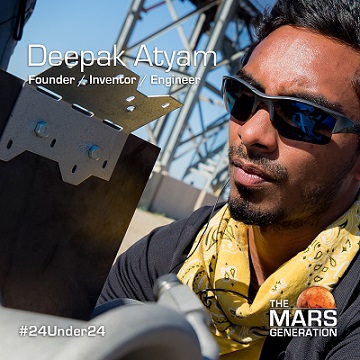
2. Deepak Atyam, Age 24, United States

Co-Founder and CEO of Tri-D Dynamics

24 Under 24 Leaders and Innovators in STEAM and Space winner

Through a startup company he co-founded called Tri-D Dynamics, Atyam works to produce low-cost liquid rocket engines. He’s had internships at multiple NASA centers, Moon Express’ Google Lunar X-prize team and SpaceX. In his undergraduate studies at the University of California, San Diego, he researched the feasibility of using 3D printing to innovate a new type class of NanoSat launcher rocket engines, and he founded a Students for the Exploration and Development of Space (SEDS) Chapter. At only 24, Atyam has already been recognized in multiple publications for his engineering, entrepreneurship and scholarship. He currently has six 5 patents pending with 1 patent granted.

Affiliations: UCSD Moxie Center for Entrepreneurship, Gordon Engineering Leadership Center, NASA, Moon Express, SpaceX, FIRST Lego League, University of California, at San Diego & Purdue University, Purdue Foundry
Field(s) of Interest: Technology, Engineering & Entrepreneurship, 3D Printing

3. Rebecca Baron, Age 17, Canada

Activist, Scientist & Founder of Because of Her

24 Under 24 Leaders and Innovators in STEAM and Space winnerNot many 17-year-olds can say they’ve crowdfunded more than $1 million to help promote literacy and girls’ education in developing countries. But Baron can, and that’s just one of her accomplishments so far in her young life. Baron delivers a popular TEDx Talk called “Conquering the Gender Gap in STEM,” and she has founded Because of Her, a nonprofit organization building a community to encourage and inspire female students to pursue STEAM-related fields. Baron’s an accomplished research scientist herself–you can find her part of a team at the University of British Columbia’s Life Sciences Institute. Before she’s reached adulthood, Baron has already been awarded a gold medal for her microbiome research focused on solutions to improve indoor air quality and toxin reductions.

Affiliations: Kitsilano Community Centre, Room to Read, Prince of Wales Mini School, University of British Columbia, & TEDx
Field(s) of Interest: Science, Global Activism & Gender Equality

4. Darren Charrier, Age 21, United States

Inventor, Engineer & Founder of Voyager Space Technologies, Inc.

24 Under 24 Leaders and Innovators in STEAM and Space winner

Charrier, 21, is building robotic spacecraft that will extend the life of satellites on-orbit through Voyager Space Technologies Inc., the company he founded. Before this most recent venture, Canadian entrepreneur Charrier served as president of his Students for the Exploration and Development of Space (SEDS) Chapter, growing a team of 20 students to more than 100. His SEDS Chapter secured NASA grant money to develop an open-source rocket engine test stand, and Charrier helped lead his Chapter to launch the Vulcan-1, the first collegiate rocket using liquid fuel from a 3D-printed engine. An inventor and brilliant engineer, this won’t be the last you’ll hear from Charrier.

Affiliations: University of California at San Diego, SpaceX, & Moon Express
Field(s) of Interest: Field(s) Space, Inventor, Engineer & Entrepreneurship

5. Joaquin Cortacans, 17, Uruguay

Public Outreach & Founder of Jóvenes Bajo la Lupa

24 Under 24 Leaders and Innovators in STEAM and Space winnerWhen 15-year-old Cortacans became the first Uruguayan to attend Space Camp through a scholarship, he couldn’t keep the knowledge to himself, and quickly became known as a STEAM and space advocate. Cortacans began giving talks on TV and radio, and he spoke to the Uruguayan Congress about increasing STEAM opportunities in his home country. Now 17, Cortacans has since started a nonprofit organization called Jóvenes Bajo la Lupa, which aims to raise awareness of the importance of science and to create a place for those who wanted to share their passion for STEAM.

Affiliations: ESO Astronomy Camp, Space Camp, Universidad Tecnológica del Uruguay (UTEC) & Interact
Field of Interest: Science

6. Bethany Downer, Age 23, Canada

Science Communicator, Public Outreach & Founder of Reaching Space Science

24 Under 24 Leaders and Innovators in STEAM and Space winnerDowner impressively marries her passions for space, wildlife and helping others into everything she does. For example, she helped reintroduce wood bison in Alaska for a wildlife conservation project, and she founded an international nonprofit called One Step Shoe Recycling, which keeps unwanted shoes to redistribute to people in need worldwide. Additionally, Downer has taken her education and done something important for the public: she founded ReachingSpaceScience.org, which explains workings of the space industry in a way that it can be understood and valued by all. Today, you can find Downer giving video and in-person talks to classrooms and adult lectures to educate about a variety of space-related topics, including solar evolution, planetary geology, black holes and dark matter.

Affiliations: European Space Agency, International Space University, Memorial University,  Space Generation Advisory Council
Field(s) of Interest: Science Communication, Conservation & Philanthropy

7. Paola Figueroa-Delgado, 22, Puerto Rico

Public Outreach & Founder of National Neuroscience Student Association

24 Under 24 Leaders and Innovators in STEAM and Space winnerGrowing up in a small rural Puerto Rico town has motivated Figueroa-Delgado to provide experiences and public outreach in STEAM fields to diverse students from underrepresented communities. Her outreach work began with a fellowship position at the Arecibo Observatory, where she served as a mentor to underrepresented pre-college students interested in pursuing a career in STEAM. During her undergraduate studies, Figueroa-Delgado founded the National Neuroscience Student Association, and she coordinated TEDxUPR, which shared scientific discoveries, insights and solutions with students all over Puerto Rico. Figueroa-Delgado is an NIH BP-ENDURE Research Fellow and was awarded an internship at Princeton University’s Department of Molecular Biology. Figueroa-Delgado volunteers in her community at animal shelters, refugee centers and at the Veterans Affairs Caribbean Health Care System.

Affiliations: Arecibo Observatory, Princeton, TEDx, NIH
Field(s) of Interest: Neuroscience, Molecular Biology & Health Care

8. Jacqueline Grundfast, Age 17, United States

Public Outreach & Founder Warwick Valley Central School District Astronomy Club

24 Under 24 Leaders and Innovators in STEAM and Space winnerGrundfast is taking her love of space and works hard to inspire her community to do the same. She established the Warwick Valley Central School District Astronomy Club, and she can be found judging STEAM Fairs in her district as well as teaching and mentoring young students in their research and science studies. This work inspired her to secure funding from her school district to build a robotic telescope for her community, promoting night sky exploration. In addition to doing a tremendous amount of outreach for her community, Grundfast still somehow finds time to be a high school student and a member of numerous national scholar societies. We’ll be hearing more about Grundfast!

Field(s) of Interest: Astronomy, Robotics

9. Pranvera Hyseni, Age 22, Kosovo

Public Outreach & Founder of Astronomy Outreach of Kosovo

24 Under 24 Leaders and Innovators in STEAM and Space winner

Hyseni, 22, is the Founder and Director of Astronomy Outreach of Kosovo. In this role, she provides invaluable telescope training to educators, STEAM resources to local schools and more. In fact, she was specially asked to develop an astronomical education program for the Ministry of Education of Kosovo, and is routinely asked to represent Kosovo at countless science conferences. With many exciting ventures in her future, Hyseni also recently had an asteroid named after her by the International Astronomical Union.

Affiliations: International Astronomical Union, Ministry of Education of Kosovo
Field(s) of Interest: Astronomy & Public Outreach

10. Roger Lascorz, Age 24, Catalonia

Public Outreach & Founder of Physics & Aerospace Are Awesome

24 Under 24 Leaders and Innovators in STEAM and Space winner

In pursuit of a space research program, Lascorz immigrated to the United States at a young age. Still only 24 years old, Lascorz already has an impressive academic resume, has published a paper with groundbreaking research on how to more efficiently extract hydrogen from water, has presented at many scientific conferences and has won numerous awards for his research. While a graduate student, he was a critical part of a major campaign promoting mental health on his campus. Today, Lascorz continues his public outreach through his organization called “Physics and Aerospace Are Awesome,” where people all over the world can discuss space and science. This resource has half a million followers worldwide!

Affiliations: Georgia Institute of Technology, University of West Georgia, Gamma Betta Phi, Aerospace Systems Design Lab, Experimental Aerodynamics Group
Field(s) of Interest: Aerospace Engineering & Physics

11. Kaitlyn Ludlam, Age 15, United States

Public Outreach & Founder of SWE Next at Fleming Island HS

24 Under 24 Leaders and Innovators in STEAM and Space winnerLudlam is an aspiring biomedical engineer who dreams of working for NASA as an astronaut. Not even old enough to drive, 15-year-old Ludlam is still highly active in her local community, spreading STEAM opportunities to students and doing public outreach to encourage women and girls to pursue STEAM careers. She is on three FIRST robotics teams, promotes the #FIRSTLikeAGirl movement through Renaissance Jax and much more. Ludlam makes time for her other interests in life aside from science by serving as a mentor for younger girls and volunteers in the American Sign Language community.

Affiliations: FIRST Robotics Competition, FIRST Tech Challenge & Society of Women Engineers
Field(s) of Interest: Engineering & Medicine

12. Tessa McEvoy, Age 17, United States

Science Communicator & Artist & Founder of Space Cadet Wannabe

24 Under 24 Leaders and Innovators in STEAM and Space winner

Some say creativity and STEAM are opposite worlds. That couldn’t be further from the truth for McEvoy, who uses her artistic talents and passion for science with the same pen stroke. By the time McEvoy was 11, she’d already launched her award-winning origami business, Outside the Box Origami and Gifts. For the past two years, McEvoy has worked hard to promote The Mars Generation, going out of her way to help generate excitement around space exploration through her illustrations, including a 23-page coloring book, “Color Me Mars Generation,” that she gifted to The Mars Generation. She’s also published an ongoing series about a “Space Cadet Wannabe,” creatively telling stories and adventures of a young girl with dreams to be an astronaut. Now 17, McEvoy continues to do what she loves, helping make science even more colorful.

Field(s) of Interest: Science Communications, Illustration & Animation

13. Katherine McKinney, Age 17, United States

Scientist & Founder of Kentucky STAR Center

24 under 24 leader and innovator in steam and space

McKinney, only a junior in high school, is in the process of publishing her first scientific paper, and in the future, she plans to study the effects of space on the human body. For now, she is an advisor for her home state of Kentucky’s STEAM collaborative and often speaks to groups and the media about the importance of student involvement in science. Noticing a lack of neuroscience research resources when she was 16, McKinney founded Kentucky STAR Center as a laboratory makerspace just for students. She is working as an intern for SpaceTango, and has been involved with more than 15 investigations that have been sent to the International Space Station.

Affiliations: NASA International Space Station, SpaceTango
Field(s) of Interest: Neuroscience & Medicine

14. Maanasa Mendu, Age 13, United States

Patent Pending Inventor & Scientist

24 Under 24 Leaders and Innovators in STEAM and Space winner

Mendu, 13, found herself curious and concerned about the problem of energy scarcity in developing countries, and she took this inspiration to the lab. She’s developed HARVEST (patent pending), an energy harvesting device that employs the Piezoelectric effect. The device takes advantage of unused ambient wind, sunlight and precipitation. Mendu is working on larger and more efficient iterations of this technology, and she just might dramatically shift how developing nations use energy all around the world.

Affiliations: Discovery Education 3M Young Scientist Challenge, Forbes 30 Under 30, Tedx
Field(s) of Interest: Science, Engineering & Entrepreneurship

15. Collin Mitchell, Age 18, United States

Robotics Mentor & Founding Member of FTC team #7187, Team Axis ITR

24 Under 24 Leaders and Innovators in STEAM and Space winner

Mitchell started mentoring and established his first robotics club at the age of 12. In high school, Mitchell continued, founding a FIRST Tech Challenge Team, #7187 Team Axis, which directly benefited 35 students. Although it was an admirable achievement, he didn’t stop there. He lobbied his school district to expand school-based robotics programs. Through his own robotics team, Mitchell was involved with community service initiatives with the Muscular Dystrophy Association, the American Cancer Society, and Helping Hands (building prosthetic hands for landmine amputees). Mitchell has done a lot of work recently mentoring other mentors, donating thousands of dollars with of new books and school supplies and packing more than six tons of food for the Oregon Food Bank. His team has built 11 prosthetic hands, and they’ve planned and conducted about 100 STEAM outreach events. Mitchell is busy making the world a better place through his passion for science!

Affiliations: FIRST Tech Challenge, University of California Santa Cruz & Helping Hands
Field(s) of Interest: Engineering & Robotics

16. Temidayo Oniosun, Age 22, Nigeria

Youth Mentor, Inventor & Founder of University Space Club

24 Under 24 Leaders and Innovators in STEAM and Space winner

Oniosun, a 22-year-old inventor from Nigeria, serves as the Regional Coordinator in Africa for the Space Generation Advisory Council. In his leadership role, he works to engage students and young professionals in the national and international levels of space policy creation. He’s made it his goal to involve himself in the space industry and create innovative applications for data collection to promote socio-economic development. Oniosun founded the University Space Club aimed at raising the next generation of Space Leaders – it is currently the largest space club in Africa. As a YouthMappers fellow, he works to create and use open-source software for geographic information, an invaluable tool for the US Agency for International Development.

Affiliations: SGAC, YouthMappers, FUTA, ISpatial Technologies
Field(s) of Interest: Science and Technology

17. Mylena Peixoto, Age 17, Brazil

Public Outreach & Founder of Mylena na NASA

24 Under 24 Leaders and Innovators in STEAM and Space winnerWhen Peixoto was 15, she discovered five new asteroids during an astronomy project she worked on with her physics teacher. Peixoto was always a hardworking person, but this impressive set of discoveries fully ignited her passion for science, exploration and pursuing her dreams. In 2016, Peixoto was invited to the United States to visit NASA and take a course at the National Radio Astronomy Observatory. Last year, she won the first scholarship offered by the International Journal of Science & Technology (IJST), where she studied at the Kennedy Space Center and was named an IJST ambassador. She is now studying engineering and will be pursuing her dream of becoming an astronaut. Peixoto has overcome immense adversity in her journey so far, and she continually proves to us that she has what it takes.

Affiliations: National Radio Astronomy Observatory,  International Journal of Science & Technology
Field(s) of Interest: Engineering & Astronomy

18. Olivia Scharfman, Age 20, United States

Public Outreach & Founder of thinkTANC

24 Under 24 Leaders and Innovators in STEAM and Space winnerScharfman, 20, serves as the Chair of the Board of Directors for the Students for the Exploration and Development of Space. As part of the largest and oldest student-run space advocacy organization, Scharfman is a role model for the next generation of scientists and spacefarers. She’s also a professional actor, starring in Broadway and Off-Broadway productions! Scharfman is now studying astrophysics and theater at Yale, and she founded thinkTANC, creating a way for her to continue her neurobiology research (on top of everything else!). Scharfman’s next goal is to obtain her pilot’s license to increase her eligibility to become an astronaut.

Affiliations: Students for the Exploration & Development of Space, Yale University, Actor’s Equity & Caltech Flying Club
Field(s) of Interest: Astrophysics & Theater

19. Julie Sage, Age 13, United States

Public Outreach, Mentor & Founder of Supernova Style Science News

24 Under 24 Leaders and Innovators in STEAM and Space winner

Sage knew when she was six years old that she wanted to be an astrophysicist, inspired by Stephen Hawking, and she has wasted no time beginning to work for that goal. She’s participated in amateur telescope-making, has learned to code, shown coding demonstrations at her middle school and is doing public outreach through her YouTube channel, “Supernova Style Science News.” Sage is a member of the Clay Center Amateur Radio Club, which send two experiments on a NASA sounding rocket and four experiments on a high-altitude balloon funded by idoodleLearning. Her dream job is to study black holes, and if she’s already working this hard when she’s 13, there’s no limit to what she will do!

Affiliations: Girls Who Code, Cubes in Space, Clay Center Amateur Radio Club
Field(s) of Interest: Science, Mathematics & Coding

20. Krittanon Pond Sirorattanakul, Age 22, Thailand

24 Under 24 Leaders and Innovators in STEAM and Space winnerSirorattanakul is one of the specially selected recipients of the Royal Thai Scholarship to study at United States universities. That level of honor is not surprising with a young person’s caliber as that of Sirorattanakul. The 22-year-old has quite the resume. One research project of his resulted in a discovery of a significant change in a Cepheid variable stars pulsation period, published in The Astronomical Journal. He received a Lee Teng Fellowship in Accelerator Science and Engineering to intern at the Fermi National Accelerator Laboratory and attend the U.S. Particle School. Among many other achievements, with a NASA-funded grant, Sirorattanakul developed “Science on a Sphere,” an educational program for middle school students to excite kids about the interconnectedness of earth systems. Sirorattanakul is continuing to work toward his goal of returning to Thailand as a research professor to educate the public about earthquakes, their risks and associated hazard mitigation.

Affiliations: Lehigh University, The Astronomical Journal, Nurture Nature Center
Field(s) of Interest: Physics, Earth Science & Seismology Studies

21. Lisa Stojanovski, Age 24, Australia

Science Communicator

24 Under 24 Leaders and Innovators in STEAM and Space winnerStojanovski works in New Zealand for Rocket Lab, a small-sat launch provider, and she’s a host on TMRO, a live web show about humanity’s exploration of the cosmos. Her thesis in graduate school at International Space University focused on “Atmospheric Requirements for a Martian Greenhouse,” which was presented as part of the 2016 International Astronautical Congress. If that doesn’t speak well enough to her leadership in space research and communication, Stojanovski has also served as the Regional Point of Contact for the Space Generation Advisory Council. Stojanovski was invited to share her skills as a scientist and communicator in order to help develop the Australian Space Agency.

Affiliations: International Space University, TMRO, Shell Questacon Science Circus, Rocket Lab, Space Generation Advisory Council
Field(s) of Interest: Science Communications, Molecular Biology & Biochemistry

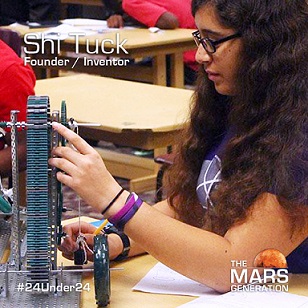
22. Shi Tuck, Age 19, United States

Inventor & Founder, Ben Davis HS Astronomy Club

24 Under 24 Leaders and Innovators in STEAM and Space winnerTuck, 19, has made it her mission to share her love for STEAM and space with women and minority communities. Starting in high school, she founded and Astronomy Club and hosted a two-day “Space Day” event for more than 1,000 elementary students and raised enough funds to purchase and donate 300 science textbooks for elementary schools in her district. Her work today includes CubeSat design, Martian rovers and research with the Laser Interferometer Gravitational-wave Observatory. Upon graduation from Stanford University, Tuck plans to work as an Electrical Engineer in the aerospace industry and continue her volunteer work in disenfranchised communities, serving as a mentor to future STEAM students.

Affiliations: Wright Patterson AFRL, Stanford University
Field(s) of Interest: Engineering & Astronomy

23. Allie Weber, Age 12, United States

Patent Pending Inventor & Science Communicator

24 Under 24 Leaders and Innovators in STEAM and Space winner

With a passion for learning and a knack for inventing, 12-year-old Weber contributes to STEAM education through a robust social media presence and her YouTube channel, “Tech-nic-Allie Speaking.” She uses these channels to share about science projects and to promote ways for other students to get involved themselves. Beginning her inventing career early, Weber developed an internal glove system called “Frost Stopper” (patent pending) that monitors cold temperatures and alerts wearers to avoid frostbite. Weber has goals for earning a doctorate degree in engineering or business to pursue her entrepreneurial passion for starting a company around her own innovations.

Affiliations: Discovery Education 3M Young Scientist Challenge, FIRST Lego League, Makers Faire
Field(s) of Interest: Technology, Engineering & Science Communications

24. Melissa Vazquez-Hornik, 24, United States

Scientist

24 Under 24 Leaders and Innovators in STEAM and Space winnerImagine being assigned to a team to get to Mars, and then being told to live and work with this small group of people constantly for three years or more. Vazquez-Hornik’s research is devoted to studying psychological factors associated with teams and long-duration missions and how we can help teams stay functional under such intense pressures. Her current research involves an international effort between U.S. and Russian space agencies with the Institute of Biomedical Problems to examine interpersonal perceptions and traits when it comes to managing space crews in isolated and confined environments. Vazquez-Hornik is making enormous advances to an understated part of space exploration. In addition to her research, Vazquez-Hornik volunteers with the Jewish United Fund, Chicago Lights Tutoring and serves as a director for the Hornik Family Foundation to support communities in need.

Affiliations: University of Central Florida, DePaul University, Illinois Space Grant Consortium
Field of Interest: Science & Psychology

Press Release: The Mars Generation Announces Winners of the 2018 24 Under 24 Leaders and Innovators in STEAM and Space Awards

Atalay 24 under 24 leader innovator STEAM space

Around the world, young people are accomplishing amazing things in the fields of science, technology, engineering, arts, and math (STEAM). The Mars Generation is proud to announce its first 24 Under 24 Leaders and Innovators in STEAM and Space Award winners.

Tuck 24 under 24 leader innovator STEAM space“The young individuals recognized with the 24 Under 24 have demonstrated innovation and tenacity that will drive us toward a brighter future in scientific enterprise,” said Abigail Harrison, founder of The Mars Generation (TMG).

“We are honored to be joined by our esteemed sponsors Aerojet Rocketdyne and United Launch Alliance (ULA) in presenting the 2018 awards,” said Harrison. She said having two leaders in the industry play an important role in announcing the award was a testimony to the companies’ commitment to advancing STEAM.

“We are glad to partner with The Mars Generation for these awards,” said Tory Bruno, CEO of United Launch Alliance and TMG Advisory Board member. “Together, we continue to foster enthusiastic young minds. Sponsoring the next generation of space explorers and youth interested in STEAM benefits nearly every industry.”

Atyam 24 under 24 leader innovator STEAM spaceThe number of submissions for a first-time award was impressive, explained Harrison. Having sponsors like Aerojet Rocketdyne and ULA elevated the visibility for nominations.

Julie VanKleeck, Vice President of Advanced Space and Launch Programs and Strategy at Aerojet Rocketdyne and also a TMG Advisory Board member, said the company was excited to support the 24 Under 24 Award: “As we work on projects that enhance our understanding of space, it’s important to inspire the upcoming generation to go even further.”

“While these students all have a passion for STEAM and/or space, it is their ability to set their passion in motion at such a young age that has earned them a place in our 2018 class,” said Harrison.

The 2018 winners of the 24 Under 24 Leaders and Innovators in STEAM and Space Awards:

To learn more about the accomplishments of each winner please click here.

  1. Canda Atalay, 17, (Turkey)
  2. Deepak Atyam, 24 (United States)
  3. Rebecca Baron, 17 (Canada)
  4. Darren Charrier, 21 (Canada)
  5. Joaquin Cortacans, 17 (Uruguay)
  6. Bethany Downer, 23 (Canada)
  7. Paola Figueroa-Delgado, 22 (Puerto Rico)
  8. Jacqueline Grundfast, 17 (United States)
  9. Pranvera Hyseni, 22 (Kosovo)
  10. Roger Lascorz, 24 (Catalonia)
  11. Kaitlyn Ludlam, 15 (United States)
  12. Tessa McEvoy, 17 (United States)
  13. Katherine McKinney, 17 (United States)
  14. Maanasa Mendu, 13 (United States)
  15. Collin Mitchell, 18 (United States)
  16. Temidayo Oniosun, 22 (Nigeria)
  17. Mylena Peixoto, 17 (Brazil)
  18. Olivia Scharfman, 20 (United States)
  19. Julie Sage, 13 (United States)
  20. Krittanon Pond Sirorattanakul, 22 (Thailand)
  21. Lisa Stojanovski, 24 (Australia)
  22. Shi Tuck, 19 (United States)
  23. Allie Weber, 12 (United States)
  24. Melissa Vazquez-Hornik, 24 (United States)

About The Mars Generation
The Mars Generation is a volunteer-driven 501(c)(3) nonprofit with an advisory board that includes astronauts, engineers, scientists and professionals from the nonprofit and business communities. With an estimated reach of more than 25 million people since 2015 and a social media following of more than 1.1 million people the organization has served more than 10,200 students and adults from around the world through multiple programs including the Student Space Ambassador Program, Future of Space Outreach Program and Space Camp Scholarship Program. TMG is supported by over 450 donors, 1,100 members, and leading space industry sponsors. Through an innovative approach of leveraging new media technology and providing engaging content and programs the organization aims to excite and educate students and adults about the importance of human space exploration and STEAM education to the future of humankind.

About Aerojet Rocketdyne
Aerojet Rocketdyne is an innovative company delivering solutions that create value for its customers in the aerospace and defense markets. The company is a world-recognized aerospace and defense leader that provides propulsion and energetics to the space, missile defense and strategic systems, tactical systems and armaments areas, in support of domestic and international markets. Additional information about Aerojet Rocketdyne can be obtained by visiting www.Rocket.com and www.AerojetRocketdyne.com.

About United Launch Alliance
With more than a century of combined heritage, United Launch Alliance is the nation’s most experienced and reliable launch service provider. ULA has successfully delivered more than 120 satellites to orbit that aid meteorologists in tracking severe weather, unlock the mysteries of our solar system, provide critical capabilities for troops in the field and enable personal device-based GPS navigation.

For more information on The Mars Generation go to: TheMarsGeneration.org

Yvonne Hundshamer
The Mars Generation
612-670-0337
groundsupport@themarsgeneration.org

Can astronauts experience motion sickness in space? | #AskAbby Space and Science Show

We are excited to announce the release of our new weekly series called the #AskAbby Space and Science Show! Our founder and president Astronaut Abby will be appearing each Tuesday, answering questions submitted by you, our community!

Want to ask Astronaut Abby a space and or science question? Please go here to submit the question for future shows!

In the very first episode of #AskAbby, please join Astronaut Abby as she answers the question, “Can astronauts motion sickness in space?” Find out everything you ever wanted to know about space motion syndrome (SAS) and much more now by watching the very first ever #AskAbby Space and Science Show!

Includes answers to questions such as: What is space motion sickness? How does NASA handle space motion sickness? Can you predict if a person will experience space motion sickness before going to space? How long does space motion sickness last? Why do astronauts experience space motion sickness? What other changes does the human body go through in space? And many more questions answered! Also some Star Trek humor and other space puns included…of course! And it wouldn’t be complete without a Uranus joke!

Tune in weekly on Tuesdays for new releases of The Space and Science Show #AskAbby series! To submit a question to #AskAbby go to: http://bit.ly/2DfPz7b


Transcript


ABBY
Welcome to #AskAbby, where I’ll be answering all of your questions about space and science. This is a new segment of The Mars Generation Space and Science Show. We’ll be coming out with episodes every Tuesday so make sure that you go ahead and hit subscribe so you don’t miss out on them.

Do you have an out-of-this-world question that you want to see answered here on #AskAbby? You can go ahead and submit it on Twitter using the hashtag #AskAbby or using the link below for TheMarsGeneration.org.

So this week’s question and the first question ever answered on #AskAbby is from Kerry Lynne who goes by @KerryChamplin on Twitter, and they asked, “Can you get motion sick while in space?” Now, motion sickness here on Earth isn’t actually that bad. When you get sick, whether it’s from being in a car or riding on a roller coaster, usually it lasts for a couple of minutes, maybe an hour if you’re unlucky. However, when you’re in space, you’re up there for months at a time whether you’re staying on the International Space Station, traveling to the moon, or even to Mars. I don’t think anyone wants to have motion sickness for that long. Can you imagine being motion sick for months on end? I can’t. However, let’s go ahead and take a look at what this would mean for astronauts.

In space, you don’t necessarily get the same type of motion sickness that you would expect to get here on Earth. You get something called “Space Motion Sickness!”

EMILY
Oh my gosh, Abby.

ABBY
[Laughing] What, Emily? Everything’s cooler when you put the word “space” before it. Right, guys? I think you agree with me.

SAS is caused by the changes in g-forces between being in Earth and in space that force your body’s vestibular system to adapt.

EMILY
Wait, Abby. What’s the vestibular system?

ABBY
Emily, I’m an astrobiologist not a doctor, dam**t! [Laughing]

EMILY
Abby, is that a Star Trek quote?

ABBY
[Nods]

The vestibular system which is in part located within your inner ear is the way that your body tells the spatial orientation it has and helps you keep your balance, things that are pretty important.

Sass is pretty– [Laughing]

EMILY
S. A. S.

ABBY
I just can’t even handle this acronym. Okay. So, S.A.S.–

EMILY
Action.

ABBY
SAS comes in varying levels of suckiness basically, ranging from really sucking with intense discomfort – vomiting, lack of appetite, fatigue, all of those terrible things – to very mild. Maybe a little bit of nausea or a headache or little bit of disorientation. Here’s the thing about vomiting in space though, is that: it floats. So, any level of SAS sounds like it would be terrible to experience.

So, if SAS is so awful, how do astronauts go about dealing with it for months on end? The answer is that they don’t. Space Adaptation Syndrome symptoms usually only present themselves for about two to four days at the beginning of an astronaut’s time in space.

If an astronaut experiences SAS to a high level, it can be detrimental to their mission and dangerous to themselves and their crewmates. However, as long as it’s not affecting their work, NASA usually just tells astronauts to suck it up. NASA actually prefers that astronauts handle SAS on their own without taking medication, because medications themselves can cause a lot of other undesirable side effects such as dizziness, fainting, all kinds of things. And even more so, we don’t quite understand yet how every medication will work in space. Unless an astronaut is experiencing severe symptoms of SAS, NASA generally does not medicate them.

So, how would an aspiring astronaut know if they’re gonna get SAS? Well, actually, there’s no way to tell. There’s no formal test as of now that can define whether or not someone is going to get SAS when they go into space. And it’s not even correlated as to whether or not you get motion sickness here on Earth. Astronauts who get motion sickness from everything to trains to planes to cars here on Earth have experienced very little to no effect of SAS in space and vice versa.

The most prominent example of Space Adaptation Syndrome was in 1985 when Senator Jake Garn flew in space. He became so violently ill that he actually went down in history for it. NASA created the unofficial “Garn Scale” which is a measurement of how sick you can get in space. It ranges from zero to one with one being the absolute most sick that anyone will ever get in space. Most astronauts average around a 0.1 on the Garn Scale whereas Jake Garn – he was a full one. Sounds terrible. Really, I feel for the guy.

Next time you go to the doctor, you might want to try saying, “Hey Doc, I’m feeling a full half Garn today.” They’ll have no idea what you’re saying, but it could be fun.

So, if you’re going to space, it’s pretty likely that you’re going to experience Space Adaptation Syndrome, and, really, nothing to be concerned about.

Quickly, while we’re on the topic though, what other important changes happen to the human body in space? Well, you’ve got:

  • Muscle atrophy
  • Osteoporosis
  • Nasal congestion
  • Loss of vision
  • Phantom limb and
  • Excess flatulence…

…which happens the most when you’re orbiting around Uranus [Laughing].

EMILY
So done.

ABBY
And they let me speak in classrooms.

If you’d like to ask a question about space or science and potentially see it answered here on #AskAbby, you can do so using the hashtag #AskAbby on Twitter or through TheMarsGeneration.org website which is linked below. Until then, make sure that you hit the subscribe button on YouTube so you can see our new episodes which will come out every week on Tuesdays.

Until next week, farewell fellow travelers of spaceship Earth.

The Mars Generation’s Post-Mission Interview with HI-SEAS Crew Members 2017 [VIDEO]

HI-SEAS Mars Analogue Mission

The crew of the HI-SEAS Mars Analogue Mission

The Mars Generation had the opportunity to conduct an exclusive interview with crew members from the HI-SEAS Mars Analog Mission during their mission that ran from January 19th to September 17th, 2017. Our blog editor and writer, Becca Browder, conducted an interview with the crew that included questions submitted by The Mars Generation members, a perk offered to members only.

The Hawai’i Space Exploration and Analog Simulation (HI-SEAS) project is a NASA-funded research program operated by the University of Hawai’i. During the simulation, crew members lived in isolation for a long-duration mission with conditions simulating those of an actual mission to Mars. The crew experienced a simulated 20-minute communications delay, lived in the 1,200-square-foot habitat, and went outside only while wearing mock spacesuits. Led by UH Mānoa professor Kim Binsted, the mission’s purpose was to study crew selection and the effects of long-term isolation on teams.

Four crews have previously completed missions at the site on Mauna Loa in Hawai’i, and now the six crew members of Mission V have finished their eight-month mission. During their mission we solicited questions from our members and selected the best questions to include in the interview. The crew gathered together to answer the questions as a group during their mission.

Watch all 4 segments of the interview below to see what it’s like to live on “Mars”!

HI-SEAS Mars Simulation 2017 | Interview Part 1 | The Space & Science Show by The Mars Generation

HI-SEAS Mars Simulation 2017 | Interview Part 2 | The Space & Science Show by The Mars Generation

HI-SEAS Mars Simulation 2017 | Interview Part 3 | The Space & Science Show by The Mars Generation

HI-SEAS Mars Simulation 2017 | Interview Part 4 | The Space & Science Show by The Mars Generation

Don’t forget to follow The Mars Generation on Twitter, Facebook, and Instagram, and sign up for our email updates today!

Five Study Tips To Be A Better Student: Student Space Ambassadors

Student Studying TipsAs part of The Mars Generation’s mission, we work to educate and inspire the next generation to Dream Big! Act Big! And Inspire Others! Through our FREE Student Space Ambassador Leadership Program (SSA), we offer ongoing mentorship and guidance.

We are excited to announce that our SSA resource committee is working on new materials to grow our library of resources for students.  Thanks to SSA Advisory Board member Jake Voorhees we have a new YouTube video to share on Study Tips. These resources are meant to support students as they work hard in school to make their dreams come true.

https://www.facebook.com/themarsgeneration/videos/876174435880556/

Five Study Tips To Be A Better Student

This time of year, students need a study boost. It’s hard to keep grinding and to put in the long hours needed to ensure you get great grades so that you can follow your career dreams.

What if it didn’t need to be this way? What if there were a few things you could do to 10x your study power? Well, good thing you found this blog post!

Here you will find five tips for studying better this fall!

  1. Prepare for Class

Setting yourself up for studying success starts way before the exam – way before you actually sit down to study. If you step into class and have no idea what that day’s lecture will be about, you will be scribbling down notes and unable to truly pay attention. Review the notes the night before. Come to class prepared to have things more thoroughly explained, to be ready to ask questions, and to engage in active learning rather than passive note scribbling!

  1. Take Good Notes

This suggestion pairs well with class prep. You have to maximize your time in class to create the best resource for yourself that you possibly can. This will empower your study potential when it finally is time to prep for an exam. The best note-taking advice comes from a Cornell professor, Dr. Pauk. This method divides your page into three sections for optimum note-taking: a primary notes section, a bulleted area on the left side, and a summary at the bottom of your page.

  1. Form Good Habits

Habits are powerful. Habits drive our lives. We are not born nor anchored with good or bad habits – we form these over time. This is what you need to do in your life, and not with just studying. If you get into a routine of only rewarding yourself when you achieve study goals, you will fall into a positive feedback loop. If you get into a routine of studying in the morning when you have the most energy / brainpower / willpower, you will be more successful. It’s hard at first, but once you repeat these routines for a few weeks, they can become lifetime habits!

  1. The Pomodoro Technique

Now for some study tactics. That’s what students want after all: “How can I study better?” Research shows we can only hold our attention for 20-25 minutes before requiring a quick break. This is exactly the Pomodoro Technique. Put your phone in airplane mode or grab a kitchen timer, remove ALL distractions from your area, and participate in focused studying for 25 minutes. Then take a five-minute break, and repeat. Do this four times for an awesome two-hour study experience! After two hours, take a more extended 20-30 minute break. Go for a walk or read a book.

  1. Spaced Repetition

This advice will make you start studying sooner. Research also shows that we retain information much better if we space out that information, learn it, forget it, relearn it, and so on. If this approach is conducted, you actually have to invest LESS time overall into studying. So when it comes time to study for finals this semester, don’t wait. Start early. Start 3-4 weeks early and review just 15-30 minutes. Each week, study more and more – accelerate your studying. By the time you reach the exam, that A will be easy!

If you’d like a more detailed explanation, check out the video embedded above. If you’re not an official Student Space Ambassador, we’d love to have you!

The Mars Generation℠ Student Space Ambassador Leadership Program (SSA) is a FREE leadership program designed to provide guidance to teens and young adults excited to share their love of space with their community. Students ages 13-24 may sign up to participate in the program, and parents and teachers are invited to sign up to use the resources. Students under the age of 13 may sign up with a parent and/or guardian.

To sign up to be a Student Space Ambassador please click here.

Going to Mars, Part 3A: Orion, The Next Generation of Travel

We are so lucky to have Ross Wakefield join us as a guest writer.

Please visit our “Get Involved” page to learn more about how you can volunteer and/or join The Mars Generation. Let’s go to Mars!

*** Please note guest submissions are options of the author and do not necessarily reflect the mission or beliefs or The Mars Generation.

Orion Spacecraft in Orbit

Photo: NASA

Introduction

It has been almost 50 years since the last time mankind truly escaped the bounds of Earth orbit and ventured out to the last destination reached beyond that point – the Moon. This was accomplished during successful landing and return of Apollo 17 to and from the Moon in 1972. That journey, made by three U.S. astronauts, represents the final time both man and machine were tested by the rigors of spaceflight beyond where Earth’s own gravity was the dominant force.

In the near five decades since, massive advancements have been made in the fields of space exploration – in terms of both the technology used to explore it, and the ways the human body and mind are being trained to prepare for it. These advancements have been so profound, so radical, that when the time came for plans to be made for mankind to make that journey beyond Earth once again, the planning called for something rather different from the amalgamation of aluminium and plastic that made up the command and lunar modules of Apollo 17.

This was to be a 21st century craft for 21st century flight – a craft capable of sending up to six travelers to the Moon…and possibly, one day, to Mars. And based on that singular vision, what has arisen is what NASA believes to be the next stage in human space exploration.

The Orion Multi-Purpose Crew Vehicle, better known simply as the Orion. A craft capable of sending mankind to Mars and returning, again and again.

But…how exactly is such a craft prepared to deal with the rigors of a spaceflight so much longer and further than any before in human history?

An earlier article spoke of the training the human body and mind has to receive for such an undertaking. This one, the first of two covering the Orion craft, shall continue that discussion. We will establish the history of how such a craft came about, outline the preparation the machine, like its human controllers, must undergo before the mission can go ahead, and describe how every part of the craft is conditioned for survival and optimal performance in the most exacting of environments over a long period of time.

Before looking at how the Orion module is set up to get to Mars, we will take a look at its history, which will cover the first key areas. The other areas will be covered in later articles.

History: How Orion Came To Be

History is littered with plans for spacecraft designed to go to Earth orbit and beyond. However, many never made it past the planning stage, due either to lack of feasibility, money, or often both. One example is the ambitious Mars Design Reference Mission conceived by NASA in the 1980s, or the Soviet Heavy Interplanetary Spacecraft design of the 1970s. However, it was reasonably clear from the start that Orion was not to be one of these – it was thought of at a time where the desire for a new kind of spacecraft was paired with the political will to make it happen.

For the longest time, NASA had been looking for a capable vehicle to replace the aging Space Shuttle fleet, especially in the aftermath of the dreadful loss of the astronauts and the shuttle Columbia in 2003. It was decided that the new craft was to be one that would fit as many requirements as possible – to be as capable of going into orbit and resupplying the International Space Station in the fashion of the Shuttle as it would be capable of returning to the Moon…or further afield.

To this end, the Orion was conceived as part of the Constellation Program put into motion by President G.W. Bush, and was shortly announced thereafter in 2004. It would be designed to fulfill both crew and cargo lift requirements to the ISS, as well as be capable of taking a crew of up to six beyond Earth orbit and return them safely. This would be coupled with a new generation of heavy lift rockets capable of sending it into orbit and beyond.

However, in 2010 a government inspection found the Constellation Program to be underfunded, behind schedule, and lacking in several key areas of development. As a result of this, almost all of the project was scrapped, including the heavy lifters…but the Orion survived the cuts, instead being re-conceived as the Orion Multi-Purpose Crew Vehicle. It would no longer use a specifically designed rocket, but instead would rely on the existing Delta IV Heavy rockets used by NASA, but the purpose remains the same as it ever had been – to follow in the steps of the Apollo missions and go even further.

Orion to Mars

Overview

Though modern technology may have changed a great deal from the heady days of the Apollo Program, some key design aspects of Orion would remain much the same – the basic composition, a crew module being attached to a command module, and the shape of the crew module itself. Re-entry dynamics being very much unchanging, the pioneers of the Apollo Program had the ablative flat surface for re-entry into Earth’s atmosphere pretty much down-pat half a century ago. In light of that, a general shape rather similar to the Apollo module was called for.

However, that is where the similarities end.

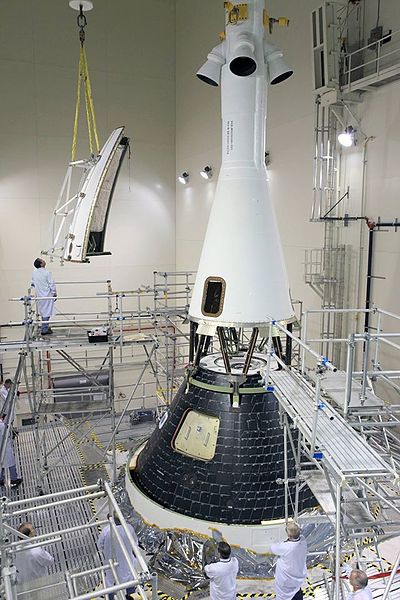
Orion Spacecraft construction

Photo: NASA

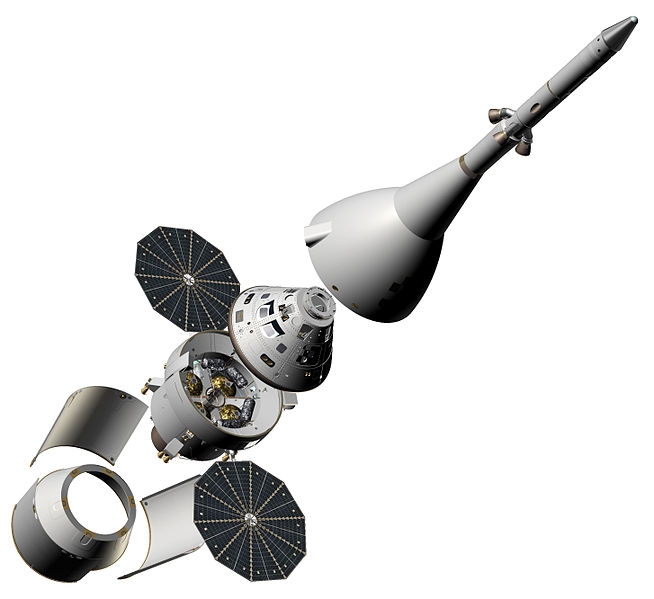
The Orion crew module is designed to be bigger in terms of volume and mass than the Apollo equivalent – two and a half times the volume and around one and a half times the mass. This increase is offset some by the attached service module which contains essential equipment and more that is much lighter than its Apollo equivalent. This increase in volume means much more room for the apparatus needed to support the crew, which boosts the capacity from the Apollo-era three to a possible six member crew in the module.

Other improvements in the name of modern technology include a digital control system similar to the “glass cockpit” systems on the most modern airliners, a system designed to achieve docking with another spacecraft automatically rather than manually (a first for a U.S. spacecraft), vastly improved computer systems, and, possibly the most significant development, heat shield ablation technology designed to not only achieve a safe re-entry, but to make the module entirely reusable after more than one journey back to Earth. Such an advancement will save vast amounts of time and money in the future. To allow for further developments in technology over the next couple of decades, the components of the Orion are also designed to be as generic and as adaptable as possible for new parts to be integrated into the module once they are developed.

All in all, the Orion is designed to combine the vehicle style and shape of the Apollo-era command module with the very latest in technology to carry it to the Moon and Mars – and safely back again.

However, it might now be asked…what about the specific systems? What exactly makes them capable of taking the long trip to Mars and back – possibly multiple times – safely and successfully?

Keeping Them Alive – Life Support

The core of the Orion is the crew module. And the core element of the crew module is, of course, the system designed to keep crew members alive and healthy through a journey that could last a matter of years before completion. Of course, the basic requirements for such a system – maintaining food, oxygen and potable water, eliminating waste, and preventing possible hazards to the life of the crew – have been the same ever since the very first human missions into space, but the advancements of technology in that time have made it easier to meet such requirements and lower the risks associated with spaceflight.

The basic life support requirements for the Orion are eightfold, but can be summed up as being able to support a full crew (either four or six) in a “shirtsleeve” – that is to say no spacesuits – environment for a full Lunar or ISS mission. Furthermore, it must be able to operate for six months in an inactive mode either attached to the ISS or in Lunar orbit, tolerate failure of more than one essential system, and satisfy the various dimension and mass limits that were part of the Orion design.

With all of that in mind, the Orion crew module life support system meets these needs and uses new, modern technologies to do so, some of which include:

Orion Spacecraft Construction

Photo: NASA

  • advanced carbon filters that recycle the air that astronauts would need (and, yes, no square scrubbers in round holes this time)
  • a Halon gas fire extinguisher system as well as hand-held fire extinguishers for the crew
  • a comprehensive temperature control that is both active (can be controlled by the crew) and passive (happens all the time regardless of crew involvement)
  • waste and water management systems that eliminate potentially harmful waste while recycling where they can

All of this accounted for, the Orion is perfectly capable of taking a crew of six to the ISS or a crew of four to the Moon.

But what about Mars?

Though the Orion crew module is capable of supporting astronauts for a reasonable amount of time, the lack of space for food and other supplies mean that more room is needed should it be required to take on the many-years venture of a Mars mission. To that end, a Deep Space Habitat (DSH) covering exercise, training, recreation, and supply space is envisioned, which will be covered in greater detail in the future.

Gotta Be Tough – Structure

As has been covered in previous articles, the rigors of spaceflight place as much stress on machine as they do to man. From the initial g-forces of liftoff to the various heat and gravitational stresses that happen upon re-entry, every aspect is designed to test the limitations of the technology placed up there…with the penalty for failure being severe. And with spacecraft, the first point of possible failure is the outside structure of the vehicle itself.

So, having considered this, the outer hull of the Orion has to be designed to resist everything that launch, a long period of spaceflight, and the rigors of not one but multiple re-entries can throw at it – and more. And as was mentioned earlier, though the general shape of the crew module hasn’t changed since the days of the very first human spaceflight – re-entry dynamics haven’t either, after all – the materials used to build and coat it have.

Firstly, the Orion crew module is fitted with possibly the most comprehensive abort system ever designed for a human spacecraft. Should a failure happen on the launchpad or ascent that might endanger the lives of the astronauts involved (and tragically both of these things have happened in U.S. missions in the past), then the abort system would fire, throwing the capsule and its occupants away from the failure and to a safe landing with immediate effect.

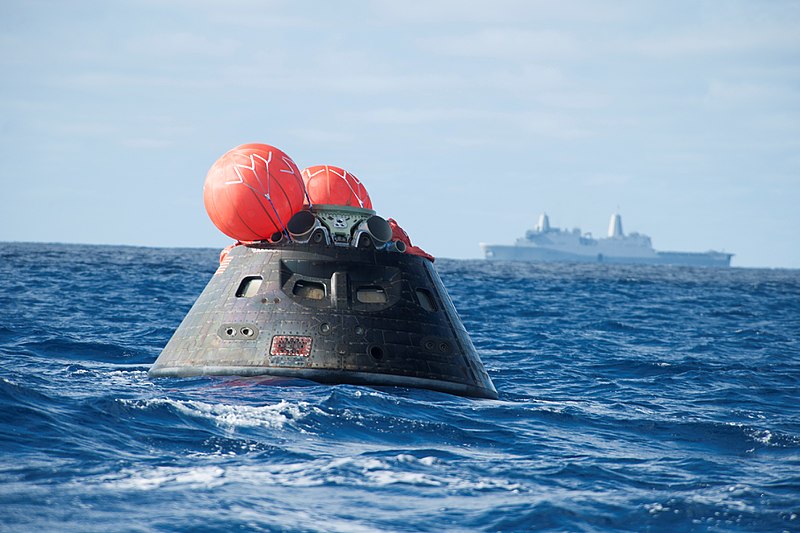
Orion Landing in Water

Photo: US Navy

Once in space, the capsule defends against the various rigors of spaceflight in a variety of ways. The structure is designed to defend against micro-meteor strikes, which on any long mission would become a significant hazard. The capsule also utilizes a form of welding named friction-stir welding (FSW) in its construction, which vastly reduces the possibility of leaks in the structure, and strengthens the hull while reducing its overall weight – always a plus in space operations.

Finally, for re-entry, the module has been fitted with the Avcoat ablator system – a system that shows the advantages of revisiting the old days, seeing as a similar system was used to outfit the Apollo crew modules. Facing the extreme conditions of temperatures of over 5,000 degrees Fahrenheit, the Avcoat material heat shield, made from a combination of silica fibres, epoxy resin and fibreglass, is fitted directly to the bottom of the crew module. When returning from the ISS or the Moon or even from Mars, the ablator will absorb all of the friction heat buildup caused by the spacecraft coming into the atmosphere at several thousand meters per second, directing it away from any weaker parts of the structure. Additionally, the ablator is designed so that upon recovery of the module, it can be detached from the crew module and a new one put in place – thus making the module reusable as many times as is deemed safe. This will be a great help both in terms of time between launches to prepare, and the overall costs of the missions themselves.

A long time in space provides an exacting test for both man and machine. With the measures put in place described here, the structure of the Orion demonstrates – as it did during its first test flight in 2014 – that it is as up to the task as its occupants will be.

Conclusion

Since its inception, the Orion has been, through a combination of some old reliable technology and most cutting edge new technology, NASA’s vision of a spacecraft that can go forth far into the 21st century. It will be all things for all occasions, as comfortable on a cargo run to the ISS as touching down on the Martian surface. In this article, the history and a few of the systems of this remarkable vehicle were covered, and in the next, the remainder will be detailed, giving a better idea of what makes this spacecraft truly special. And it will reveal that why, in come a couple of decades time, this craft could indeed be taking people to one of our nearest planetary neighbors for the very first time.

More from Ross:

The Road To Mars: Our Past and Our Future

Going To Mars, Part 1: The Human Element

Going To Mars, Part 2: The Curiosity Rover, A Martian Marvel

Ross WakefieldRoss Wakefield is a freelance science writer, communicator and consultant, with specialized expertise in the field of current and historical space developments. Ross has a Bachelors degree in Physics with Astrophysics from the University of Leicester and a CMCU in Astronautics and Space Engineering from Cranfield University and is a member of the Institute of Physics and British Mensa. Ross is currently beginning a series of articles with The Mars Generation on various space-related topics. When he’s not glued to a computer screen, he enjoys playing and watching sport, reading various books and trying to find where the nearest good pool table is in the United States. Find Ross on his Twitter.


Press Release: Aerojet Rocketdyne Executive Joins the Advisory Board for The Mars Generation Nonprofit

Julie Van Kleeck - TMG new Advisory Board Member

Julie Van Kleeck

MINNEAPOLIS, MINNESOTA, UNITED STATES, November 7, 2017 / — Julie Van Kleeck, Aerojet Rocketdyne’s Vice President of the Advanced Space and Launch Business Unit, will be joining The Mars Generation (TMG) as a member of the advisory board. In support of a common mission to promote the next generation’s progress in space exploration, Van Kleeck will apply her background in leadership and space development to guide board objectives and advocate for the non-profit organization as an advisory board member.

Van Kleeck has been instrumental in the development of leading-edge rocket propulsion technology and products – many of which are in production today at Aerojet Rocketdyne. She has received numerous technical awards from Aerojet Rocketdyne and other outside organizations. In addition to being active in Aerojet Rocketdyne’s outreach and advocacy efforts for STEM and Women in Aerospace programs, she’s responsible for the company’s Advanced Space Products strategy, technology development and product development efforts.

“I am excited to work with an organization that creates and promotes opportunities for young people all around the world to explore their interests in space and beyond.” – Julie Van Kleeck

“I look forward to serving on The Mars Generation’s advisory board,” said Van Kleeck of her new position. “In addition to developing products that enhance our understanding of space, it’s just as important to inspire the upcoming generation to go even further. I am excited to work with an organization that creates and promotes opportunities for young people all around the world to explore their interests in space and beyond.”

The Mars Generation operates several core programs including the Future of Space Outreach Program, the Space Camp Scholarship Program and the Student Space Ambassador Leadership Program (SSA). All programs focus on reaching the mission of The Mars Generation which is to excite young people and adults about human space exploration and STEM/STEAM (Science, Technology, Engineering, Art, Math) education and foster an understanding of the importance of these two elements to the future of humankind on Earth.

“Our advisory board members are coming from increasingly diverse backgrounds. Such variance helps maximize The Mars Generation’s positive impact in space and STEAM fields around the world,” said Abigail Harrison, TMG founder and board chair. “We are confident that with the support of our advisory board members, we can expand our programs and increase our impact around the world.”

About The Mars Generation
The Mars Generation is a 501(c)(3) nonprofit in the United States. The organization is volunteer-driven with a board of directors that includes astronauts, engineers, scientists and professionals from the nonprofit and business communities. With a reach of more than 25 million people since 2015 and a social media following of more than one million people the organization has served more than 10,200 students and adults from around the world through multiple programs including the Student Space Ambassador Program, Future of Space Outreach Program and Space Camp Scholarship Program. TMG is supported by over 450 donors, 1,000 members, and leading space industry sponsors. Through an innovative approach of leveraging new media technology and providing engaging content and programs the organization aims to excite and educate students and adults about the importance of human space exploration and STEM education.

About Aerojet Rocketdyne
Aerojet Rocketdyne is an innovative company delivering solutions that create value for its customers in the aerospace and defense markets. The company is a world-recognized aerospace and defense leader that provides propulsion and energetics to the space, missile defense and strategic systems, tactical systems and armaments areas, in support of domestic and international markets. Additional information about Aerojet Rocketdyne can be obtained by visiting www.Rocket.com and www.AerojetRocketdyne.com.

For more information on The Mars Generation go to: TheMarsGeneration.org

Yvonne Hundshamer
The Mars Generation
612-670-0337
groundsupport@themarsgeneration.org