Press Release: The Mars Generation Opens Applications For 2018 Space Camp Scholarships

The Mars Generation Space Camp ScholarshipsMINNEAPOLIS, MINNESOTA, UNITED STATES, October 19, 2017 / — The Mars Generation (TMG) is pleased to announce that we are now accepting applications for full-paid scholarships to Space Camp located in Huntsville, Alabama for summer of 2018. The scholarships include full tuition, flight suits, transportation and spending money. This is the third year of operation for this unique program.

To apply students will need to first verify they reach the following qualifications:

  • Must be age 15-17 as of July 1, 2018
  • Have interest and aptitude in STEM (Science, Technology, Engineering, Math) subjects
  • Live in the continental U.S. (Lower 48 states)
  • Never have attended Space Camp
  • Be available to attend Space Camp the week of July 7-July 14, 2018
  • Demonstrate financial need – determined by student being at or below the income guidelines for free lunch set in the USDA free lunch program.

To apply students will fill out an application form, submit a short video introducing themselves and explaining why they think STEM education and/or space exploration are important to humankind and also have a teacher or mentor submit a recommendation. For complete application information please go to TheMarsGeneration.org/scholarships.

The deadline for student applications is January 15, 2018.

The Mars Generation Space Camp Scholarship program is a unique program offering support beyond the estimated $2,000 for tuition and transportation fees to attend the camp. To prepare TMG Scholars for the awe-inspiring experience of attending Space Camp and completion of their outreach project, students and parents will receive guidance from The Mars Generation’s Space Camp Scholarship program committee. Students will also receive guidance for their outreach project from this committee.

About The Mars Generation
The Mars Generation is a 501(c)(3) nonprofit in the United States. The organization is volunteer-driven with a board of directors that includes astronauts, engineers, scientists and professionals from the nonprofit and business communities. With a reach of more than 25 million people since 2015 and a social media following of more than one million people the organization has served more than 10,200 students and adults from around the world through multiple programs including the Student Space Ambassador Program, Future of Space Outreach Program and Space Camp Scholarship Program. TMG is supported by over 450 donors, over 1,000 members, and leading space industry sponsors. Through an innovative approach of leveraging new media technology and providing engaging content and programs the organization aims to excite and educate students and adults about the importance of human space exploration and STEM education.

For TMG Space Camp Scholarship Application information click here.

Yvonne Hundshamer
The Mars Generation
612-670-0337
groundsupport@themarsgeneration.org

NASA’s Chief Engineer Julie Kramer-White on the Orion Spacecraft Mission

We are so lucky to have Caroline Geraghty join us as a guest writer. Please scroll to the bottom of this post to learn more about Caroline.

Please visit our “Get Involved” page to learn more about how you can volunteer and/or join The Mars Generation. Let’s go to Mars!

*** Please note guest submissions are options of the author and do not necessarily reflect the mission or beliefs or The Mars Generation.

Introduction

The fields of aerNASA Chief Engineer Julie Kramerospace engineering and technology are constantly evolving. It’s been almost half a century since humans first stepped foot on the Moon, a feat many thought impossible. Now, humanity is pushing the boundaries of space exploration even further: we are pursuing Mars.

In 2003, NASA launched the Mars Exploration Rover Opportunity which landed on its target destination in 2004. Since then, NASA has been collecting data from Mars about water activity, soil, and temperature. This is just one step of many in the quest to send humans to Mars.

More recently, NASA is building the Orion, a spacecraft designed to take humans to the moon and beyond. NASA is currently constructing Space Launch System (SLS) which is the rocket that will launch Orion to deep space.

I, Caroline Geraghty, had the opportunity to speak with NASA’s Chief Engineer Julie Kramer-White about her rewarding career at NASA and the origin of Orion.

Interview

1. What inspired you to go into space engineering?

There was a big push in the U.S. in the 1970’s to encourage girls in math and science. I had an aptitude in both, so was encouraged to consider either medicine or engineering by several of my teachers. I didn’t know any aerospace engineers growing up in Indiana. The only aerospace engineer I knew was Scotty on Star Trek! But I definitely knew I wasn’t just interested in engineering.

I wanted to work at NASA on human spaceflight programs. That was the early Space Shuttle Program, before the Challenger accident. In fact, the biography accompanying my senior picture in my high school yearbook says I intend to work at NASA. Luckily, NASA and Purdue, the university I attended, had a long history together…I was recruited into Purdue’s co-operative education (student intern) program with NASA in 1986, and I’ve been at NASA ever since.

2. How did NASA’s Orion come about? When and where did the project get started?

Orion became an official program around 2006 with the selection of Lockheed Martin as the program’s prime contractor. There was work (requirements, design-concept work, etc.) that predates that, but let’s call that the official beginning of the program. Orion, or CEV (Crew Exploration Vehicle) as it was called at the time, was intended to fill the void in U.S. human spaceflight capability that would come when the Space Shuttle program ended (it would have been over 20 years old at that point). Furthermore, Orion was designed to allow for exploration beyond low Earth orbit.

Shuttle was a magnificent piece of engineering, but was intended specifically for low Earth orbit. Its wings and payload bay, which gave it the capabilities to land on a runway and haul heavy, large payloads to orbit, were not practical from a mass or reentry perspective for going beyond low Earth orbit.

Getting beyond LEO, as we call low Earth orbit, is all about mass. If your spacecraft is too heavy, you won’t get out of the earth’s gravitational influence, let alone have the performance to get to the Moon or beyond. For every pound of spacecraft that you take to the Moon or Mars, you need many pounds of propellant, so the problem compounds pretty quickly.

Also, one of the things we learned over time was that a side-mounted spacecraft, like the Shuttle, was less desirable from a crew safety perspective. It would always be vulnerable to debris or ice shed from the stack. So, all the new spacecraft designs are top mounted. This allows the use of crew escape systems which can push or pull the capsule to safety in the event of a problem with the launch vehicle.

3. December 5th, 2014, saw the first trial flight [of Orion] which ended with a splashdown in the Pacific ocean. This must’ve been an amazing event to see happen successfully.

Of course a lot of us had invested a tremendous amount of time and energy into the program at that point, and the Space Shuttle had been retired for about 2.5 years. So, we were very excited to get to launch. We had a lot of confidence in the engineering and checkout that had been put in the vehicle, so we expected it to be successful. However, this test flight was so successful that I would have to say: even we were a little surprised at exactly how successful it was. We flew a test flight to stress the vehicle and its systems, so we could learn as much as possible before we fly astronauts on Orion. And it performed exceptionally well under those conditions.

4. With vigorous tests being carried out on the craft, and most recently, the successful live testing of the Abort module, what testing plans should we expect to see next?

We have several different tests at the component and subsystem levels ongoing. For example, our final qualification drop tests of our parachute system and our integrated avionics and software lab are going on right now…The EM-1 (Exploration Mission 1) spacecraft is being built right now, and will soon power on for the first time. We will add the European Service module in the spring, test the two together and then send the stack to Plum Brook Station near Cleveland Ohio in the U.S. for testing in their big thermal vacuum chambers. This will simulate the harsh environment in space and ensure that the spacecraft thermal conditioning systems are working before we send it out into deep space.

At the same time we have the spacecraft in testing at Plum Brook, we will be conducting our second and final integrated ascent abort test, Ascent Abort-2. We conducted an “off the pad” abort test in 2010, and this companion test will demonstrate abort system capability in the transonic region. This high altitude test represents the design condition for controlling the abort vehicle. So, we need to demonstrate that our guidance systems and motors are effective for aborting off the launch vehicle if there were ever to be a problem during ascent. So, it will be a very exciting year for us on the Orion program.

5. The plans for the first mission to carry astronauts into orbit or deep space are not expected until 2023. Can we see this happen before this as initial aim for 2021?

Our current manifest, or flight plan, has us flying EM-1 in 2019 and EM-2 in 2023. The pace of these flights is really driven by our ability to develop and build the systems, or what we call DDT&E (Design, Development, Test and Evaluation). There are human systems, such as the environmental and life control systems that are needed for human spaceflight, but are not currently on the EM-1 vehicle. These systems are currently under development resolving key challenges in the design and performance (lightweight, low power, high reliability), but we won’t ramp up final production and qualification on those systems until EM-1 is done. The pace of spacecraft development is really just a reality of funding profiles. We load our development schedules to match our budgetary commitments for a given year. We would love to fly sooner or more frequently, and we are always looking for opportunities to move key development milestones, like our first human spaceflight, earlier!

6. How are astronauts being prepared in training to adapt to long periods duration missions inside the Orion capsule?

We have engineers and scientists in a variety of disciplines working to answer this very question. We have human factors engineers at Johnson Space Center in Houston, where the Orion program is also based, working to figure out how some of the elements inside Orion like exercise equipment or even food can be optimized to support long duration missions. The International Space Station is also teaching us a lot about how the human body performs after being in space for a long time, both physically and psychologically. We are still learning quite a bit from Scott Kelly’s yearlong mission on the ISS. We also routinely have astronaut involvement in Orion design and development work, as well as in training. They can provide unique insight from their perspective of what it will be like to interact with the vehicle once they are inside it [and we can] integrate that into our designs.

7. Are there specialist suits being designed for deep-space orbit (7 year old Hayden’s question)?

We are using a modified version of the previous space shuttle ACES (Advanced Crew Escape Suit) for early flights…That’s the orange suit you would have seen for shuttle astronauts. We’ve made some safety enhancements, as well as modifications for it to interface with the Orion spacecraft suit loop (that’s the system that provides breathing gases). But it has a limited capability for extended extravehicular activity (EVA), and is not intended for planetary surface exploration. New suits are in development for these applications. These suits build on our extensive lessons learned from Apollo missions to the Moon and all our EVA experience from space station. The next generation of suits should promise to be the lightest, most mobile and reliable yet.

8. When and how far away is Orion from preparing to orbit around the Moon? And the task of asteroid capture, will this take very precise and detailed planning?

As I mentioned above, EM-1 is being built right now, with power on anticipated next month. Launch is anticipated in Fall of 2019 after an extensive integrated test program. This spacecraft level test program (vibration, acoustics, thermal and vacuum) qualifies the design for launch, abort and deep-space flight. Once the design passes this rigorous qualification process, future builds go through a shorter acceptance process. This first mission of Orion and the Space Launch System (SLS) rocket will send Orion thousands of miles beyond the Moon. NASA remains committed to the next human missions to deep space, but we are no longer pursuing the Asteroid Redirect Mission (ARM). We will continue to work on some of the ARM technologies, such as solar electric propulsion, which will advance future in-space transportation needs. We recently unveiled a concept using SLS and Orion for building a deep-space gateway and transport in the vicinity of the Moon to help us prepare for human deep-space destinations, including Mars.

9. Upon successful orbit of the Moon, what do you and the team hope to gain from this? Will this give more data and in-depth knowledge in planning for the next stage, for the Mars mission?

Just like our high speed entry test in 2014 allowed us to test out the core flight software, avionics backbone, heat shield, and reentry systems, a test flight around the Moon allows us to test out all of our systems in the real deep-space environments, and for days versus hours. The EM-1 spacecraft will add the service module with the propulsion systems, power generation via the solar arrays and thermal control via the radiators and heat exchangers. We also have expanded the software functionality since EFT-1 [Exploration Flight Test 1] as well as updated the heatshield and several other systems based on lessons learned. The goal is to reduce risk on critical systems prior to adding crew on EM-2.

10. With all the findings so far about the Mars atmosphere and radiation, do we know enough to plan for 2032? With so many new planet discoveries, will Mars still stay in the forefront of human space travel?

The area of space around the Moon and Mars will stay part of our objectives for human spaceflight missions for the foreseeable future. Before we could consider the longer term human exploration associated with ‘earthlike planets’ in the habitable zones of other stars, we need to really advance our systems that allow for independence from Earth. We need to advance our propulsion systems to enable faster travel over these massively long distances. Mars is over 30 million miles away, compare to the Moon’s 200,000 miles. Travel time today is days for the Moon and months for Mars…years for anything further.

We need to continue to advance the reliability and efficiency of regenerative power and life support systems, and continue to work in situ resource utilization projects, as resupply and even staging supplies becomes less and less practical. We are making a lot of progress on understanding and measuring radiation. This allows us to develop strategies to protect humans and hardware. Of course, that won’t stop our robotics and planetary probe teams from continuing to reach out into the solar system. They do a tremendously important job of pathfinding our way, laying the scientific groundwork, and making it clear what challenges await possible colonization of these farther out destinations. They will also benefit from advances in efficiency and reliability of propulsion and power systems in terms of reaching further faster.

11. A question for the future of space, engineering, and budding astronauts: what would your advice be to young people today about working towards a career in this industry?

If you are serious about turning your love of space into a career in the aerospace industry, I would give all the typical advice. Take as much math and science as you can! But I would also say, make it a priority to pursue opportunities for internships or cooperative education programs that allow you to go to college and work as an engineer. I was lucky enough to do this at Purdue University when I was getting my bachelors degree. This allows you to really understand what it is that engineers do before you graduate and have to commit to a specific facet of engineering. There are so many different disciplines of engineering that support spaceflight. It’s just a matter of finding the right fit from a discipline perspective, and the right fit from a government, industry, academia perspective. And, some of our most important people, aren’t even engineers! They are the people that lead our agencies and institutions, business people, and communications people that manage our finances, tell our stories, and make it possible for us to design, build test, and explore. Finally, persistence is my word. Progress in this field, particularly the human spaceflight side of exploration, is measured in decades…You have to be committed and work long and hard, and know how to stay on point for a long term goal. So, learn early to be focused, but flexible, because it’s a long game!

Author Biography:

Hayden TMG memberCaroline Geraghty if a full time mother to her son with special needs, Hayden. At seven years old, Hayden is one of the youngest Students Space Ambassadors for The Mars Generation. He has Autism and ADHD, and the fields of space, astronomy, and aerospace engineering have unlocked his world.

By doing outreach work and getting involved with The Mars Generation, Caroline and Hayden have embraced many opportunities to be a part of the space industry. They’ve met with astronauts, talked to university professors, and become active in astronomy organizations. Caroline uses her passion to learn something new everyday, even when people say that her dreams are “unrealistic.” With the lessons she’s learned, she teaches her son, Hayden, that it’s never too late to follow your dreams.

The Mars Generation Coloring Book: Our Birthday Present

Color Me Mars GenerationWe are so excited to share a wonderful birthday gift we received for our 2nd birthday. “Color Me Mars Generation” is a delightful and creative coloring book that is not just full of fun pages to color, but is also a fun space story that stars our founder Astronaut Abby with the fictional character Jess. Moreover, it features many stories of amazing women who have made history in space and STEAM fields (science, technology, engineering, arts, math).

While the fields of Science, Technology, Engineering and Mathematics (STEM) are of vital importance to the advancement of the space industry and face their own unique set of challenges, they aren’t the only fields needed for us to get to Mars. Art is essential to success in STEM fields. It is the creative mind that figures out complex challenges like how to build a spacecraft, design a habitat, and develop food systems as well as many other challenges we have to face before we get to Mars. It is creativity combined with STEM fields that advances us as humans and allows us to continue to innovate. For this reason, people sometimes use the acronym STEAM instead of STEM to emphasize the significance of art.

This present was given to our community by an amazing artist and STEAM communicator, 16 year-old Tessa McEvoy. Tessa is a TMG Student Space Ambassador and often illustrates our events and activities using a fun character named Jess and many times includes our founder Astronaut Abby and others from the TMG will appear in the illustrations as well.

Tessa’s cartoons are fun and make space and STEAM something that kids can relate to. Find out all about the adventures Jess and Astronaut Abby go on in this coloring book (hint there is space travel with a little twist including our very own board member Morgan Irons showing up for some space gardening) while also learning some history about amazing women in space and STEM.

The coloring book is filled with story, history, and imagination.  Furthermore, while there are loads of great coloring pages, the book also has many opportunities for your child to draw their own images to go with the story!

 Click here to download the 23 page coloring book today for FREE ! 


Press Release: United Launch Alliance CEO Lends Leadership to the Advisory Board for The Mars Generation Nonprofit

Salvatore T. Tory Bruno president and chief executive for United Launch Alliance (ULA)

United Launch Alliance (ULA) President and Chief Executive Tory Bruno

MINNEAPOLIS, MINNESOTA , UNITED STATES, October 3, 2017 / — United Launch Alliance (ULA) President and Chief Executive Tory Bruno joins The Mars Generation (TMG) as a leading member of the advisory board. In support of a common mission to further deep space and interplanetary exploration, Bruno will apply his extensive industry background to help guide board objectives and advocate for the non-profit organization as an advisory board member.

“Serving on the advisory board of The Mars Generation is an incredible honor,” said Bruno of the election. “There is no better way to build a pipeline of enthusiastic and capable young people for tomorrow’s jobs than to work directly with an organization devoted to cultivating the next generation of space explorers and the teams of brilliant minds needed to support them.”

The Mars Generation operates several core programs including the Future of Space Outreach Program, the Space Camp Scholarship Program and the Student Space Ambassador Leadership Program (SSA). All programs focus on reaching the mission of The Mars Generation which is to excite young people and adults about human space exploration and STEM/STEAM (Science, Technology, Engineering, Art, Math) education and foster an understanding of the importance of these two elements to the future of humankind on Earth.

“With the extensive and diverse background of our advisory board, The Mars Generation continues to be innovators in the nonprofit, STEAM and space sectors,” said Abigail Harrison, TMG founder and board chair. “We are leveraging technology to reach a large international audience to truly cultivate their passion for STEAM education and space exploration.”

About The Mars Generation
The Mars Generation is a 501(c)(3) nonprofit in the United States. The organization is volunteer-driven with a board of directors that includes astronauts, engineers, scientists and professionals from the nonprofit and business communities. With a reach of more than 25 million people in the organization’s first two years of operation and more than 1,200 students from around the world participating in its Student Space Ambassador program, over 450 donors, 1,000 members and several space industry sponsors in place, the organization continues to grow and offer programs to excite and educate students and adults about the importance of human space exploration and STEAM education.

About United Launch Alliance
With more than a century of combined heritage, United Launch Alliance is the nation’s most experienced and reliable launch service provider. ULA has successfully delivered more than 115 satellites to orbit that aid meteorologists in tracking severe weather, unlock the mysteries of our solar system, provide critical capabilities for troops in the field and enable personal device-based GPS navigation.

For more information on The Mars Generation go to: TheMarsGeneration.org

Yvonne Hundshamer
The Mars Generation
612-670-0337
groundsupport@themarsgeneration.org

Press Release: “Embracing the Future” Youth Conference invites the 20-Year-Old Founder of The Mars Generation to Istanbul, Turkey

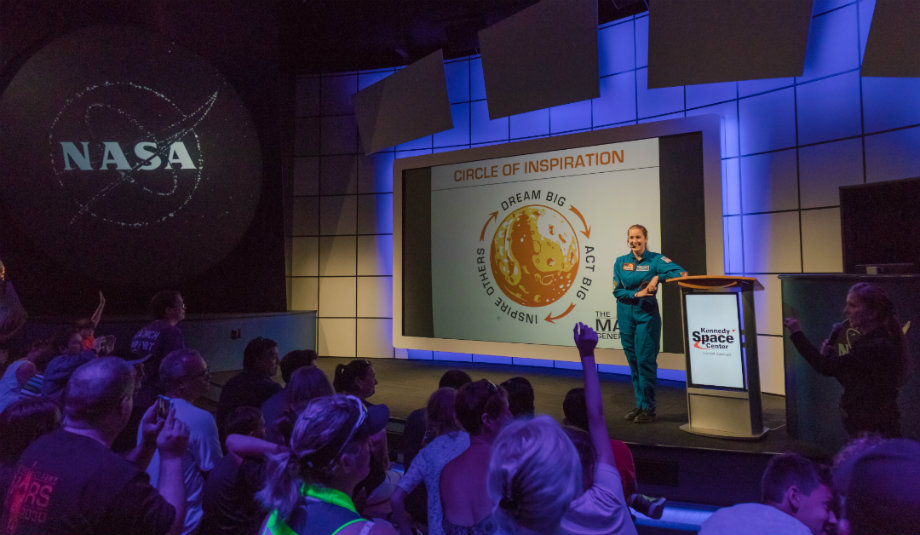
Astronaut Abby Speaking at Kennedy Space Center

International space and science ambassador to speak with student leaders from over 57 countries to foster excitement for space exploration and STEAM education

MINNEAPOLIS, MINNESOTA, UNITED STATES, September 27, 2017 / — Abigail Harrison, also known as Astronaut Abby, a 20-year-old aspiring astronaut and international ambassador for space exploration and science, technology, education, arts, and math (STEAM) education has been invited by the Al Sharq Youth Forum to represent The Mars Generation nonprofit at their Annual ‘Embracing the Future’ Conference in Istanbul, Turkey October 7- October 8, 2017. Harrison will appear as a guest speaker to talk about her own journey toward becoming an astronaut and being the first person to step on Mars. She will also share the story about The Mars Generation, a nonprofit founded by Harrison that is dedicated to advancing space exploration and STEAM education.

The Al Sharq ‘Embracing the Future’ Conference is an opportunity for hundreds of young leaders from around the world to find dynamic solutions to pressing issues facing the world today. Over 800 participants, including more than 60 experts, academics, policy-makers, current and former elected officials, and journalists will gather in peer learning and best practice sessions. The goal of the two-day event is to create an awareness among youth and youth leadership for both practical and programmatic approaches to navigating a constantly changing world. The agenda for the event includes workshops, competitions, performances, and more from across cultures.

“It is an honor to be invited to the Al Sharq ‘Embracing the Future’ Conference and see first-hand the commitment of young leaders from around the world to creating positive change” said Harrison. “Getting humans to Mars is something that will require collaboration among nations, and I am delighted to be able to share my own story as well as speak about The Mars Generation’s work to invite people of all ages and all interests into the conversation about space exploration.”

It is an honor to be invited to the Al Sharq ‘Embracing the Future’ Conference and see first-hand the commitment of young leaders from around the world to creating positive change.”— Abigail ‘Astronaut Abby’ Harrison

Currently with an audience of more than one million fans and followers, Harrison is recognized as a leader in her generation, the Mars generation – identified as the generation expected to first step foot on Mars in the mid 2030’s.

Emphasizing the importance of international cooperation in the field of space exploration and inspiring youth toward a future in STEAM and space, the Al Sharq Forum has invited the 20-year-old aspiring astronaut to:

  • Be a Guest Speaker in a Spotlight segment titled “The Mars Generation.”
  • Participate in a diverse variety of sessions including several keynote speeches, dialogues and panels that are aimed at broadening the outlook of the participants in several topics.
  • Offer hope to young leaders and encourage them to find dynamic solutions to the pressing issues facing the world today.
  • Tour Turkey and see local history and attractions to gain an understanding of the culture and people.

For real time updates of Harrison’s unprecedented tour of Turkey as an international space and STEAM ambassador from October 6- October 10, 2017 follow the hashtag #TMGtoursTurkey on Twitter, Instagram and Facebook.

About Abigail Harrison
Harrison is the founder of The Mars Generation nonprofit. Currently a junior at Wellesley College in Massachusetts majoring in Astrobiology and Russian, Harrison is positioned to enter a PhD program upon graduation and continue her pursuit of becoming an astronaut and member of the first human crew to land on Mars in the 2030’s. Supporters around the world follow her journey to becoming an astronaut via the blog Harrison authors at AstronautAbby.org and on Twitter, Facebook, Instagram and YouTube.

About The Mars Generation
The Mars Generation is a 501(c)(3) international nonprofit founded in 2015 in the United States. The organization offers programs to excite and educate students and adults about the importance of human space exploration and STEAM education. The organization is volunteer-driven with a board of directors that includes astronauts, engineers, scientists and professionals from the nonprofit and business communities. The organization has had tremendous growth in the first two years of operation with more than one million followers on social media and a reach of more than 25 million people.

About the Al Sharq Forum
The Al Sharq Forum is an independent international network whose mission is to develop long-term strategies to ensure the political development, social justice, and economic prosperity of the people of the Al-Sharq region located in the Middle East. The Al Sharq Forum reaches its mission through public-spirited research and high-quality events, promoting the ideals of democratic participation, multi-stakeholder dialogue and social justice.

For more information on The Mars Generation go to: TheMarsGeneration.org

Yvonne Hundshamer
The Mars Generation
612-670-0337
groundsupport@themarsgeneration.org

Press Release: The Mars Generation Announces Selection of Student Space Ambassador Leadership Program Advisory Board Members

Jake Vorhees

Jake Voorhees – SSA Board Member

MINNEAPOLIS, MINNESOTA, UNITED STATES, September 18, 2017 / — The Mars Generation (TMG) is pleased to announce the selection of the newest members of the Student Space Ambassador Leadership Program Advisory Board. The board members represent a partnership between students and professional leaders from the nonprofit, education and business sectors.

De_Lin_Show_the_mars_generation_ssa

De Lin Show – SSA Board Member

The focus of the advisory board will be to continue to grow and strengthen the Student Space Ambassador Leadership Program (SSA). The SSA Advisory Board will help lead efforts to build a stronger tomorrow by energizing youth today about science, technology, engineering, arts, math (STEAM) and space while also educating youth and adults about the importance of both to humankind.

“With the extensive and diverse background of our student and professional board members, the SSA Advisory Board has the unique opportunity to reach a large, international audience of students and to truly cultivate their passion for STEAM education,” said Brittany Wedd, SSA board chair. “As a board, we will be utilizing our many talents and skills to augment the resources and programs that we offer to our Student Space Ambassadors.”

The SSA Advisory Board is comprised of the following professionals and students:

  • Brittany Wedd – Board Chair – Director of Operations Discovery Station Nonprofit
  • Morgan Irons – Vice Co-Chair – CSO of Deep Space Ecology
  • Jeff Herold – Board Member – STEM Educator and Solar System Ambassador (NASA)
  • Danny Jaques – Board Member – Instructional Resource and Data Specialist and Teacher Liaison Officer U.S. Space Foundation
  • Mike Johnson – Board Member – Pilot and workforce development expert
  • Emily Judd – Secretary – Student at the University of Michigan
  • Hayley Lewis – Board Member – Student at the Embry-Riddle Aeronautical University
  • De Lin Show – Board Member – Student and Teaching Assistant
  • Aaron Shepard – Board Member – Student at Clemson University
  • Jake Voorhees – Board Member – Civil Engineer and founder of the 1% Engineer Society
Aaron_Shepard_the_mars_generation_ssa

Aaron Shepard – SSA Board Member

On his inspiration for joining The Mars Generation’s SSA Advisory Board, Aaron Shepard states, “Humanity landed on the moon because society insisted on it. The human race must continue to demand that we travel deeper into the cosmos if we want to land on worlds that are even further away. It is our goal to encourage this next generation to do just that.”

About The Mars Generation Student Space Ambassador Leadership Program
The Mars Generation Student Space Ambassador Leadership Program was created to inspire, support and mentor the next generation of leaders in science, technology, engineering, arts and mathematics (STEAM) and the space-related industries. The program serves as a mentorship and leadership program for students as well as a workforce development and recruiting program for both STEAM and space industries. The Mars Generation Student Space Ambassador Leadership Program has been credited as a major force for bringing forth our future leaders in STEAM and Space.

About The Mars Generation
The Mars Generation is a 501(c)(3) nonprofit in the United States. The organization is volunteer-driven with a board of directors that includes astronauts, engineers, scientists and professionals from the nonprofit and business communities. With a reach of more than 25 million people in the organization’s first two years of operation, over one million followers on social media, over 1200 students from around the world participating in its Student Space Ambassador Leadership program, over 600 donors, 850 members and several space industry sponsors in place, the organization continues to grow and offer programs to excite and educate students and adults about the importance of human space exploration and STEAM education.

For more information on The Mars Generation go to: TheMarsGeneration.org

Yvonne Hundshamer
The Mars Generation
612-670-0337
groundsupport@themarsgeneration.org


The Mars Generation Announces #AskAbby Feature on Our YouTube Show

Ask Abby at Kennedy Space Center

Our leader and founder, Abigail Harrison aka Astronaut Abby, is a student who aspires to  become an astronaut. Astronaut Abby appears regularly at events around the world as an International Space and STEM Ambassador to educate and excite people about the importance of space exploration and STEM education to the future of  humankind. During these appearances Abby usually speaks and then answers questions. The Q and A has always been wildly popular. Due to the popularity we have decided to give our online community an opportunity to ask Astronaut Abby questions. Abby will answer questions submitted as part of a regular feature on our YouTube show, The Science and Space Show. This is a really exciting opportunity to get your most pressing space and science questions answered.

How You Can Ask Astronaut Abby Questions?

If you have a question for Abby you can submit it now using this  simple form .

We look forward to having educators, parents, students and anyone else who is curious about space exploration to get involved and #AskAbby your space questions. This is an opportunity for classrooms and individuals to directly connect with Astronaut Abby and ignite their curiosity. Please feel free to #AskAbby as many questions as you have.*

To #AskAbby a question simply fill out this form now.

Make sure to subscribe to our YouTube channel here to get updates of our new episodes of The Science and Space Show and our exciting new #AskAbby features!

*Abby will make an attempt to answer as many questions as possible. There is no guarantee your #AskAbby questions will be answered or how quickly they will be answered.

Members Of The Mars Generation: Check Out Our Inspiration Contest!

Members of The Mars Generation

It’s our 2nd anniversary and we are announcing a new and fun way to participate in The Mars Generation to celebrate our 2nd year of success as an organization! Starting today and each month we will be hosting an Inspiration Contest and anyone who is a member of The Mars Generation can enter for a chance to win!

Prizes will be awarded month and include: TMG logo t-shirts, patches, magnets, keychains, coffee mugs and much more!

To enter the TMG Inspiration Contest for a chance to win follow these steps:

  • Make sure you are a member of The Mars Generation.
  • Share photo(s) or video(s) of things that inspire you or show your love for TMG on your Twitter, Instagram and our Facebook page.
  • Use #TMGinspires and #contest hashtags when sharing your photo(s) or video(s) and tell us why you are inspired. And also please tag our social media channels (when possible). The hashtags are how we track entries so don’t forget it!
  • You can enter as often as you like and we will hold a prize drawing the first week of every month for fun prizes including patches, pins, t-shirts and more!
  • You must have your Facebook, Twitter and Instagram set for public to be able to view for the contest entry to be recorded.

If you are NOT a member hurry and sign up today! Once you are a member you will get all kinds of perks including being able to enter our “Inspiration Contest” for chances to win prizes every month!

Please note: By entering a photo or video in the contest, you are giving us permission to use the photo for any other TMG promotion in the future.

Please read the rules here and make sure you understand our rules before choosing to participate.

Join Us As A Member Today

If you’re NOT already a member, join us today! Members of The Mars Generation are part of an inspirational, educational elite group dedicated to furthering young people’s success in the fields of science, technology, engineering, arts, and math (STEAM) and space. Once you are a member you instantly join a worldwide community of people passionate about advancements in STEAM education and also advancing human space exploration.

Become a part of our community today, and help us educate and excite people about human space exploration and sending humans to Mars! Our outreach work is essential to driving public interest in human space exploration. Additionally, your support helps us make students’ and young people’s dreams in STEAM and space come true. So sign up now right here!

Your support will help us change the world!

Become a member today! You can also sign up for future blog posts to be delivered right to your inbox to learn more, and follow us on Facebook, Instagram and Twitter.

Going to Mars, Part 2: The Curiosity Rover, A Martian Marvel

We are so lucky to have Ross Wakefield join us as a guest writer.

Please visit our “Get Involved” page to learn more about how you can volunteer and/or join The Mars Generation. Let’s go to Mars!

*** Please note guest submissions are options of the author and do not necessarily reflect the mission or beliefs of The Mars Generation.

Martian Sunset

Introduction

For a long time now, Mars has been the object of desire for many missions from a range of different space agencies. Many of them have been very successful (like the incredible story of the NASA rover Opportunity, whose proposed mission life cycle was 90 days yet is still gathering and sending data after 13 years), and some not-quite-so successful (the poor Beagle 2, long believed to have been destroyed upon landing but recently discovered to have been inactive simply because two solar panels failed to deploy, blocking the communications antenna). Though Mars has a reputation for making missions difficult for various reasons (roughly two-thirds of probes sent to Mars have failed before their missions could be completed), at the present time there are no less than eight different active vehicles sent by mankind either in orbit or on the Martian surface itself.

One of these vehicles, the most recent successful arrival on the surface, has given us more data than ever about the Martian environment. It is assessing the climate, analyzing geology, offering possible conclusions on whether or not life of any kind once existed on Mars, and perhaps most importantly, looking to answer a fundamental question:

If we were to visit Mars in the future…how hospitable would it truly be?

In the early 2000s, NASA began work on a project that would eventually become known as the Mars Science Laboratory (MSL) mission. The idea was to determine once and for all the current and past habitability of Mars for organisms both complex and simple.

The centerpiece of this mission was the rover that the MSL carried with it, right down to the Martian surface itself: the vehicle named Curiosity.

The Curiosity Mission, Now and Into the Future

Early Stages to Landing

In 2004, NASA began taking proposals for the various parts that the probe would take to Mars, and within four years most of the instrumentation had been completed and was being tested. Though the project did run over-budget during development and NASA had to simplify many of the instruments in order to make a revised launch date, the rover – given the name Curiosity thanks to sixth-grader Clara Ma from Kansas – took flight from Cape Canaveral in late 2011; the beginning of a ten-month journey to Mars.

The MSL mission had, and still has, several basic objectives – chief among them to identify possible “biosignatures” or features that imply that a biological presence had once been on Mars. The mission also performs detailed geological testing of the area to identify exactly what kind of rocks and soil may be found on the Martian surface. And finally, it records and analyses radiation levels both during the journey to Mars and once on the surface. That data, of course, would be potentially crucial for planning a future human Mars mission – and more on that later.

Mars Science Labratory missionOn August 6th, 2012, Curiosity landed successfully in the Gale Crater, very close to the equator of Mars. After a tense 14 minute wait, news of this reached the waiting mission staff, and very soon after that the world knew that the most complex and elaborate rover yet designed for Mars missions would soon begin its exploration. The choice of Gale Crater had been carefully considered beforehand; the site for the landing had to include both a variety of different materials for geological analysis and also the kind of rocks capable of indicating the evidence of past water and (maybe, just maybe) ancient fossils. From past observations of the surface, that particular location satisfied all these requirements – and its close proximity to the Martian equator would help with communication.

On the Surface

Once on the ground, Curiosity got to work, using a variety of instruments to assess the Martian surface in pursuit of its mission. Though the initial thoughts regarding what the rover could carry had been limited by budget and time constraints, a wide variety of instruments were fitted to the rover for use.

These included:

– a spectrometer designed to assess the chemical makeup of rocks using alpha particle radiation and X-rays, ideal for getting an accurate composition of the sample.

– an X-ray diffraction analyser, designed to target specific minerals within rocks and identify whether or not any particular rock might have had water involved in its creation or its development. Past or present water, is, of course, a key indicator of possible life.

– an instrument for analysing the few gases in the Martian atmosphere, looking in particular for specific oxygen and carbon signatures within carbon dioxide and methane that would tell if those gases were produced chemically or organically.

– a radiation detector, switched on at launch in order to measure the radiation doses given to the mission both by the Sun and by other possible sources.

– a weather package designed to measure wind speed, temperature, humidity and other important values.

– a variety of different cameras – five for imaging the surface and other interests, and 12 for supporting the movement of the rover itself.

With all of this instrumentation on one vehicle, Curiosity is by far the most complex rover ever sent to a body outside of Earth orbit and land successfully.

Within a few months of landing, the rover made a rather spectacular success when it came across what was described as an “ancient stream-bed.” This indicated that there had, at one time, been a wide-flowing and vigorous river system, at least in that area. Though the existence of flowing water in the past had been heavily touted since the Mariner missions of the 1970s, this added further weight to the idea that Mars did, in recent history, contain flowing liquid water – and by extension, possibly life. Further discoveries the following year of abundantly accessible water in soil samples added more credence to this theory.

In early 2013, a sample of rock taken by Curiosity at Gale Crater detected water, carbon dioxide, oxygen, sulphur dioxide and hydrogen sulphide. This is a chemical combination very well-suited for the existence of microbe life, thereby adding further weight to the idea that Mars was, once upon a time, potentially habitable for simple forms of life.

In late 2014, the rover detected a spike in methane levels ten times higher than the baseline value in the Martian atmosphere, as well as other organic compounds within rock samples. While the source of these compounds is debatable, it is entirely possible that they could have been produced by ancient microbial processes.

In late 2015, there was enough data gathered by Curiosity for a conclusion to be made that the landing area of Gale Crater was once either a large lake, or stream, or both, billions of years ago.

Finally, in late 2016, NASA gave a summation of the mission so far, where they confirmed the relative success of at least one objective of the mission. In their opinion, the Gale Crater site once contained an ancient river or lake, with a chemical energy source and all the chemical ingredients needed for life to have once existed there. Their conclusions were definitive – while Mars likely does not have life now and possibly did not in the past, the conditions were extremely favourable for life to have existed there once upon a time.

From the time of its launch, the rover has measured the doses of radiation from galactic cosmic rays as well as energised particles emitted by the Sun. The findings, however, were sobering: the dose that the rover took in the time frame that a human Mars mission would entail (860 days total: 360 days traveling back and forth and 500 days on the surface) was almost twice what NASA deems an unacceptable lifetime limit for its astronauts in orbit around the Earth.

Future of Curiosity

Though the initial plan was for the rover and the mission to be active for just two years, within a few months of landing the mission plan for Curiosity was extended indefinitely. This didn’t come as a surprise to most familiar with the sheer durability and toughness of such rovers: the story of the NASA rover Opportunity, as shown above, pays testament to that.

Presently, Curiosity is to be found exploring the surfaces of Mount Sharp, looking for further clues as to

Mars Curiosity Rover Self Portrait

Martian history and in particular how the planet moved from a relatively habitable abode for simple life to one incapable of supporting it. Still in excellent working order with only a couple of minor technical difficulties to inhibit it, the rover has traveled over 16.5 kilometres from its landing site.

Right now, the key objective that the rover is focusing on as it climbs Mount Sharp is to discover exactly how and when the lakes and rivers upon Mars dried out, thereby giving possible clues as to why it happened.

On its fifth “birthday,” the rover even played a little “Happy Birthday” tune to itself – and with any luck, Curiosity will continue to roll on in the course of its mission for many years to come.

What Does It All Mean For Future Missions?

In the roughly five year timeline since Curiosity first landed on Mars, this probe has given NASA and the world a treasure trove of information regarding surface and atmospheric conditions on Mars, some of which confirmed what previous missions had hinted, and some of which was entirely new. It has, by all accounts, been a remarkable success – and no doubt there is still much more to be found and more information to be sent back by the durable, brilliant rover.

However, the thirst is for more than just robotics to set their wheels on the surface of our nearest planetary neighbour. As has been mentioned in previous entries, more than one organization on Earth has the hunger to put humans on Mars and to do it soon. But to do that, we need a lot of information about conditions there – both for the sake of mission parameters and for the safety of the astronauts that would go.

So, in light of that, what has the Curiosity mission told us about a potential human Mars mission that is noteworthy?

Well, the first discovery is possibly the most difficult factor discovered by the mission, and the one most likely to put serious holes in a lot of Martian ambitions – the high radiation levels.

As was noted earlier, the maximum accepted lifetime dose of radiation by NASA for its low Earth orbit astronauts is one that will give a three percent additional risk of fatal cancer development. The readings from the rover show a total dose of around 1 sievert of radiation during an 860-day Mars mission, which corresponds to a five percent additional risk – almost double what NASA deems acceptable. And this, of course, does not take into account other missions that the astronaut may have been on previously in their lifetime, nor the (likely) vital time in a zero-G environment that they would need for the purposes of training for such a Mars mission. This finding, showing that the total dose was higher than many people expected, indicates that serious consideration is going to have to be given to radiation shielding for any astronauts involved in such a mission.

There are, of course, solutions to this problem – increased radiation shielding for the craft involved, as well as the choice of building a habitat for this purpose (likely essential for long-term habitation of Mars anyway) once on the surface that would be likewise shielded. Such shielding does increase the potential weight of any mission sent, and so increases the cost and possible complexity. Such things will have to be carefully considered in the planning of any future human mission.

The second discovery involves the landing of the rover itself, where a rather unique system was used. Rather than just one system – thrusters, an airbag or parachutes – being used to arrest the fall of the rover to the surface, Curiosity instead used a unique combination. Initially, a heat shield was used to reduce speed during the initial entry into the thin Martian atmosphere. This was followed by a parachute once further down, and thrusters once within around two kilometers of the ground. Finally, and most uniquely, a “sky-crane” system was used, where cables helped lower the rover away from the rest of the descent vehicle until touchdown, at which point the cables separated and the other part of the lander flew away to land elsewhere. Such a system was entirely novel and was deemed one of the few possible ways that a wheeled rover as large as Curiosity could be landed safely – that is, without causing damage to vital systems through impact or the dust cloud generated by such a landing.

The success of this principle demonstrated that heavy yet delicate payloads can be deposited on the Martian surface, and as any human mission is going to require an awful lot of heavy yet delicate equipment, this method is a useful possibility for getting materials down to the surface.

The Curiosity rover has also confirmed beyond reasonable doubt that while organic compounds exist on Mars, organic life likely does not at this point in time, which has connotations for precautions that any crew might have to take if it came to encountering simple life there – such as increased anti-contamination procedures and the like.

All of these, along with various discoveries that have been made regarding chemical and organic findings on Mars by the rover, mean that this mission has been given a wealth of information that will prove useful if and when humanity decides to send some of its own representatives to the Red Planet.

Conclusion

Almost five years after its landing, the Curiosity rover is still almost fully functional, rolling away through the Martian landscape, testing and sampling all the time. A testament to the ingenuity of those who helped place it there as well as the durability of the rover itself, it should continue to supply incredibly useful data for many years to come.

By far the heaviest and most complex vehicle ever to land on the surface of a planet that is not our own, it has spent the last half a decade giving us a wealth of information. Through discoveries made by this one rover, we now have a much better idea of the best method to deliver heavy payloads to the Martian surface, the previous habitability of Mars, and the likely dose of radiation that a human mission to Mars might face, and more. Even now, it seeks to answer another question about Martian history by attempting to discover at least a rough idea of the time at which liquid water there might have vanished.

In the next couple of decades, it is possible that a human Mars mission will finally result in human feet upon that planet. Maybe, just maybe, when they do…

…there will be a tough little rover, battered but still working…rolling up to greet them.

More from Ross:

The Road To Mars: Our Past and Our Future

Going To Mars, Part 1: The Human Element

Going to Mars, Part 3A: Orion, The Next Generation of Travel

Ross WakefieldRoss Wakefield is a freelance science writer, communicator and consultant, with specialized expertise in the field of current and historical space developments. Ross has a Bachelors degree in Physics with Astrophysics from the University of Leicester and a CMCU in Astronautics and Space Engineering from Cranfield University and is a member of the Institute of Physics and British Mensa. Ross is currently beginning a series of articles with The Mars Generation on various space-related topics. When he’s not glued to a computer screen, he enjoys playing and watching sport, reading various books and trying to find where the nearest good pool table is in the United States. Find Ross on his Twitter.

3M Young Scientist Challenge: Collaborating With TMG For The Future of STEAM

3M Young Scientist Challenge

The Mars Generation is excited to announce a fun new initiative we are involved with that will start today, August 25, 2017, and run through October. We are thrilled to share that we are partnering with 3M to be part of the 3M Young Scientist Challenge Final Event taking place October 16-17, 2017.

Our founder, Astronaut Abby will be representing The Mars Generation at the 3M Young Scientist Challenge Final Event as the event Ambassador.

What does this mean?

Abby will be present at the final event to meet the finalists and spend time with them as they go through the final challenge. Abby will speak at the event, tour 3M labs and the 3M Innovation Center, watch and judge the final challenge presentations and much more. The finalists are group of amazing young scientists grades 5 – 8 from around the United States. Each finalist submitted a video of an innovative solution to solve an everyday problem and made it through judging to this final event. Tune into the #YoungScientist hashtag to follow along on this innovative scientific adventure.

The Mars Generation has chosen to collaborate with 3M (an organization known for scientific innovation) for the 3M Young Scientist Challenge Final Event because it closely aligns with STEAM (Science, Technology, Engineering, Art, Math) education and part of our mission to excite and educate kids and adults about STEAM education and why it’s important to the future of humankind.

The Mars Generation’s innovative approach to leverage new media and technology has led us to become leaders in STEAM and space communications and advocacy. We are a nonprofit built on the backbone of using social media and technology to change the world! With over one million followers on social media and an estimated reach of over 25 million people, since our founding in 2015, we are excited to use our vast network to help share the 3M Young Scientist Challenge Final Event with the world and excite even more students to reach for their Mars!

We want to thank 3M for their donation to The Mars Generation for our work on this project. It means a lot to our community to have the support of a leader in science and technology. We look forward to this partnership and being a part of this exciting event that truly encompasses the mission of The Mars Generation.

***All posts that are part of this paid promotion will be marked with #ad, #paid or #sponsored. All proceeds of this work with 3M will be donated directly to The Mars Generation, to help us continue to carry out our mission.