The Mars Generation Los Angeles Tour – JPL and Endeavour here we come!

image for LA blog post

The Mars Generation is venturing out west for the second time this summer to Los Angeles!

Our first visit was a quick 36 hour visit that did not leave us time to tour all the great space industries, but fortunately we have been invited back to California and this time we are able to spend a whole week seeing the sights.

The tour will take place the week of August 27 to September 1 and will include visits to popular locations such as NASA’s Jet Propulsion Laboratory (JPL), the California Science Center, SpaceX, Aerojet Rocketdyne, and more! 

On Tuesday, August 29, our founder and leader Astronaut Abby will be visiting the California Science Center and taking a private tour of the Endeavour exhibit with curator Dr. Kenneth Phillip. This is a special visit for Abby because she viewed the last Endeavour launch in 2011, and this experience led to her meeting her mentor Astronaut Luca Parmitano. Visiting Endeavour six years later is exciting as it is a big part of the founding of The Mars Generation. To learn more about this story watch Astronaut Abby’s Tedx Talk here.

Additionally, our founder, Astronaut Abby, will be doing some filming for a documentary called Chasing Earhart, which will serve as a case study on the life and disappearance of Amelia. “Our project, from the outset, is foundationally different from any project associated with Amelia that has come before it. We have no bias and no stake in anything other than finding out the truth regarding her disappearance.” You can learn more about this project here.

We are excited to be including several of our past Space Camp scholarship recipients in the tour. Three of our recipients will be joining the JPL tour on Thursday, August 31st! It’s so special to reconnect with these students and also give them another “out of this world” experience to keep inspiring them towards their own passions in science, technology, engineering, arts, and math (STEAM) and space! The students attending the tour are: Milagro G., Merary M. and Tiffany H. Watch for updates as we share all kinds of videos and photos of this reunification!

We will be updating our channels multiple times daily throughout the week so make sure you follow us on our Facebook, Twitter and Instagram and follow Astronaut Abby on her Facebook, Twitter and Instagram, too.

Follow the hashtag #TMGtoursLA to follow the entire tour as it unfolds. Lots of surprises in store!

The Mars Generation Joins Kennedy Space Center’s Summer of Mars [VIDEO]

We are honored that The Mars Generation was invited to be part of the Kennedy Space Center’s Summer of Mars events! On August 5, 2017 our founder, Astronaut Abby made an appearance at the Kennedy Space Center as a special guest speaker to talk about our nonprofit and our important work at The Mars Generation. Watch to learn more about how The Mars Generation was founded and our important work!

To learn more about The Mars Generation, be sure to sign up for updates and also follow us on Facebook, Instagram, Twitter, and Google +! Onward to Mars!

FINAL Founding TMG Membership Campaign: Get your limited edition patch today!

This is your last chance to become a founding member of The Mars Generation. Don’t miss this opportunity!

It’s The Mars Generation’s FINAL founding membership campaign! Hurry and sign up today to get one of our 2 year anniversary patches! These patches are a limited edition and when they are gone they are gone! So don’t delay – sign up now to ensure you  get one!

We have a goal of reaching 1,000 members by our 2nd anniversary! We only need 240 more people to reach this goal! You can help us reach this goal! Sign up today!

To reach our 1,000 founding member goal we need your help NOW! Earn the title of “Founding Member” for this inspirational, educational non-profit and join us today to receive a member t-shirt and our limited edition patch (when they are gone they are gone)!

Why join The Mars Generation as a founding membership TODAY?

GET AWESOME SPACE SWAG NOW FOR SIGNING UP INCLUDING:

  •  limited-edition patch that is only available to people who sign up
  • Exclusive Dream Big! TMG Member T-shirt (super soft ringspun cotton)
  • TMG magnet and stickers
  • Founding member card (yes, it’s laminated!)

YOU ALSO GET A BUNCH OF AWESOME PERKS YEAR ROUND (CLICK HERE TO LEARN ABOUT THEM! 

TMG Membership patches and t-shirtYour membership supports our outreach work and programs that have already reached millions and will continue to grow. We work to inspire today’s youth to become tomorrow’s leaders in science, technology, engineering, art, and math (STEAM) and space exploration as well as inspire everyone to Dream Big, Act Big and Inspire Others. We are also working, through our mass outreach, to educate and excite people about human space exploration and why we need to send humans to Mars. This outreach is essential to driving public interest and funding for all space exploration.

Read more about this founding member opportunity on our TMG Membership page and sign up today!

**Members who have already signed up will be offered a discount code to buy the limited edition patch at a discount. Once they’re gone, they’re gone!

This truly is your last chance to become a founding member. After October 1, 2017 we will no longer offer founding memberships for The Mars Generation.

Take this opportunity now, and sign up to receive FREE REWARDS and exclusive PERKS. Join The Mars Generation as a founding member today!

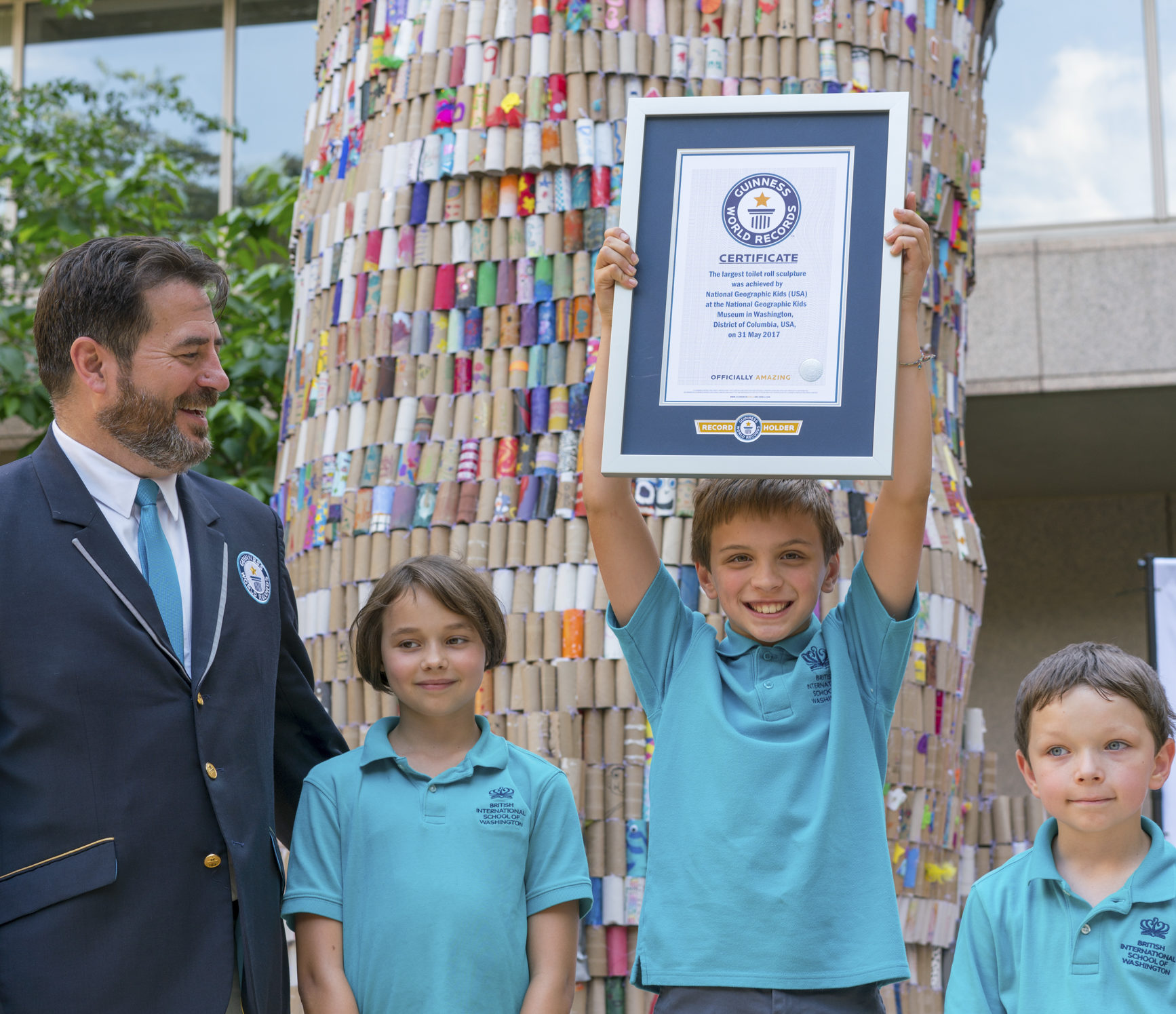
The Mars Generation Breaking World Records with National Geographic Kids

World record toilet paper roll structure

Photograph by Hilary Andrews / National Geographic

The Mars Generation is excited about our partnership with National Geographic Kids this past year to support a record-breaking project in Science, Technology, Engineering, Arts, and Mathematics (STEAM)! On May 31st, at their Washington, D.C. headquarters, National Geographic Kids unveiled the results: a giant rocketship made out of toilet-paper rolls. A representative from the Guinness Book of World Records, Jimmy Coggins, was one among a team of surveyors that certified this toilet paper roll structure, earning it a place in the Guinness Book of World Records. Using a grand total of 20,241 rolls, it measures up at an impressive 24 feet tall with a volume of 456.23 cubic feet, or 12.92 cubic meters.

As advocates for STEAM education, The Mars Generation played an integral role in gaining public support for the project. We chose to promote this effort because it fits our mission: to excite young people and adults about human space exploration and STEAM education and foster an understanding of the importance of these two elements to the future of humankind on Earth. What better way to do this than by breaking a world record?

The Mars Generation participated by posting and encouraging their audience of over 970,000 social media followers to help spread the word and encourage people to get excited and participate. With a goal to excite kids and families about STEAM, a project like this is monumental in what it has accomplished.

Rachel Buchholz, VP and editor-in-chief of National Geographic Kids magazines commented: “We thought that building a giant sculpture of a rocket, using toilet-paper-roll tubes we usually just throw away, would be a fun way to get conversations started about upcycling and space.” Such a conversation it did start, evidenced by the amount of people that contributed. YouTube personalities Parry Gripp and Hank Green, former U.S. Children’s Poet Laureate J. Patrick Lewis, and Major League Soccer stars were among some notable contributors.

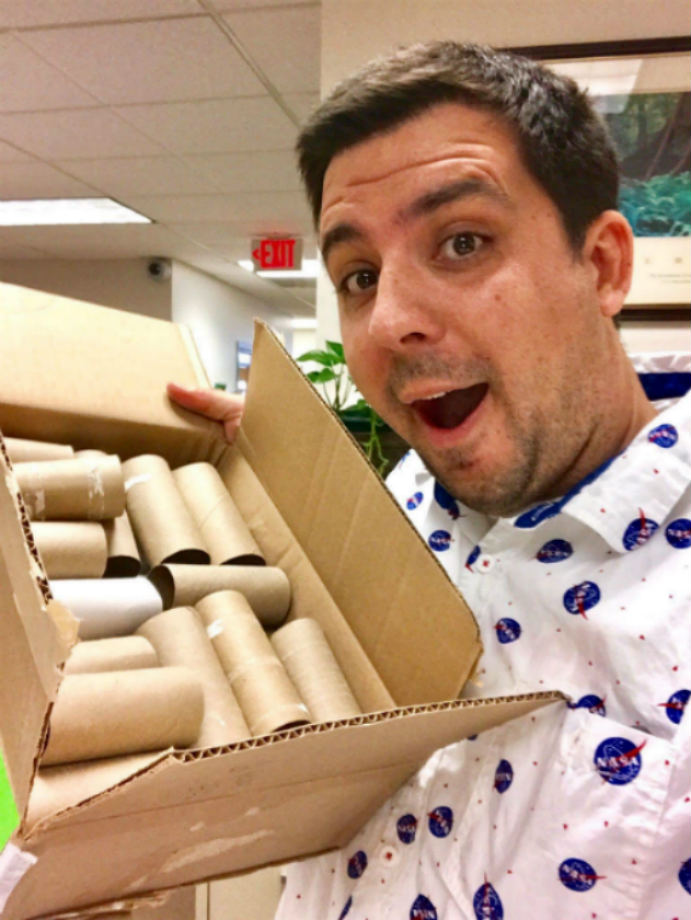
Jeff Herold - TMG member and STEM teacherAmongst the contributors was The Mars Generation’s own, STEAM educator Jeff Herald, known as @STEMJeff on Twitter. Jeff collected and submitted hundreds of toilet paper rolls for the project from his middle school students in Arizona. Thousands of other community members of The Mars Generation also contributed to the project.

The Mars Generation was glad to partner with National Geographic Kids on a project that encouraged students around the world to Dream Big, Act Big, and Inspire Others. We were honored to join several outstanding organizations as partners including Girls Who Code, DIY, National Geographic Education, DreamUp, Life is Good and the California Science Center. The Mars Generation was also thrilled to work in conjunction with project sponsor, Toyota Highlander.

To learn more about The Mars Generation, be sure to sign up for future blog posts. Additionally, you can follow us on Facebook, Instagram, Twitter, and Google +, or donate to our nonprofit to show your support.

TMG’s 24 Under 24 Leaders In STEAM Awards: Get Nominated Now!

24 Under 24
Around the world, students and young people are accomplishing amazing things in the fields of science, technology, engineering, arts, and math (STEAM).  Such accomplishments are driving us towards a brighter future filled with ingenuity and advances in scientific enterprise. Often, we do not recognize students and young people for their work, or realize that indeed young individuals are changing the world and contributing in a real way to a better society.

We aim to recognize some of these accomplishments with our annual 24 Under 24 Leaders and Innovators in STEAM and Space Awards.

We are thrilled to be working with Aerojet Rocketdyne and United Launch Alliance (ULA) as sponsors of the awards. We are thankful for their support of the awards and helping to make this happen for all students!

Hurry and get nominated and/or nominate student or young individual today to be considered for recognition by the TMG 24 Under 24 Leaders and Innovators in STEAM and Space Awards. 

Aside from giving a well-meaning mom bragging rights (and you, too), why should a student or young person be interested in this award?  The awards will:

  • stand out as an achievement on college applications, job resumes, LinkedIn profiles, and more.
  • bring credibility and recognition to students and young people for future endeavors.
  • distinguish talented young STEAM individuals and build credibility for future work.
  • introduce young people to the professional world of STEAM, and connect them to like-minded people.
  • spread the word about the young individual’s current projects, acting as an outreach tool to boost public interest.
  • empower the recipient to inspire other students and young people with their story.
  • and much more!

Space camp 24 under 24 awardsAdditionally, because of the recognition from the awards, young individuals are immediately linked to The Mars Generation community of STEAM and space supporters.  With a support network that aims to motivate and push dreams even further, there is no limit to what a young leader may continue to accomplish.  These accomplishments inspire others in similar positions to pursue their STEAM ambitions, creating a positive ripple of change.

Students and young leaders, don’t hesitate to ask a mentor, advisor, teacher, or any other adult in your life to nominate you by filling out the form here.  Your application will be strongest if it comes from a mentor, teacher or community member.  The time to pursue your dreams and celebrate your hard-earned accomplishments is now!  You don’t have to hope and wait to be discovered – being open about your triumphs and asking for recognition is a big part of success.  Share the awards page and application link now with the adults in your life and ask them to nominate you today!

Some ways in which students and young people are making a difference in STEAM and space today include (these ideas are to help you think hard about who to nominate):

  • Leveraging online tools as a way to become a young STEAM communicator and excite others about the world of STEAM.
  • Combining art and technology in the form of 3D printing to model our world.
  • Starting STEAM and space clubs at school to connect to peers with a common interest.
  • Participating in science fairs around the world.
  • Innovating with technology to change the world.
  • Using art as a way to excite people about science and technology.
  • Participating in robotics, STEAM and other competitions.
  • Launching their own companies that advocate for STEAM education.
  • Producing Youtube videos which inform the public about STEAM and space.
  • Solving real-world problems with STEAM-based solutions
  • Doing outreach such as reading to kids about STEAM subjects, speaking, writing for online publications and more!
  • Do you want to see your accomplishments in science, technology, engineering, arts, and/or mathematics (STEAM) and space to be recognized?  Encourage a trusted adult to nominate you today!

Nominations will be accepted through October 15, 2017 for students and young people meeting the following requirements:

  • Must be age 24 or under.
  • Can be from anywhere in the world.
  • Must be involved in any project or work within STEAM and/or space. This includes but is not limited to outreach work, publishing papers, speaking, research, competitions, inventions, innovation – projects that underscore leadership in STEAM and/or space exploration.

The 24 Under 24 Leaders and Innovators in STEAM and Space Award recipients will be announced in December 2017.

Press Release: Recruiting Students and Professionals to Join as Members of The Mars Generation SSA Board

Space Advocacy Group Matches Students to Industry Mentors for Leadership of STEAM Workforce Program

MINNEAPOLIS, MN, UNITED STATES, June 15, 2017 /EINPresswire.com/ — The Mars Generation (TMG) announces an exciting opportunity to shape the future of their popular Student Space Ambassador Leadership Program (SSA).

The-Mars-Generation-MembersThe Mars Generation is seeking students and professionals who believe in their philosophy to Dream Big, Act Big and Inspire Others, to apply to the SSA Board. Both students and professional mentors can help lead efforts to build a stronger tomorrow by energizing youth today about science, technology, engineering, arts, math (STEAM) and space while also educating kids and adults about the importance of both to humankind.

“The stars inspire us to reach for our own dreams, no matter what that dream is. When you pursue a dream you need a lot of help.” stated Captain Wendy Lawrence, TMG Board member, Naval Aviator and NASA Astronaut.

The Mars Generation Student Space Ambassador Leadership Program includes students and professionals working together to help each other while applying their skills and passion to strengthening and expanding the SSA and the programs offered. The one-to-one ratio of the SSA advisory board encourages “leading from within” with one professional mentor position for every student, to provide guidance and help students grow their leadership skills.

The Mars Generation reaches a broad audience, creating a groundswell of support for space exploration and compelling funding of space exploration benefitting the future of the Mars generation. Board members will have exciting opportunities to collaborate with many other space and STEAM organizations while strengthening and growing the SSA and programs offered.

The Mars Generation is volunteer-driven with executive and advisory boards of leaders from the space industry as well as nonprofit, education and business sectors. Whether you are a space industry professional, teacher, or a student with an interest in STEAM… regardless of your job title or area of study, if you are interested in joining The Mars Generation as a member of the SSA advisory board, apply now.

The Mars Generation Student Space Ambassador Leadership program was created to inspire, support and mentor the next generation of leaders in science, technology, engineering, arts and mathematics (STEAM) and the space-related industries. The program serves as a mentorship and leadership program for students as well as a workforce development and recruiting program for both STEAM and space industries. The Mars Generation Student Space Ambassador Leadership program has been credited as a major force for bringing forth our future leaders in STEAM and Space.

About The Mars Generation
The Mars Generation is a 501(c)(3) nonprofit in the United States. The organization is volunteer-driven with a board of directors that includes astronauts, engineers, scientists and professionals from the nonprofit and business communities. With a reach of more than 10 million people in the organization’s first year of operation and more than 1200 students from around the world participating in its Student Space Ambassador program, over 600 donors, 650 members and several space industry sponsors in place, the organization continues to grow and offer programs to excite and educate students and adults about the importance of human space exploration and STEAM education.

For more information on The Mars Generation go to: TheMarsGeneration.org

Yvonne Hundshamer
The Mars Generation
612-670-0337
groundsupport@themarsgeneration.org

What is The Mars Generation?

Join The Mars Generation’s Space Coast Marathon Team

We are so excited to announce that we have created a team for the Space Coast Marathon and Half Marathon on November 26, 2017!  You can join us and our leader Astronaut Abby by joining our team today!

Astronaut Abby

As a member of our team, you’ll help raise money for The Mars Generation while also raising awareness for space and STEM education. By committing to run the Space Coast Marathon (or any other race in your area), you’ll be a member who is active (literally and figuratively) in trying to make a difference.

If you agree to raise at least $500 for The Mars Generation, you’ll be added to our team. As a team member you will receive coaching and fundraising support as well as receive a uber cool team running shirt and a chance to win prizes as well! You will also get to be a part of a great group of people running to make a difference in the world! The half-marathon is sold out, but we have 10 spots left on our team! Act now so you don’t miss out on this great opportunity.

The Space Coast Marathon and Half Marathon is a fun and unique marathon that is held in Cocoa Beach, Florida each year. By joining our team, you’ll be able to run Florida’s oldest marathon during the last year of their  “Big Bang Series”  program. This program was created to honor the Space Shuttle Program and the accomplishments and sacrifices of all those involved by giving out astronomical themed medals. For 2017, the last year in the “Big Bang Series,” the shuttle honored is Atlantis.

You can get more information about the Space Coast marathon and half marathon here. This is the only space-themed marathon and half marathon on the planet, which truly makes it exciting. Please consider joining us in November!

For more information on how to join our team and even more prizes you can win for fundraising click here: http://themarsgeneration.org/team-mars-generation/

If you can’t join us in November but want to donate follow this link: https://www.givemn.org/fundraiser/space-coast-marathon-fundraiser-to-send-kids-to-space-camp58d888f906ac2

Going To Mars, Part 1: The Human Element

We are so lucky to have Ross Wakefield join us as a guest writer.

Please visit our “Get Involved” page to learn more about how you can volunteer and/or join The Mars Generation. Let’s go to Mars!

*** Please note guest submissions are options of the author and do not necessarily reflect the mission or beliefs or The Mars Generation.

Introduction

Previously, we took a look at where the various national, multinational and private space companies around the world were in terms of a possible human mission to Mars – their current capability, a limited look at the technology they are developing for possible future missions, and what their potential time-lines were for a landing on our nearest planetary neighbor.

It is the last of those topics that forms the basis of this first detailed article; the various pressures both mental and physical that astronauts would expect to face on such a long voyage into space, and what methods are being developed – and have already been developed –  to be able to deal with those pressures.

What We Know So Far

First Missions, Space Stations

It has been fifty-six years since a human – the Russian Yuri Gagarin – first slipped the surly bonds of Earth and became the first man to orbit the Earth, beginning the journey of humanity into space in earnest. Not too long afterwards, the US sent human missions beyond Earth orbit multiple times, six of which were to land on the Moon. All of these missions were never longer than a few days in length, but all of them made vast and meaningful contributions not only to the strength and tenacity of the human spirit, but also to our knowledge of the environment beyond the Earth and how to survive there. Space, though it may look comforting and awe-inspiring from down on the Earths surface, is dangerous in a multitude of different ways – but more on those later.

ISS

In the many years since Apollo 17 returned from the Moon humanity has not sent another human out beyond Earth orbit, but instead has worked on long term habitation in the slightly more welcoming environment of what is called Low Earth Orbit (or LEO for short). Within this very nearby orbital environment, several attempts at long-term habitation have been made in the form of various space stations. At first, the stations were built by individual nation-states rich enough to fund them (such as the US Skylab and the Russian Mir), but after the end of the Cold War enough nations realized that cooperation was the best policy and so first the idea and then the actuality of the International Space Station came into being. Beginning construction in 1998, first inhabited in late 2000, still being adapted with more and more parts as of 2017 and due to be used until at least 2024, the ISS is a truly remarkable success story regarding cooperation in space.

Current Capability and Caveats

Aboard the ISS, a crew of six lives for anything up to 200 days in the course of one ‘expedition’, with three being replaced usually before the 200-day mark is reached. This length of time, coupled with the premise that astronauts can travel to the ISS for multiple different expeditions after spending some time back on Earth, means that many astronauts have clocked up a very great deal of time in space. The current record-holder (as mentioned in the last article) is one Russian Gennady Pedalka, with a grand total of 878 days logged in space as both a member of the crew of Mir and the ISS over five separate space missions. A handful of other astronauts have also logged over 800 days in space, and many more have managed over 500. Through the length of time of these varying missions in orbit, much information has been gleaned about the capacity of the human body to survive in space and how the space environment affects the human body both physically and mentally.

However, while various astronauts and cosmonauts have spent a very great deal of time in orbit, both the length of time and the various difficulties that would be faced are on another scale to what has been achieved so far. The record, as stated above, is 878 days – a remarkable figure, but one what still falls short of the likely mission time-line for a human exploration of Mars. That figure, based on the current plans of various space agencies and private companies, is around three years total – so approximately 1100 days. Also, those 878 days were split into five different blocks – Cosmonaut Pedalka had the chance to return to Earth and the various comforts it offered at reasonably regular intervals to allow himself to rest and recuperate. The members of a human Mars mission would have no such luxury.

With all of that in mind, let’s now expand on what some of those effects of a mission to Mars might be – physical and mental.

The Human Cost

Physical

As mentioned above due to the length of time some people have spent in space we have learned a very great deal about the short and long term physical effects a Mars mission might have on its astronauts. While there are additional factors to be considered when venturing beyond Earth orbit (more on those in a moment), careful analysis of each astronaut put into orbit both while there and once they returned to Earth has given us a reasonably good picture of what to expect.

On the Muscles

The first issue, in the long term, is muscle wastage. When a human being is in a zero-G environment, they will not use many of the muscles that people down on Earth would use without thinking in the course of their day-to-day movements – walking, sitting down, standing up, even the muscle movements that simply keep the human body upright against gravity, amongst others – all movements that would be done without thought on Earth, but have no zero-G equivalent. Because of this the unused muscles will, over time, begin to atrophy away and be no longer able to be used effectively. This would no present a problem if the person in question were staying in space for the rest of their lives…but as it would be nice for them to return to Earth someday, those muscles need to be ready for when they do.

To this end, all space agencies expect and carry out a strict training regimen for their astronaut candidates that rival those of champion athletes. Both before their mission and particularly during, astronaut candidates engage in resistance exercise (weight practice) three to six days a week and aerobic exercise (running, cycling etc) for five hours a week. However recent findings from NASA indicate that even this is not enough; after a six month mission to the ISS, astronauts presented back on Earth with significantly decreased peak power and muscle mass. The addition of more fitness equipment and an even stricter training regimen for ISS inhabitants has helped mitigate this somewhat, but not completely. And this is the effects observed over six months of spaceflight; a mission to Mars would be six times as long.

Frank-De-Winne-on-treadmill

On The Bones

The second issue is the likely deterioration of bone over a long term space mission. Under normal circumstance, new bone is laid down in the direction of mechanical stress; however in a zero-G environment there is precious little mechanical stress for this to occur. This results in a loss of bone tissue, largely centered on the lower vertebrae, pelvic hips and femurs, making these bones weak.  Over a period of time, this results in symptoms similar to people on Earth suffering from the condition osteoporosis – greatly weakened bone which vastly increases the risk of broken bones when the astronaut returns to Earth.

To help counteract this, various space agencies employ the exercise regimen described above (though exercise hasn’t been proven to be useful in preventing bone loss as it has in preventing muscle degradation) and a variety of dietary supplements, most notably calcium and vitamin D. It is also possible that Earth-based remedies for osteoporosis may also work for long-term spaceflight, though once again the effectiveness of such remedies in this application is unknown.

Other Issues

Another big issue is one that cannot be wholly quantified unless a human mission is sent beyond Earth orbit. Once a spacecraft with humans ventures beyond the Earths own magnetic field, the craft will be exposed to all of the radiation (in the form of high-energy elementary particles) that the Sun can throw at it. This as you might have guessed, is not a good thing – these particles act in the same way radioactive fallout from a nuclear explosion or reactor meltdown would on Earth, potentially causing long-term cancers and even acute and fast-acting radiation sickness if the dose is big enough. Over a long time period, even the craft electronic systems themselves begin to fail: the fate of several probes and orbiters sent to various other planets in the Solar System attest to this.

The only way thought of so far to defend against such elementary radiation is to use shielding of various types to deflect the particles and so keep them away from the crew. Of course, the more shielding that is used and the safer the crew will be, the heavier the craft will be and so there are limits on such things. As a result, right now NASA and other various organizations are busy searching for methods that will be both lightweight and able to deflect radiation to an acceptable degree, on the craft going to Mars, the lander, and even the spacesuits of the crew themselves.

There are also other short-term (motion sickness) and long-term (visual disruption and possible inter-cranial pressure) physical effects that could present issues for a human mission to Mars, as well as the simple problem of not being able to return to Earth to receive very advanced medical care if needed – meaning that the astronauts would have to rely on their existing supplies, the medical expertise of those on board, and advice from the ground if needed.

Mental

Almost as important as the physical effects of a long-term zero-G environment is the mental ones. Astronauts from all over the world are trained to be ‘the best’ – the brightest, the toughest, the ones most geared to survival in the harshest of environments – but long-term spaceflight can and will stretch the mind of even the very toughest human being, as history has shown (the Skylab ‘mutiny’ in 1973, where the three orbiting astronauts refused all contact with the ground as well as all duties for a day, was an overt and spectacular example of the psychological pressures of spaceflight as well as other factors reaching critical mass, but many less spectacular examples also exist).

Astronauts-in-ISS

However, measuring and gauging the mental effects of spaceflight on individuals and groups in order to obtain information that could be used in future missions is at least a little easier than for physical effects, as numerous on-Earth comparisons can be found: long-term submarine missions and other isolated military postings, for instance, represent a similar situation to a long-term spaceflight mission  – confinement with a small crew within a small habitat and a hostile environment outside. In light of this, there have been numerous discoveries made about the ability of humans to function psychologically in such situations.

More recently, space agencies from various nations have put together initiatives whereby a small crew of humans are subjected to the most realistic simulation of a Mars mission yet: confinement within a spaceship/station-style habitat in a remote area of Earth for a length of time at least comparable with that of a mission to Mars.

Mission Analogs

The analog that NASA uses is named HI-SEAS (Hawaii Space Exploration Analog and Simulation), based on the slopes of the Mauna Loa volcano in Hawaii. Isolated and roughly 2,500 meters above sea level, HI-SEAS began operations in 2013 and has been active every year since, staging ‘missions’ of duration from four months to a year designed to mimic as closely as possible the conditions a crew would experience going from Earth to Mars, and to monitor crew behavior, morale, and stress management and various other factors, all crucial should a human mission to Mars be launched in the near future. The timescale of the missions that HI-SEAS simulates are rather lower than that of current planned Mars missions, but regardless of this the facility continues to produce a wealth of information useful to the future success of a Mars mission.

The Russian equivalent project was named the Mars-500, and was (in the final stages of the project) designed to simulate a full 520-day Mars mission as part of its function. The crew of six – three Russians, a Frenchman, an Italian and a Chinese national – participated in exercises designed to simulate everything, from launch to landing on the Martian surface to walking around in spacesuits on the Martian surface analog. During this year and a half, amongst the various other tests a battery of psychological examinations were given to the ‘cosmonauts’ in order to gauge their various mental states. In terms of such, the results of the simulation were a superb success – the crew were well able to adapt to their environment, there were next to no conflicts amongst the crew, and the possible language and cultural barriers that might have existed between the differing nationalities on the crew turned out to be groundless. It bodes well that a crew was able to survive and function in the way a crew would have to on a Mars mission with next to no visible, significant psychological pressure.Mars 500

These two analogs, as well as varying other experiments, have given mission analysts a very good idea of the potential psychological problems that could result from spaceflight, as well as various ideas on countering them. These include conferences with friends and family in real time, sending of meaningful gifts, and the celebration of various special days (birthdays, national holidays) in conjunction with Earth. All of these have been at least partially proven to reduce crew stress on either orbital or even lunar missions.

However, both the length of time and the distance from Earth that a Mars mission represents present serious and untested barriers: both communication and the sending of resupply that might be relied upon to improve morale would be severely degraded the further a mission were to venture from Earth, and also the sight of Earth itself moving far away and becoming an insignificant dot in space might well have a negative effect psychologically on potential astronauts. This last factor, however, might be ameliorated by the use of a telescope through which Earth could be viewed.

Conclusion

The information that various space agencies have gleaned regarding the effects of spaceflight on the human body is substantial. Through nearly sixty years of orbital flight, we have been able to assess how exposure to possibly the single most hostile environment known to mankind can affect a human being both physically and mentally. We know that bone degrades after just a short time in space and what supplements to use to counteract it, and we know that long-term missions do not effect crew morale significantly. We know that muscle mass must be retained through the strictest of training regimens whilst in zero-G conditions, and we know that the support role of a mission commander is critical and positive in relation to crew cohesion and being able to ‘get the job done’.

However, for all the information that we have, there are still a great many unknowns that would factor into a human Mars mission that could end up affecting the crew in an adverse fashion. What, for instance, will be the radiation doses from the Sun and other sources that such a mission would have to deal with, and how could they be at least mitigated? How exactly would the human body deal with not just six months, but three years of zero or low-G environment? And when a crew is away orbiting Mars, spending months on end looking at Earth through a telescope, getting communication delayed by several minutes at least and waiting for the right planetary alignment to fire their thrusters to come home…would they really function in the same way as the crews psychologically tested in any one of the analogs used on Earth?

For all that we do know regarding the effects of a Mars mission on the human body and mind, there is still much – perhaps too much – that we don’t know. But, given the information we do have thus far and what we are still learning…by the time we do launch that mission and set out for the Red Planet, we’ll know enough. Enough to get there, to get back, and to tell the tale.

More from Ross:

The Road To Mars: Our Past and Our Future

Going To Mars, Part 2: The Curiosity Rover, A Martian Marvel

Going to Mars, Part 3A: Orion, The Next Generation of Travel

Ross Wakefield

Ross Wakefield is a freelance science writer, communicator and consultant, with specialized expertise in the field of current and historical space developments. Ross has a Bachelors degree in Physics with Astrophysics from the University of Leicester and a CMCU in Astronautics and Space Engineering from Cranfield University and is a member of the Institute of Physics and British Mensa. Ross is currently beginning a series of articles with The Mars Generation on various space-related topics. When he’s not glued to a computer screen, he enjoys playing and watching sport, reading various books and trying to find where the nearest good pool table is in the United States. Find Ross on his Twitter.


Meet NASA’s Newest Class of Astronaut Candidates

2017 Nasa Astronaut CandidatesThe Mars Generation would like to congratulate the newest class of NASA astronaut candidates! NASA received a record-breaking amount of applications (over 18,300!) and has selected 12 women and men as the agency’s new astronaut candidates. Please scroll to the bottom of this post to review the names of the astronaut candidates.

With many people asking what the selection process is like and how one can become an astronaut the best advice we can give is to read the post written by our leader, Astronaut Abby and also visit NASA’s website for more information. Another way to get a feel for what it takes to become an astronaut is to read the biographies of NASA astronauts. You can find the candidates biographies linked below and from their visit other astronaut biographies on the NASA website.

The 2017 astronaut candidates will go to Johnson Space Center in August to begin two years of intense training. Once they finish training and upon acceptance into the NASA astronaut corps they could then be assigned to a variety of missions, including: performing research on the International Space Station, launching from American soil on spacecraft built by commercial companies, and departing for deep space missions on NASA’s new Orion spacecraft and Space Launch System rocket.

Applicants included U.S. citizens in all 50 states, the District of Columbia, and U.S. territories Puerto Rico, Guam, and American Samoa. The talented women and men selected for the new astronaut class represent the diversity of America and the career paths that can lead to a place in America’s astronaut corps.

The 2017 astronaut candidates are:

Kayla Barron, 29, Lt., U.S. Navy, is originally from Richland, Washington. She graduated from the U.S. Naval Academy with a bachelor’s degree in systems engineering. A Gates Cambridge Scholar, Barron earned a master’s degree in nuclear engineering from the University of Cambridge. As a submarine warfare officer, Barron was a member of the first class of women commissioned into the submarine community. She’ll come to NASA from the U.S. Naval Academy, where she has been serving as the flag aide to the Superintendent.

Zena Cardman, 29, calls Williamsburg, Virginia, home. She completed a Bachelor of Science in Biology and Master of Science in Marine Sciences at The University of North Carolina, Chapel Hill. Cardman is currently a National Science Foundation Graduate Research Fellow working on her doctorate at The Pennsylvania State University. Her research has focused on microorganisms in subsurface environments, ranging from caves to deep sea sediments. Her field experience includes multiple Antarctic expeditions, work aboard research vessels as both scientist and crew, and NASA analog missions in British Columbia, Idaho and Hawaii.

Raja Chari, 39, Lt. Col., U.S. Air Force, hails from Waterloo, Iowa. He graduated from the U.S. Air Force Academy with bachelor’s degrees in astronautical engineering and engineering science. He continued on to earn a master’s degree in aeronautics and astronautics from Massachusetts Institute of Technology (MIT) and graduated from the U.S. Naval Test Pilot School. Chari has been serving as the commander of the 461st Flight Test Squadron and the director of the F-35 Integrated Test Force at Edwards Air Force Base in California.

Matthew Dominick, 35, Lt. Cmdr., U.S. Navy, was born and raised in Wheat Ridge, Colorado. He earned a Bachelor of Science in Electrical Engineering from the University of San Diego and a Master of Science in Systems Engineering from the Naval Postgraduate School. He also graduated from the U.S. Naval Test Pilot School. Dominick was at sea on the USS Ronald Reagan, serving as department head for Strike Fighter Squadron 115, when he got the call saying he’d been selected as an astronaut candidate.

Bob Hines, 42, considers Harrisburg, Pennsylvania, his hometown. He graduated from Boston University with a bachelor’s degree in aerospace engineering. From there, he went on to graduate from the U.S. Air Force Test Pilot School, and then the University of Alabama, where he earned a master’s degree in aerospace engineering. He has served in the U.S. Air Force and Air Force Reserves for 18 years. For the last five years, Hines has served as a NASA research pilot at Johnson.

Warren “Woody” Hoburg, 31, is originally from Pittsburgh, Pennsylvania. He earned a bachelor’s degree in aeronautics and astronautics from MIT. He continued on to earn a doctorate in electrical engineering and computer science from the University of California, Berkeley. He is a private pilot and has extensive experience with wilderness search and rescue efforts. Hoburg will come to NASA from MIT, where he currently is leading a research group as an assistant professor of Aeronautics and Astronautics.

Dr. Jonny Kim, 33, Lt., U.S. Navy, was born and raised in Los Angeles. He enlisted in the U.S. Navy, then trained and operated as a Navy SEAL, completing more than 100 combat operations and earning a Silver Star and Bronze Star with Combat V. Afterward, he went on to complete a degree in mathematics at the University of San Diego and a doctorate of medicine at Harvard Medical School. Kim is a resident physician in emergency medicine at Massachusetts General Hospital.

Robb Kulin, 33, hails from Anchorage, Alaska. He earned a bachelor’s degree in mechanical engineering from the University of Denver before going on to complete a master’s degree in materials science and a doctorate in engineering at the University of California, San Diego. He has previous experience as an ice driller in Antarctica on the West Antarctic Ice Sheet and Taylor Glaciers, and as a commercial fisherman in Chignik, Alaska. Since 2011, Kulin has worked for SpaceX in Hawthorne, California, where he leads the Launch Chief Engineering group.

Jasmin Moghbeli, 33, Maj., U.S. Marine Corps, considers Baldwin, New York, her hometown. She earned a bachelor’s degree in aerospace engineering with information technology at MIT, followed by a master’s degree in aerospace engineering from the Naval Postgraduate School. She also is a distinguished graduate of the U.S. Naval Test Pilot School. Moghbeli currently tests H-1 helicopters and serves as the quality assurance and avionics officer for Marine Operational Test and Evaluation Squadron 1 in Yuma, Arizona.

Loral O’Hara, 34, calls Sugar Land, Texas, home. She earned a bachelor’s degree in aerospace engineering at the University of Kansas and a master’s degree in aeronautics and astronautics from Purdue University. As a student, she participated in NASA’s KC-135 Reduced Gravity Student Flight Opportunities Program, the NASA Academy at the agency’s Goddard Space Flight Center, and the internship program at NASA’s Jet Propulsion Laboratory. O’Hara is currently a research engineer at Woods Hole Oceanographic Institution in Woods Hole, Massachusetts.

Dr. Francisco “Frank” Rubio, 41, Maj., U.S. Army, is originally from Miami. He earned a bachelor’s degree in international relations at the U.S. Military Academy at West Point and a doctorate of medicine from the Uniformed Services University of the Health Sciences. Rubio has accumulated more than 1,100 hours of flight time in helicopters, including 600 hours of combat and imminent danger time. He’s currently serving as a surgeon for the 3rd Battalion of the Army’s 10th Special Forces Group at Fort Carson, Colorado.

Jessica Watkins, 29, hails from Lafayette, Colorado. She graduated from Stanford University with a bachelor’s degree in geological and environmental sciences, then went on to earn a doctorate in geology from the University of California, Los Angeles. Watkins has worked at NASA’s Ames Research Center and Jet Propulsion Laboratory and currently is a postdoctoral fellow at the California Institute of Technology, where she collaborates on the Mars Science Laboratory rover, Curiosity.

Congratulations again to all these men and women!

Find photos and additional information about the new astronaut candidates at:

https://www.nasa.gov/2017Astronauts

#TrainLikeAMartian Day 5 Challenge: Agility Astro-Course

Mars Generation Day 5 Train Like A Martian

Welcome to Day 5, NOT the final day of the #TrainLikeAMartian Challenge! Friday May 26, 2017

To view all challenges and prize winners please check out our Live Blog Post.

To view fun photos and videos from the challenge so far click here.

This is the NOT the final day! 

We have added 1 bonus day for you all to submit photos and videos of many of the 5 day challenges with more prizes to give away through 11:59 CST Saturday May 27! So keep sharing through tomorrow!

Click here to read about the bonus day and bonus prize opportunities! You have until Saturday May 27 to win! 

The focus is to raise awareness for the importance of STEM, space and fitness and also to help raise funds for The Mars Generation programs including sending students who lack financial resources to Space Camp. This is your last day to join us for a chance to win lots of great prizes! To see the live blog post with the entire week of challenges as well as prize winners click here.

Please check out the rewards for donations here and make a donation today to help us reach our fundraising goal of $10,000. This is our last day to reach our goal!

You do not need to donate to participate and be entered for a chance to win prizes.

Train Like An Astronaut Agility courseDay 5 Challenge: Agility Astro-Course

Our focus today is to improve your agility, coordination and speed! For this challenge you setup some type of agility course – this can be done with canned food instead of cones and then test yourself to complete it!

See how you do with getting up and down and how fast you can finish your own course. Want some instruction on how to complete these activities? Click here for awesome NASA* resources from their Train Like An Astronaut program or watch the video below. NASA provides detailed guides including adaptations for all their Train Like An Astronaut program activities. Scroll to the bottom of the page to see all the different guides.

 Day 5 STEAM Challenge:

Grab a ball and a permanent marker to play “Add It Up.” Click here to learn how to play this fun MATH game. 

Day 5 Bio-Hack Challenge:

Skip the cheese and try some grass feed beef or lamb and add some grass feed butter to your vegetables.

How to Win Be Entered to Win Cool Space Prizes

Complete the challenge activity or any physical activity and share photos on Twitter, Facebook, Instagram using our event hashtag #TrainLikeAMartian to be entered in our daily drawings. You can be entered multiple times:

  • Every photo  (up to 3 photos per day) = 1 entry/ photo
  • Every video (up to 3 videos per day) = 2 entries/ video
  • Every post asking your followers to donate to The Mars Generation that includes both #TrainLikeAMartian and TheMarsGeneration.org/donate = 2 entries for each social media post
  • You may enter on multiple social media channels for even more chances to win!

Sign up for the Train Like A Martian Challenge here to qualify for prizes and also to receive email updates about the challenge.

Challenge your friends to join you for #TrainLikeAMartian, click here to find out how.

Find out about the cool rewards you can earn through fundraising and/or donating to The Mars Generation by clicking here.

*NASA does not endorse nor is affiliated with The Mars Generation or the Train Like A Martian Challenge.

*Photo credit NASA